Join WhatsApp Channel


Horizon Search Institute (HSI), an independent nonprofit research organization, convened its inaugural salon on June 9, 2026, at the House of the Redeemer in Manhattan, New York, bringing together 14 senior leaders from financial services, healthcare policy, law, venture investment, government, the United Nations system, and academia for a dinner and moderated discussion.
According to an HSI statement, the conversation focused on how artificial intelligence is transforming “decision-making, risk, and accountability” across some of the world’s most heavily regulated sectors. Participants also explored why a growing number of institutions are beginning to view “governance” not as “compliance theater” but as a source of “speed and competitive advantage.”
The event also marked the introduction of HSI’s first published research under its Responsible AI pillar, Horizon Scan 001: AI Governance in Regulated Industries. The report examines how oversight frameworks in financial services and healthcare are evolving from point-in-time approvals toward continuous, lifecycle-based accountability.

Ashwin Telang, a lead author of the report, presented its findings, followed by a moderated discussion informed by both the Scan and the Institute’s Research Brief 001.
Opening remarks were delivered by Ramu Damodaran of the University for Peace at the United Nations, who is also the founding Chief of the UN Academic Impact initiative and former Editor-in-Chief of the UN Chronicle. HSI Executive Director David Lovejoy welcomed participants and delivered closing reflections.
“Oversight used to end at approval. It now begins there. The institutions that grasp that early won’t simply be compliant — they’ll be ahead. That is what it means to treat governance as a source of advantage rather than compliance theater,” said Lovejoy.
The program also featured Abdullah Ishak Khan, HSI’s Inaugural Global Fellow and Deputy Director at the Bangladesh Economic Zones Authority under the Prime Minister’s Office, who discussed opportunities and challenges facing the next generation of governance researchers.
Discussions throughout the evening centered on three key themes. The first focused on governance in finance, examining how financial institutions are adapting model-risk management frameworks developed over the past 15 years, including those based on the Federal Reserve’s SR 11-7 guidance, to oversee agentic AI systems capable of recalibrating themselves between review cycles.
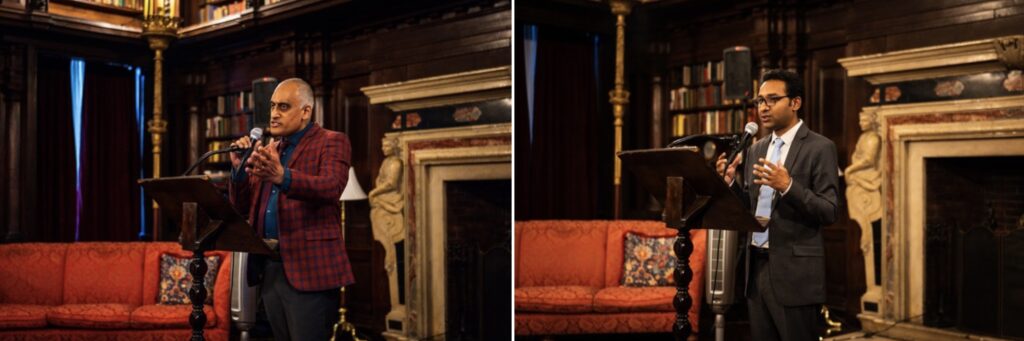
The second explored ethics in healthcare, including how health systems are addressing the ethical implications of AI deployment and whether emerging governance frameworks can adequately define whom these systems are ultimately designed to serve.
The third theme addressed trust and transparency, particularly how organizations can foster confidence in AI-driven decisions among employees, patients, and clients when the underlying processes may not be visible or easily challenged.
HSI’s research agenda is organized around four pillars: Responsible AI, Human Performance, Planetary Futures, and Governance & Diplomacy. According to the statement, the Institute brings together leaders from finance, government, multilateral institutions, and academia to test research findings against real-world practice.
The inaugural salon is the first in a planned series of events. According to HSI, the conversation will continue at a follow-up gathering in London later this autumn.
Related posts:
 Digital from India: Leapfrogging Development Through Text-Enabled Citizen-Centric Governance
 India’s Response to Terrorism and Strategic Ties with U.S. Take Center Stage at Inaugural Hopkins India Conference
 IMF’s Dan Katz Warns Middle East Escalation Could Impact Global Economy, While AI and Shifting Trade Links Shape 2026 Outlook
 Exclusive: United Nations Leadership to Join India-AI Impact Summit 2026 as Global South Shapes AI Governance Dialogue