Washington: India is seeking greater predictability in access to advanced artificial intelligence technologies as foundational AI models become central to digital governance, public services and economic innovation.
The issue figured in India-US bilateral discussions in Washington, where New Delhi raised concerns that sudden export restrictions or policy shifts could disrupt access to advanced AI systems after they are made available.
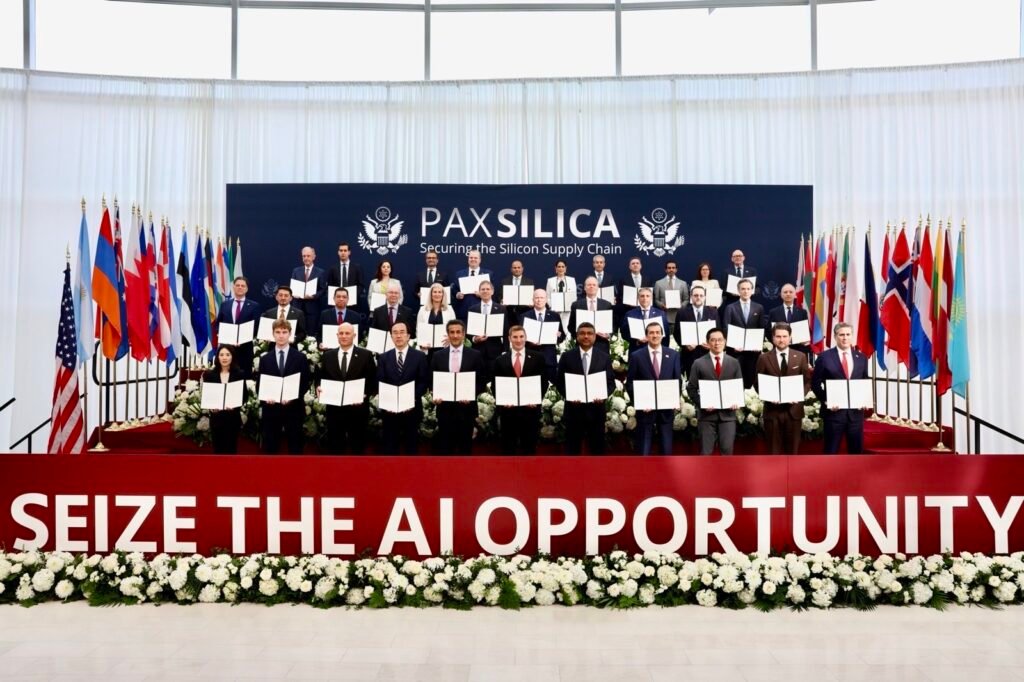
The talks were held on the sidelines of the two-day Pax Silica summit, a US-led initiative focused on trusted AI supply chains, semiconductor ecosystems and technology networks outside China’s control.
Senior officials from the Ministry of Electronics and Information Technology are leading the Indian delegation at the summit, which is being hosted by the US Department of State and led by Jacob Helberg, Under Secretary of State for Economic Growth, Energy, and Environment.
Advertisement
Secretary in the Ministry of Electronics and Information Technology (MeitY), S. Krishnan, said there was an understanding that access to technology would not be withdrawn after it had been provided. “There was an understanding, and something that they certainly mentioned, that access to technology, once it is provided, will not be cut off. I think that was an assurance,” Krishnan told the SCMP.
The assurance is significant for India as countries race to secure access to advanced AI models, compute infrastructure, chips and trusted technology platforms. New Delhi is also seeking a larger role in AI deployment across public services, agriculture, healthcare, education, manufacturing and governance.
Speaking to ANI after the bilateral meeting, Krishnan said the main focus was on deepening India-US cooperation in technology and shaping a shared understanding of how the AI innovation ecosystem could evolve. The discussions also covered the roles both countries could play in the AI ecosystem, including how India’s innovation economy could shape the future of AI, he added.
The MeitY Secretary further said the real value of AI would come from its diffusion and deployment across key sectors of the economy. “Ultimately, the benefits of AI really come from its diffusion and deployment in various sectors, real sectors of the economy, whether you are talking about manufacturing, whether you are talking about agriculture, healthcare, education, governance and all of these spaces,” he said.
India also used the talks to underline the need for more resilient and diversified technology supply chains. Krishnan also said countries should avoid excessive dependence on any one geography or source of supply for critical technology needs. “We are not over-dependent on any one geography or any one source of supply for anything that we need in the technology space. I think there was an acknowledgement of that,” he said.
Those concerns formed part of the wider Pax Silica agenda, where partner economies discussed how to build trusted AI infrastructure, secure supply chains and expand access to compute, chips and private investment.
The summit brought together partner economies, affiliate economies and senior executives from companies building and financing technologies that will underpin the AI era. US Under Secretary of State Jacob S. Helberg said 35 nations had signed the Joint Statement on AI Opportunity at the summit. In a post on X, Helberg said the countries had aligned behind a “pro-growth, pro-innovation” regulatory approach for the AI era.
He said the joint effort reflected a commitment to trusted supply chains, private sector mobilization and infrastructure that would power the next century. “The future of AI will not be determined by who regulates first. It will be determined by who builds first and builds the most capacity,” Helberg added.
Joint Statement on AI Opportunity Partnership
The Joint Statement on AI Opportunity said the signatory countries had gathered “in common purpose” to affirm a shared vision for innovation ecosystems and a common commitment to trusted partnership and technological progress.
The statement recognized the importance of the physical backbone of artificial intelligence. This includes critical minerals, energy, computer and semiconductor manufacturing. It said the future of AI should be built on trusted collaboration, economic security, innovation and fair competition.
The countries expressed support for an AI approach that promotes entrepreneurship and innovation. They also backed policies and frameworks that advance technological innovation and promote investment.
The statement said signatories would seek to champion a pro-growth regulatory environment. It said such an environment should help builders, startups, workers, citizens, communities and platforms test, deploy and scale secure and trusted AI ecosystems.
It also called for cross-border venture capital flows and research partnerships.
The signatories said they would work together to enable industry partnerships and investments in next-generation data centers, expand access to AI compute and advance innovation in trusted AI models.