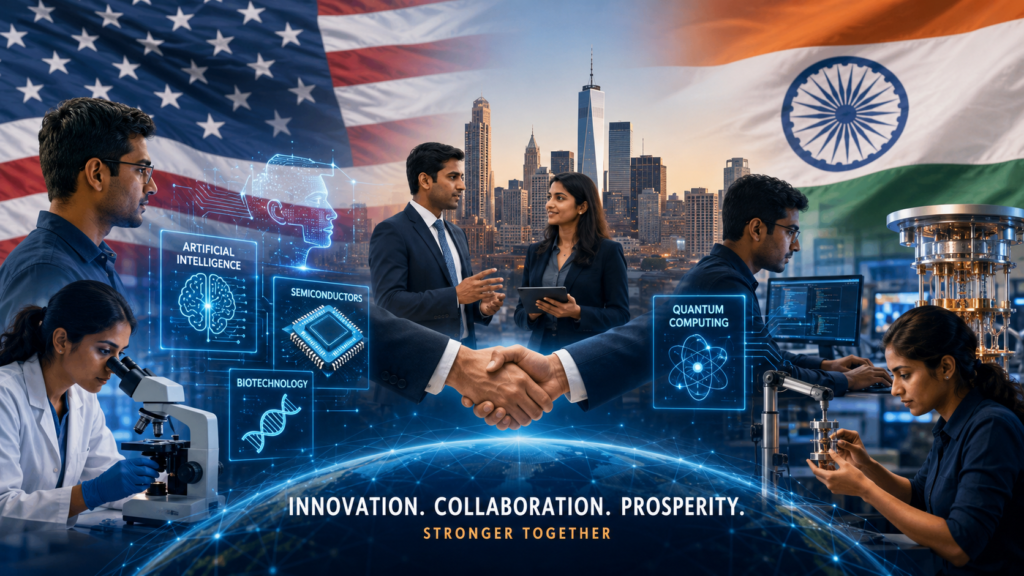
Indian-origin professionals are poised to play an even more influential role in shaping the U.S.-India strategic partnership as emerging technologies such as artificial intelligence (AI), semiconductors, biotechnology and quantum computing redefine global economic and geopolitical competition, according to a new study.
The study, Beyond Migration: The Evolution, Impact, and Strategic Significance of the Indian Diaspora in the United States by Amit Burdak, argues that the Indian diaspora has moved far beyond its traditional identity as a successful immigrant community to become a strategic asset underpinning technological innovation, research collaboration and economic competitiveness in both countries.
“The Indian diaspora has transcended the immigration framework and transformed into a strategic community that is making a simultaneous contribution to economic competitiveness, scientific innovation, democratic participation, and bilateral cooperation,” the study said.
The research suggests that the next phase of the diaspora’s influence will be driven less by conventional information technology and more by leadership in frontier technologies that have become central to national security and industrial policy.
Advertisement
Indian-origin scientists, engineers and entrepreneurs already occupy influential positions across America’s innovation ecosystem, with strong representation in artificial intelligence, semiconductor design, biotechnology, advanced manufacturing and scientific research. As governments in Washington and New Delhi deepen cooperation in these sectors, the diaspora is expected to become an increasingly important conduit for talent, investment and technological collaboration.
The study notes that India remains the largest supplier of highly skilled professionals to the United States. Indian nationals accounted for nearly 70 percent of approved H-1B specialty occupation beneficiaries in Fiscal Year 2025, while Indian students continue to dominate enrollment in U.S. graduate programs in science, technology, engineering and mathematics (STEM). That pipeline is expected to feed future growth in AI research, chip design, quantum computing and biomedical innovation.
The report argues that Indian-origin professionals have already become integral to America’s innovation economy, contributing significantly to research, patents, startup creation and technological breakthroughs. Rather than representing a one-way “brain drain,” the diaspora increasingly facilitates “brain circulation,” enabling knowledge transfer, research partnerships and cross-border investment between India and the United States.
That role is expected to expand as both governments prioritize cooperation in critical and emerging technologies through initiatives such as the India-U.S. Initiative on Critical and Emerging Technology (iCET). The study says collaboration in semiconductors, quantum technologies, artificial intelligence and biotechnology is creating new opportunities for researchers, entrepreneurs and corporate leaders of Indian origin to strengthen supply chains, accelerate innovation and enhance technological resilience.
The research also points to the growing presence of Indian-origin executives leading global technology companies, research institutions and multinational corporations. Their leadership, it argues, not only shapes corporate strategy but also strengthens institutional linkages between the two countries through investment, talent mobility and collaborative innovation.
However, the study cautions that realizing the diaspora’s full strategic potential will require reforms to U.S. immigration policies. Employment-based visa restrictions and lengthy green card backlogs continue to create uncertainty for highly skilled professionals at a time when global competition for technology talent is intensifying.
The report concludes that the strategic importance of the Indian diaspora will increasingly be measured not by its size but by its ability to drive breakthroughs in artificial intelligence, semiconductors, biotechnology and quantum technologies—sectors expected to define economic growth, national security and global technological leadership over the coming decades.
As India and the United States seek closer cooperation in these frontier industries, the study argues that Indian-origin professionals will remain one of the strongest human bridges connecting the innovation ecosystems of the world’s two largest democracies.