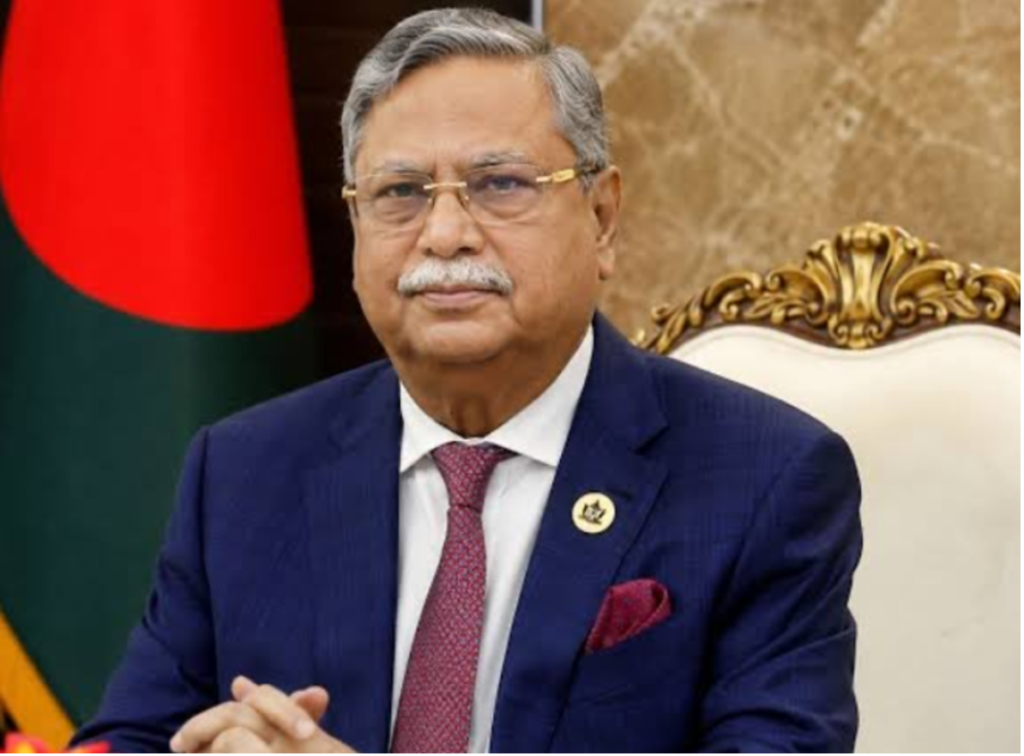
Bangladesh’s President Mohammad Shahabuddin, widely known by his nickname ‘Chuppu’ resigned on Friday, bringing to an end a tenure that had become increasingly uncomfortable for almost every major political force in the country.
Sources said he was “advised” to resign and was under increasing pressure to take a safe exit out of the country rather than risk a political attack on him by opponents.
A number of names are circulating as replacements for ‘Chuppu’ including Irene Zubaida Khan, a British-Bangladeshi lawyer, who has served as head of Amnesty International. Another name doing the rounds is Nasimul Gani, currently Bangladesh’s top civil servant, who may be brought in.
Pro-West Bangladeshi Prime Minister Tarique Rahman’s government has been rounding up Awami Leaguers and stamping out dissidence ever since ousted Premier Sheikh Hasina announced that she would possibly return to Dhaka this winter.
Advertisement
The President was the last of her “loyalists” who held some form of power in Bangladesh, and analysts believe ‘Chuppu’ was forced out after rumors or alleged intelligence reports surfaced claiming he was in contact with Sheikh Hasina, — a claim which has been denied by the President.
Shahabuddin, once regarded as a close ally of Sheikh Hasina, became a pivotal figure in the political upheaval that followed her ousting. It was he who administered the oath of office to Muhammad Yunus as head of the interim government in August 2024, a move that deeply angered Hasina and Awami League supporters.
However, Shahabuddin later gave interviews to the press suggesting that Hasina had never formally resigned as prime minister.
The claim, also advanced by some of her supporters, seemingly challenged one of the central constitutional premises on which the interim administration had been established – that a constitutional void had been created by Sheikh Hasina resigning and an interim regime had to be brought in to fill that administrative and political vacuum.
In doing so, the President seemed, at least implicitly, to undermine the legitimacy of the interim government that he himself had helped install, leading to demands by students supporting the Yunus regime for his resignation.
“Chuppu” survived mainly as his removal would have taken away the fig of legitimacy cover that the Yunus government had. However, his relations with the interim government remained strained till the end.
The President was elected in April 2023 and was slated to remain till 2028. A veteran of the 1971 war, and a former judge, Shahabuddin was the only Awami Leaguer remaining in Bangladesh’s political-administrative set up after a student protest in August 2024 toppled Sheikh Hasina’s government, forcing her to fly to India in a Bangladesh Air Force plane.
Shahabuddin seemed to welcome the election of the Bangladesh Nationalist Party (BNP) and the ascendance of its chief Tarique Rahman to power in February this year. Analysts believe he regarded an elected BNP government as a more legitimate and stable alternative to the interim arrangement.
However, his position increasingly appeared out of step with the political forces that had come to dominate the post-Hasina order.
Sources in Dhaka claimed Shahabuddin tried to patch up with former prime minister Sheikh Hasina through telephone calls to her Delhi residence, during a visit to London for medical treatment in May this year.
Sources claimed Bangladesh’s intelligence agencies later learned about the conversation, possibly from western counterparts, after which a message was conveyed to the President suggesting that he step down.
Over the past several weeks, pressure to remove him appears to have intensified. The campaign seems finally to have reached its conclusion with his resignation on health grounds.
His departure marks the culmination of a political journey in which Shahabuddin moved from being associated with the Hasina establishment, to facilitating the formation of the interim government, and finally to making statements that appeared to question the constitutional narrative underpinning the post-2024 political transition. (UNI)