In an effort to reset US-China relations, President Xi Jinping characterized the current global landscape as undergoing “transformations not seen in a century,” warning that the international order is becoming increasingly “fluid and turbulent.”
At the same time, Xi delivered a pointed warning over Taiwan, describing it as “the most important issue in China-US relations.” He cautioned that mishandling the matter could trigger “clashes and even conflicts” between the two countries and place the broader relationship in jeopardy.
Against this backdrop, he posed a defining strategic question for both nations: whether China and the United States can avoid the so-called “Thucydides Trap,” the historical tendency for rivalry between a rising power and an established one to end in conflict, and instead forge a “new paradigm of major-country relations.”
Xi expressed his willingness to “work together with President Trump to set the course and steer the giant ship of China-US relations, to make 2026 a historic, landmark year that opens up a new chapter in China-US relations.”
Advertisement
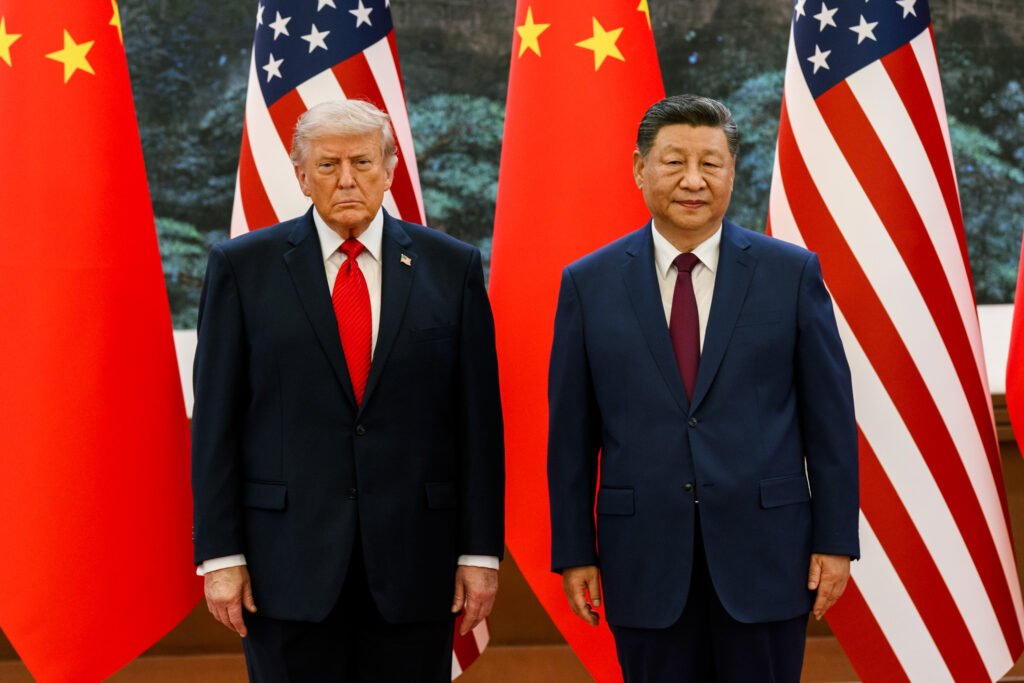
Chinese President Xi Jinping and US President Donald Trump struck an unusually conciliatory tone during high-level talks in Beijing, presenting their meeting as a pivotal effort to stabilize relations between the world’s two largest economies amid growing geopolitical uncertainty.
A key outcome of the summit was Xi’s announcement that both leaders had agreed on a new framework described as a “constructive China-US relationship of strategic stability.”
According to Xi, the concept envisions cooperation as the foundation of ties, competition managed within limits, differences kept under control, and long-term peace maintained through predictable engagement.
Calling it more than a slogan, Xi stressed that “constructive strategic stability” would require concrete action and policy coordination from both sides over the coming years.
The Chinese leader also emphasized the importance of economic cooperation, describing bilateral trade ties as “mutually beneficial and win-win in nature.”
As per the statement released by the Chinese government, He argued that disagreements should be addressed only through “equal-footed consultation,” while pointing to recent negotiations between economic and trade officials as having produced “generally balanced and positive outcomes.”
Xi reiterated that China would continue opening its economy wider to foreign investment and welcomed deeper participation by American companies in China’s reform and modernization drive. He said both countries should preserve the momentum created by the latest round of economic discussions, the statement said.
The summit also focused on expanding cooperation in areas beyond trade. Xi called for broader exchanges in health, agriculture, tourism, law enforcement, and people-to-people ties, while advocating stronger communication channels in diplomatic and military spheres to reduce risks and prevent misunderstandings.
Reiterating Beijing’s long-standing position, Xi said “Taiwan independence” and peace across the Taiwan Strait were “as irreconcilable as fire and water.” He urged Washington to exercise “extra caution” in its handling of the issue.
Trump, for his part, praised Xi and sought to project personal rapport as a stabilizing factor in bilateral ties. Calling it “a great honor” to visit China, Trump said the two leaders had developed “the longest and greatest relationship the presidents of the two countries have ever had.”
He described Xi as “a great leader” and China as “a great country,” adding that the Beijing summit was “the biggest summit the world is watching.” Trump said he intended to strengthen communication and cooperation with Xi while ensuring that differences were managed responsibly.
“The United States and China are the most important and most powerful countries in the world,” Trump said, adding that together the two nations could achieve “big and good things” for both peoples and the international community.
Trump also highlighted the role of business engagement, noting that he had brought leading American corporate executives to Beijing and encouraged them to deepen cooperation with China.
Beyond bilateral issues, the two presidents exchanged views on several major international flashpoints, including West Asia, the Ukraine conflict, and developments on the Korean Peninsula.
The leaders also agreed to support each other in hosting major international gatherings this year, including the APEC Economic Leaders’ Meeting and the G20 Summit.
Ahead of formal talks, Xi hosted a ceremonial welcome for Trump at the eastern entrance square of the Great Hall of the People in Beijing, underscoring the significance China attached to the visit and the broader attempt to recalibrate ties between Washington and Beijing.