|| “Peace and war are the two wheels of policy.” – Kautilya, Arthashastra ||
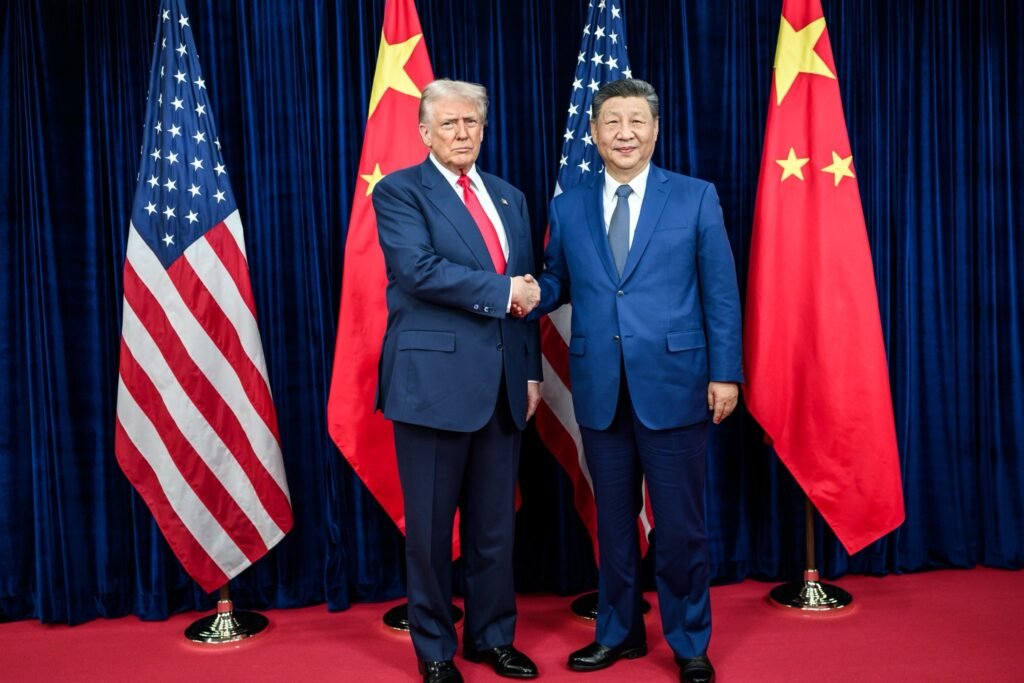
Donald Trump’s forthcoming visit to China does not signal a return to engagement-era diplomacy or a slide into irreversible Cold War bipolarity. Scheduled for mid-May 2026 in Beijing, with trade, rare earths, Taiwan, Iran, artificial intelligence, and strategic risk management on the agenda, the visit reflects a more ambiguous international environment; a managed rivalry between two revisionist great powers bound by competition and interdependence at once.
Amid growing systemic instability, the visit takes place within a liberal international order weakened by deglobalization, technological fragmentation, and the renewed force of hard-power politics. A more transactional and coercive environment is emerging in its place, shaped by hedging, contested alignments, and economic statecraft.
What makes the visit consequential is not the expectation of a breakthrough, but the recognition in both Washington and Beijing that unconstrained antagonism carries escalating costs. Neither side seeks accommodation in the traditional sense. Yet neither side can fully absorb total rupture. The summit should therefore be read not as détente, but as geopolitical management under conditions of deep mistrust.
Advertisement
In 2019, Kurt Campbell and Jake Sullivan argued that Washington’s China strategy had to move beyond the old assumption that engagement would transform Beijing. They called instead for a steadier approach that accepted competition while seeking “favorable terms of coexistence.” In Beijing, the central issue is not whether rivalry can be eliminated, but whether both powers can keep it within political, economic, and military limits. Sullivan later reinforced this point, stating that competition with China “does not have to lead to conflict or confrontation” if managed responsibly. Campbell’s recent emphasis on strengthening U.S. competitiveness while keeping diplomatic channels open points in the same direction; rivalry must be pursued, but also constrained.
Collapse of Strategic Optimism
Trump’s 2017 visit to Beijing carried the theatrical symbolism of great-power courtship. Xi Jinping offered exceptional ceremonial hospitality, and both governments expressed cautious optimism about economic accommodation and leader-level engagement. That phase has ended.
Over the intervening years, nearly every dimension of the bilateral relationship has become securitized; trade, technology, finance, maritime access, semiconductor production, supply chains, data governance, and artificial intelligence. What began as a tariff dispute has evolved into systemic geopolitical rivalry.
Washington now views China not only as a competitor, but as a peer adversary capable of challenging American primacy across multiple domains. Beijing, in turn, reads U.S. export controls, the consolidation of the Indo-Pacific alliance, and semiconductor restrictions as evidence of a long-term containment strategy.
Offensive realists would recognize this transformation as a systemic security dilemma. Measures cast as defensive by one side are read by the other as encirclement, feeding a cycle of escalation. Yet unlike the ideological rigidity of the original Cold War, this rivalry sits inside complex economic networks. Both powers pursue advantage while remaining structurally interconnected.
Transactional Realism and Coercive Interdependence
Current administration policy appears to be pursuing a hybrid framework that blends economic nationalism, coercive diplomacy, and selective stabilization. At its core lies a transactional conception of international order.
Unlike postwar liberal internationalists, who regarded institutions and alliances as stabilizing public goods, the current administration treats diplomacy primarily as a venue for bilateral bargaining and distributive gains. International legitimacy becomes secondary to asymmetrical advantage.
Policy emphasis on tariff leverage, reciprocal trade structures, supply-chain repatriation, industrial sovereignty, and decoupling in critical technologies follows from this approach. The objective is not comprehensive separation from China, but the recasting of asymmetrical dependencies.
Treasury Secretary Scott Bessent has characterized economic relations with China in terms of rebalancing and resilience, marking a departure from the earlier neoliberal assumption that economic integration leads to political convergence. Rare-earth minerals capture this shift clearly. They are no longer treated only as commodities, but as geostrategic assets integral to national security.
Semiconductor restrictions follow a similar pattern. They are less about commercial competition than technological denial. Washington is effectively seeking to use what scholars call “coercive interdependence,” leveraging asymmetrical nodes of globalization for strategic advantage.
Yet an internal contradiction remains. The White House seeks economic confrontation with China, selective cooperation, regional deterrence, and domestic political spectacle simultaneously. These objectives do not always cohere. The summit may therefore produce tactical agreements while leaving the deeper architecture of rivalry unchanged.
Stabilization Without Reconciliation
Beijing enters the summit from a position of defensive confidence. Chinese leaders appear convinced that long-term rivalry with Washington is unavoidable, but also understand that uncontrolled confrontation would damage growth, capital confidence, technological acquisition, and regional influence.
Consequently, China’s objective is not reconciliation, but stabilization on terms that preserve strategic flexibility. Xi Jinping’s government seeks to reduce volatility without conceding on what Beijing defines as its “core interests,” especially Taiwan, technology, territorial sovereignty, and regime legitimacy.
At this juncture, the summit becomes delicate. China likely sees Trump’s personalized, transactional style as both risk and opportunity. Unpredictability increases uncertainty. Yet Beijing may also judge that leader-centric bargaining creates space for tactical concessions less available under more institutionalized administrations.
Beijing’s broader posture reflects classical realist patience. Chinese policymakers appear willing to absorb short-term friction in pursuit of long-term advantage. They may believe that U.S. political polarization, fiscal strain, alliance fatigue, and fragmentation within globalization will gradually shift the balance in China’s favor. Whether that assessment is correct remains uncertain, but it clearly informs their behavior.
Taiwan: Epicenter of Strategic Disequilibrium
No issue looms larger over the summit than Taiwan. Taiwan is not merely a territorial dispute. It is the convergence point of military deterrence, technological supremacy, alliance credibility, nationalism, and regime legitimacy.
For Beijing, Taiwan remains an unfinished component of national reunification and civilizational restoration. For Washington, Taiwan increasingly serves as a linchpin within the Indo-Pacific balance of power. An indivisible issue emerges, resistant to compromise, because both parties attach stakes to it that exceed the bounds of ordinary bargaining.
Danger lies not necessarily in imminent war, but in miscalculation under ambiguity. The president’s diplomatic style sharpens these anxieties. Allies in Tokyo, Taipei, and Seoul remain uncertain whether transactional bargaining could eventually blur longstanding security assurances.
Recent comments by Secretary of State Marco Rubio reaffirming American commitments to regional stability appear designed partly to reassure allies unsettled by fears of diplomatic improvisation. Yet Beijing may still test rhetorical boundaries on “One China” formulations, strategic ambiguity, or language on arms transfers.
Even subtle linguistic shifts may carry disproportionate geopolitical implications. Great-power competition now operates not only through military deployments, but also through signaling, perception management, and narrative legitimacy.
Beyond Trade: Iran, AI, and the Paradox of Transition
One of the most revealing aspects of the summit agenda is its breadth. Washington increasingly needs Chinese cooperation, or at least Chinese restraint, across multiple geopolitical theaters, even as it frames China as its principal long-term challenger.
Iran makes this contradiction explicit. China’s role as a major purchaser of Iranian energy and as a diplomatic intermediary gives Beijing influence Washington cannot easily ignore. The administration reportedly seeks Chinese assistance in preventing wider regional destabilization and maintaining energy-market stability.
Here lies a central paradox of multipolar transition. Strategic rivals are becoming operationally indispensable to one another.
Artificial intelligence governance presents a similar dilemma. Both powers recognize that AI is now central to military modernization, cyber escalation, intelligence systems, and economic productivity. Yet mechanisms to regulate AI competition remain embryonic.
Given these constraints, the summit may initiate early steps toward crisis-management architecture rather than substantive technological cooperation. In Cold War terminology, this resembles the early logic of “guardrails,” not trust-building, but escalation management.
Transactional Diplomacy and the Crisis of Liberal Order
Beyond China policy, the summit also reflects a deeper transformation in American statecraft. Current foreign policy diverges sharply from post-1945 liberal internationalism. It prioritizes sovereignty over institutionalism, bilateral leverage over multilateral consensus, and transactional reciprocity over normative universalism.
Critics argue that this approach weakens alliance credibility and undermines institutional predictability. Supporters contend that it restores flexibility and reduces asymmetries of burden within the international system. The China summit may therefore test whether transactional diplomacy can sustainably manage great-power rivalry.
Risks remain substantial. Transactional frameworks can yield short-term gains while weakening long-term coherence. They also heighten uncertainty among allies, who may fear that security guarantees are becoming negotiable variables within broader bargaining structures.
Older liberal assumptions are themselves strained by geopolitical fragmentation and domestic backlash. In that sense, the summit captures a broader historical transition; the shift from rules-based globalization to competitive geopolitical pluralism.
Competitive Coexistence or Escalatory Drift?
Trump’s visit to Beijing will likely yield symbolic stabilization, limited economic agreements, and carefully choreographed declarations on dialogue and cooperation. Structural antagonisms beneath the relationship will remain intact.
Borrowing from a concept used by scholars and policymakers to describe the post-engagement phase of U.S.-China relations, Washington and Beijing are now engaged in competitive coexistence, a condition in which systemic rivalry persists beneath intermittent tactical cooperation.
- Neither side seeks capitulation.
- Neither side fully trusts the other.
- Neither side can completely disengage.
Such conditions produce an unstable equilibrium. Agreements may emerge, channels may reopen, and the optics may improve. Yet the larger contest will remain one of power, technology, security, and order. Washington and Beijing are learning to bargain, deter, compete, and depend on each other inside the same unsettled frame. The future of U.S.-China relations is defined not by engagement-era optimism or Cold War separation, but by competitive coexistence.
Disclaimer: The opinions and views expressed in this article/column are those of the author(s) and do not necessarily reflect the views or positions of South Asian Herald.