 Join WhatsApp Channel

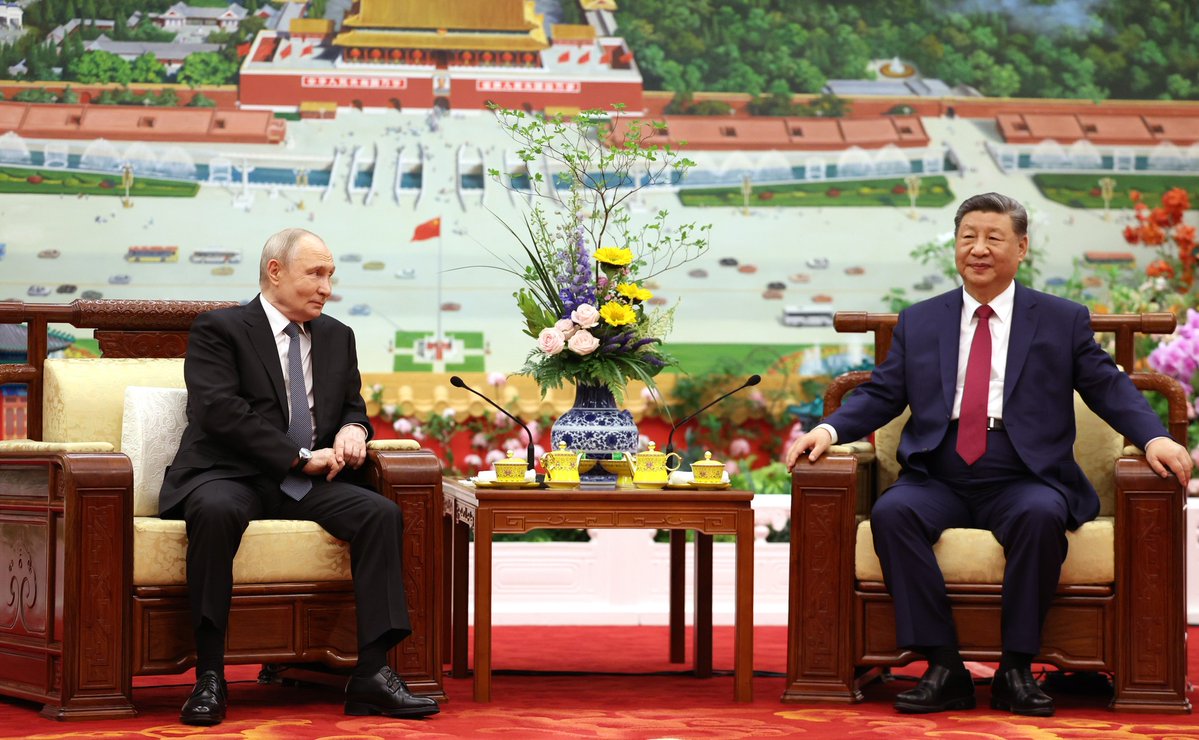
It is easy to say things when the concerned party or person is not around, especially negatives. Which is exactly what happened when President Xi Jinping of China hosted his Russian counterpart, Vladimir Putin. Both of them wasted no time to pounce on the United States and its “irresponsible” foreign policy and in the process warning a “drift back to the law of the jungle.”
The summit of longtime friends came close on the heels of a two-day visit of the President of the United States, Donald Trump that left many puzzled as to what exactly transpired.
“The global peace and development agenda is facing new risks and challenges, and there is a danger of fragmentation of the international community and a return to the ‘law of the jungle’,” Presidents Xi and Putin said in a joint statement. “Attempts by a number of states to unilaterally manage global affairs, impose their interests on the entire world, and limit the sovereign development of other countries, in the spirit of the colonial era, have failed.”
The joint statement did not name any country but was quite clear to whom the references were intended, principally the United States and generally the “Western” world. In the past both Beijing and Moscow have sharply criticized efforts of the West to slap punitive measures on nations as a way of forcing certain behavior, all of which reminded perhaps of erstwhile colonial powers. What has attracted attention is that President Xi did not talk of his thesis on the return of the Law of the Jungle when his visitor came from Washington. Or perhaps he did in one of those private conversations.
The Trump administration did not have to wait for the Xi-Putin to be reminded of the flak it is receiving on its foreign policy in the Western Hemisphere and beyond at home and abroad. The manner in which the United States has gone about attacking boats in the Pacific and Caribbean in the name of narco-terrorism and the raid on a Presidential compound to capture the President of Venezuela and bring him to New York have been roundly criticized internationally and not just by China and Russia. Now the global attention is on Washington’s menacing posturing on Cuba.
The problem with Presidents Xi and Putin is not in pointing out the “irresponsible” foreign policy of the United States; that they would talk of this in the absence of Washington at the table can also be given a pass. But what cannot be ignored is the “holier than thou” attitude in the realm of international politics. It is true that the Trump administration jumped at the instigation of Israel and attacked Iran on February 28 in a conflict that engulfed the region and now threatens to spill beyond. But can Beijing and Moscow pretend they are somehow the best examples of international relations and for international law?
President Putin started his “Special Military Operation” against Ukraine in February 2022 on what was seen as a scandalous pretext of taking on Nazi thugs. Now in the fifth year, the conflict with Kyiv would seem to have gone beyond the Law of the Jungle or a simple issue of Might is Right to descending into the cheap and chilling talk of using nuclear weapons. If Washington is now taken to task for not making clear the objectives on Iran, four years into the Ukraine conflict, Moscow’s objectives too remain blurred and fuzzy. Was it fear of Kyiv joining an expanding North Atlantic Treaty Organisation, Russia looking for secure borders or a desire to return to the “Grandeur” of the erstwhile Soviet Union and its empire of yesteryears?
And China too has too much on its plate to be complaining of others. Its blatant disregard for international navigational rules are endangering shipping not just in the South China Sea but also in the Indo Pacific as a whole. Neither China and Russia can be accused of using terrorist proxies like what Iran has done with the Hamas, Hezbollah and the Houthis, but have generously propped up regimes like that of North Korea with economic assistance, nuclear and missile technologies to destabilize large parts of Asia.
Talking of peaceful re-unification with Taiwan is one thing but openly threatening Taipei with military action knowing full well of the implications is a different thing altogether. Whether all these add up to “responsible” international behavior is a no-brainer. If anything, it has only given newer ideas to nations on ways to get on to that “powerful” list so that the “mighty” will think twice before trying something.
Presidents Xi and Putin are certainly right in pointing out a recent tendency in international relations, of militarily powerful nations going after ‘weaker’ ones. That said, the United States does not have exclusive rights to the Return to the Jungle award. China and Russia would also be rightful claimants to the prize. In fact, Britain and France too could be added to a growing list of nations that have individually and collectively undermined the effectiveness of the United Nations by pompously holding on a veto and still having the audacity to talk about anachronism and change in the same breadth.
Disclaimer: The opinions and views expressed in this article/column are those of the author(s) and do not necessarily reflect the views or positions of South Asian Herald.
Related posts:
 Putin Lands in New Delhi as India Reasserts Strategic Autonomy Amid Global Pressure
 US expresses concern over India-Russia relationship
 Putin’s Delhi Gambit: How a High-Stakes Visit Could Redraw India’s Geopolitical Map
 “There’s No Deal Until There’s a Deal,” Says Trump After Meeting Putin at the US-Russia Alaska Summit
