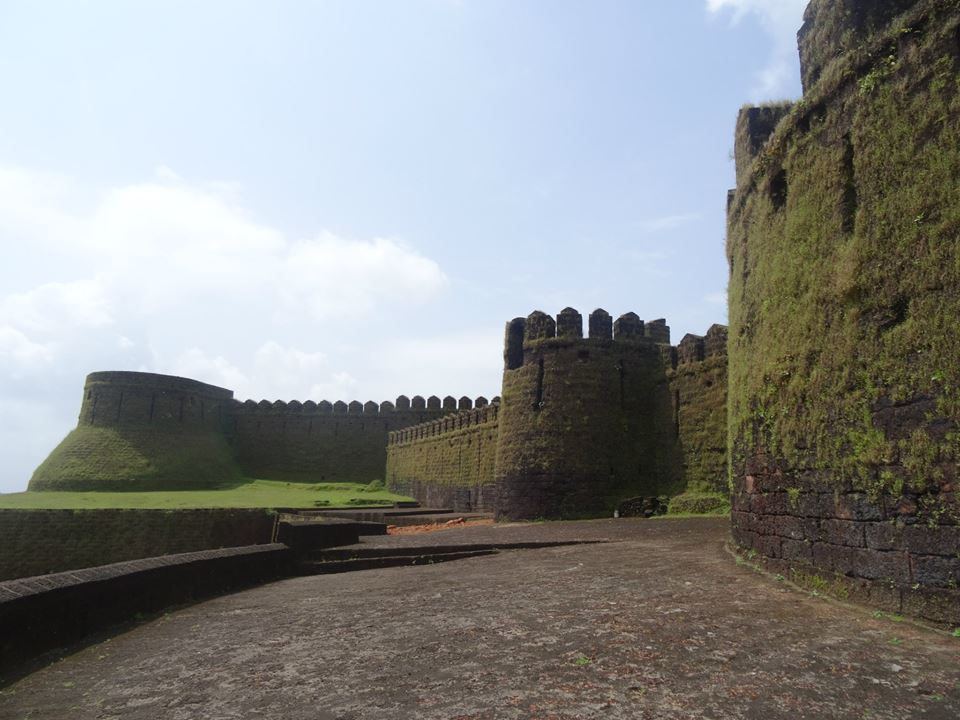
Lassoing a fort rampart, a riverine curve as a natural moat. This somehow always gets my historical fiction-loving mind going, as I imagine the defensive potential as well as the moonlit escape by a boat in the night.
An odd combo made odder with the words of the French thinker Paul Virilio, who reflects on the fort as a somewhat living thing. “An odd mixture, the fortification has become a combination of different species: mineral and animal come together in a strange fashion, as if the last fortress symbolized all of the armor types of the carapace, from the turtle to the tank, as if the surface bastion, before disappearing, exposed one last time its means and its methods in the domain of the animate as well as the inanimate.” The Mirjan Fort, in Northern Karnataka, is an eleven-acre, double-walled laterite citadel in semi-ruin.
Its appeal is more garden-like storehouse than impregnable bastion. Ascend its mossy steps and peep over its backside at one end. There is the sylvan coolth of an unhindered backwater view, with the charm of a tributary by a village. In this case, the Aghanashini, a child of the Sharavathi River.
When a friend and I decided to ride from Ankola to Mirjan on his two-wheeler on a post-monsoon whim, a paragraph in the Ankola Tourism booklet informed us that a Pepper Queen had ruled the trade and the area for over fifty years. The booklet goes on to tell us that Mirjan is in Kumta taluk, in Uttara Kannada district, which has 70% forest cover and more than twenty-four beaches. What I can also confirm, on shutting that booklet and looking around, is that the Fish Centers on the way are a nice local version of a dhaba-like stop, with yummy, fresh fish meals.
Advertisement
As the coast teaches you, if there is a backwater, expect a grand seaside and a harbor or two nearby. In this case, to the west of pretty, rural Mirjan is the Arabian Sea and, twenty miles southwest, Karwar with its port life. This ride off the coast is particularly lovely post-monsoon and worth the little meander, even on a pre-monsoon early morning from Kumta.
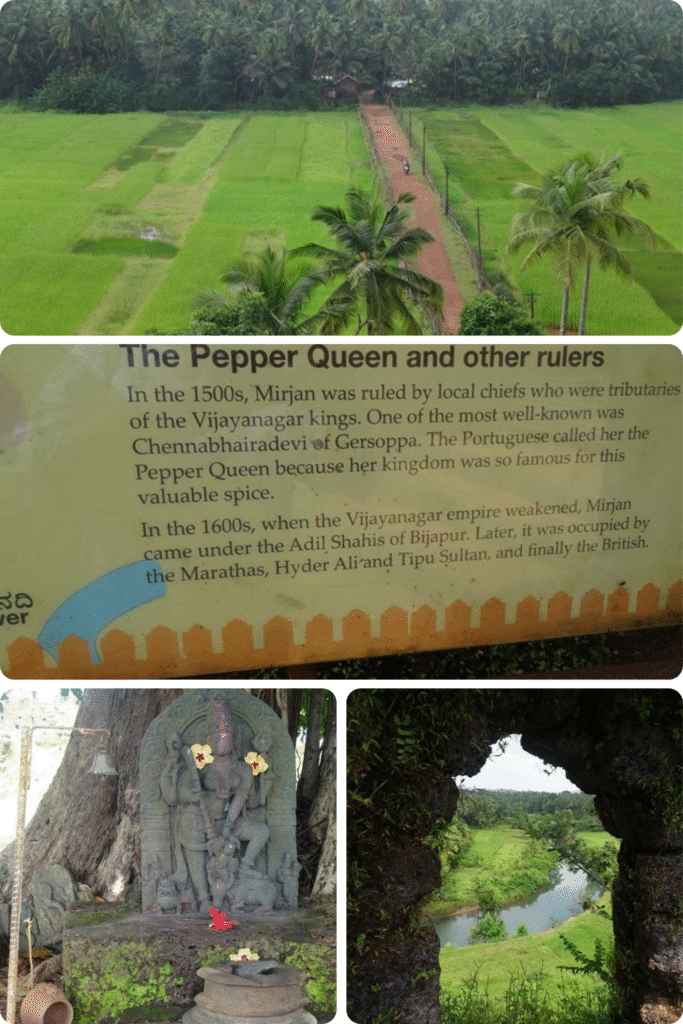
So, was this a micro-port for breezy, busy trade in another time? The available texts here in Mirjan do well to confuse. The ASI booklet says Mirjan might be the 1st-3rd century AD town of Mussiris, frequented by Roman merchants for spices. It adds bibliographical heft to this claim with several rusty signboards and follows it up with, “until the 17th century it was never a popular place.” But it also has a signboard saying that from the 1500s, the local rulers under the Vijayanagara Empire were in charge. The most popular being Queen Chennabhairadevi of Gersoppa! An ASI excavation in 2000 yielded hidden water channels, Chinese porcelain, and a gold coin issued by the Portuguese Viceroy in 1652 A.D.
In fact, having loafed through the grand and the small, the riverside and the jungle interior when it comes to Indian forts, one has sensed how a fortification gives you a whiff of the past, quite practically. As a royal bastion or as a naval engineering need, as a guerrilla in the thicket or the bristling showiness of a new conqueror. One can often place them in the context of the creator’s geopolitical time, scale of kingdom, and perhaps ego.
What it is also is naturally a charming picnic spot, in that strange, beautiful way that forts seem to carve themselves into the landscape and yet feel like you have come upon them suddenly. There is something so warm about the place that one wonders what kind of woman built this. Was she a queen or a local noble? Queen Chennabhairadevi of Gersoppa apparently helped the Vijayanagara rulers trade Arabian horses for pepper. Some say she also lived right here and controlled the trade. The Portuguese called her Rainha de Pimenta, Rani, the Pepper Queen, it seems. The very Portuguese military turret that survives is evidence again of this connection.
Its other pleasures are marginally modern. Open early AM. An amble or two. Phone roaming working in parts. No assault by local tour guides in droves here. Despite a once-famed trade of pepper and ginger, not a tea shop in sight. But superb views of pepper, coconut, and paddy fields.
Later online searches yield the queen’s Jain leanings and her retiring from here to an island after a battle of some sort. Another search shows documentary filmmaker Krishnendu Bose’s 2014 film Missing, where he meets the fish worker women of Mirjan and tells a partly depressing tale of how women are tackling climate change and indifferent government policies.
Fish, dear queen, come back.
Travel Log
The best way to get to Mirjan is to get to Kumta or Ankola town. Mirjan is half a kilometre off NH 17 in Kumta Taluka in Northern Karnataka. It is 10 km from Kumta town and 26 km from Ankola town by road.
It is an easy stopover on the way to Gokarna from South Karnataka too. See the exact location on Google Maps. The nearest big rail junction is Karwar. Early morning and afternoon train options both take roughly an hour and a half from Karwar to Ankola. The nearest international airport is Mangalore or Goa.
Tips: If you are a history lover, you are unlikely to find any ASI booklet at the location, although when we were here, the ramparts were being de-mossed, and an in-charge who had served in the Armed Forces, a friendly local from this village, could tell us about it. Keep your own water, as the nearest restaurant is half a kilometre off on the highway. Expect simple, fresh, and tasty seafood at the highway joints.
Kumta taluk is supposed to have tasty vegetarian fare from the Havyaka Brahmins, so it is good to ask where it is being served seasonally. Ankola and Kumta both offer pricey beachside resorts or homestays, as well as cheaper inland and highway stay options. With the other attractions nearby, you could turn the lesser-seen Kumta-Ankola area into a long weekend’s offbeat holiday.
Disclaimer: The opinions and views expressed in this article/column are those of the author(s) and do not necessarily reflect the views or positions of South Asian Herald.