Join WhatsApp Channel

There are few things more revealing in public life than the questions people refuse to answer.
A speech can be rehearsed. A photograph can be staged. A rumor can be fed just enough to keep people interested but questions are dangerous because they move power, if only for a moment, away from the person speaking and towards the person asking.
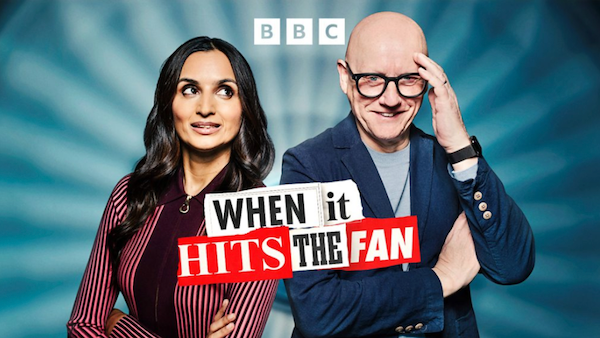
This week on When It Hits the Fan, David Yelland and I looked at three stories about questions, and the different ways powerful people try to manage them. Andy Burnham giving a major political speech without taking questions from journalists. Prince Harry and Meghan once again caught between palace briefings, security concerns and the question of whether a UK visit can happen without becoming another royal drama. And Taylor Swift, whose rumored wedding to Travis Kelce has become a masterclass in how much attention can be created by leaving just enough unanswered.
Andy Burnham and the Politics of Not Taking Questions
Andy Burnham used a major speech in Manchester this week to set out his vision for the country, including plans for greater devolution and what has been described as a “No 10 of the North”. What he did not do afterwards was take questions from journalists.
That decision caused predictable irritation among the media. But from a PR perspective, it is not difficult to see why his team made the call.
If Burnham had taken questions, the story could easily have changed within seconds. Instead of his message about growth, devolution and renewal, the headlines might have become about who he would appoint as Chancellor, whether he would change policy on immigration, or how he would respond to whatever question a broadcaster knew would make the cleanest clip.
The risk of questions is not that they are unfair. It is that they move the agenda.
For politicians, that is the central tension of modern media. The traditional press no longer has the monopoly on reaching the public that it once had. Social media, newsletters, podcasts and direct-to-camera videos have changed the balance of power. Politicians and business leaders can now bypass journalists and speak directly to audiences in their own words, at their own pace, with their own framing.
Clients and bosses often like that world. It feels safer. No hostile follow-up. No curveball. No moment where a line is taken out of context and sent around the internet before the speech has even ended.
But earned media still matters. In fact, it may be becoming more important again. Traditional journalism carries third-party credibility, and in an AI-mediated world, credible media sources increasingly shape how people, and machines, understand public figures and organizations. That is the trap.
Avoid the media completely and you look evasive. Submit entirely to the media’s agenda and you risk losing your own. The skill is knowing when to take questions, when to withhold them, and when silence starts to say more than the speech.
Burnham’s decision may have worked this time. His message landed largely on his terms. But if he truly is on the path to Downing Street, this cannot become a permanent posture. A prime minister cannot govern by monologue. At some point, power has to answer back.
Harry, Meghan and the Search for a New Story
The latest briefing war around Prince Harry and Meghan’s possible UK visit began, as these stories often do, with apparent certainty. Reports suggested the family might return to Britain, that Archie and Lilibet could see their grandfather, and that there may even be a visit to Diana’s resting place at Althorp.
Then came the familiar complication: security. Once again, the story shifted from family reunion to legal history, palace sources, Home Office processes and who had briefed what to whom. For Harry, this is difficult territory. He has long argued that security is a matter of safety, not status, so he cannot simply pretend it does not matter when the optics become inconvenient. Consistency matters in reputation management, particularly when a person has spent years building an argument around one central concern.
But there is a bigger issue here. What does success look like for Prince Harry now?
It is probably not nationwide popularity in Britain. That may be too ambitious. A more realistic win would be to reduce conflict, protect the Invictus Games and other credible parts of his public work, and create a moment that feels human rather than strategic.
In plain terms, success might simply be a picture of a father with his son and grandchildren.
Yet even that is complicated. A photograph would carry enormous symbolic power. It would visually confirm access, soften years of distance and give the public a story it instinctively understands family, reconciliation, children meeting their grandfather. But it would also create a new battleground. Who takes the photograph? Who releases it? Is it official? Are Meghan and the children in it? Does the Palace approve it? Does Harry’s team?
Sometimes the absence of a photograph can be a tactic. Without an image, the media cycle has less to feed on. The reconciliation, if it happens, can feel less performative.
The danger for Harry and Meghan is that they remain trapped in an old storyline. The public has already consumed the fairy-tale wedding, the royal rupture, the Oprah interview, the Netflix reinvention and the California chapter. The next story cannot simply be another round of briefing and counter-briefing.
At some point, people tire of conflict, even glamorous conflict.
The strongest PR move may be the quietest one: come, do the work, reduce the drama, and allow the human story to speak before the machinery of royal commentary swallows it whole.
Taylor Swift and the Joy of Not Knowing
Taylor Swift’s rumored wedding to Travis Kelce has become a public guessing game, with reports focusing on Madison Square Garden, street permits, guest numbers and whether the whole thing is a carefully staged misdirection.
What is fascinating is not whether the rumors are true. It is how enjoyable the uncertainty has become.
Swift understands mystery better than almost any public figure alive. Her fans are trained to look for clues, decode symbols and treat incomplete information as part of the experience. In most crisis situations, a vacuum is dangerous because other people fill it for you. In Swift’s world, the vacuum is part of the product.
There is a long history of celebrity weddings and media management. Once, privacy was the default. Then came the magazine deal era, where photographs were sold to titles like OK! and Hello! More recently, celebrities have used their own channels, documentaries and social feeds to control the image themselves.
Swift does not need any of those old arrangements in the same way. She can reach millions directly. She can say nothing and still dominate the conversation. She can let the press, fans and algorithms do the work while keeping the most important details just out of reach.
That is not accidental, it is breadcrumbing. Give people too little and they lose interest. Give them too much and the mystery dies. Give them just enough and they start doing your distribution for you.
There is something almost generous about it when it is done well. Nobody is being misled about a war, a scandal or a public policy issue. This is speculation as entertainment, a benign conspiracy in which the media, fans and public all understand the game and enjoy playing along.
Disclaimer: The opinions and views expressed in this article/column are those of the author(s) and do not necessarily reflect the views or positions of South Asian Herald.