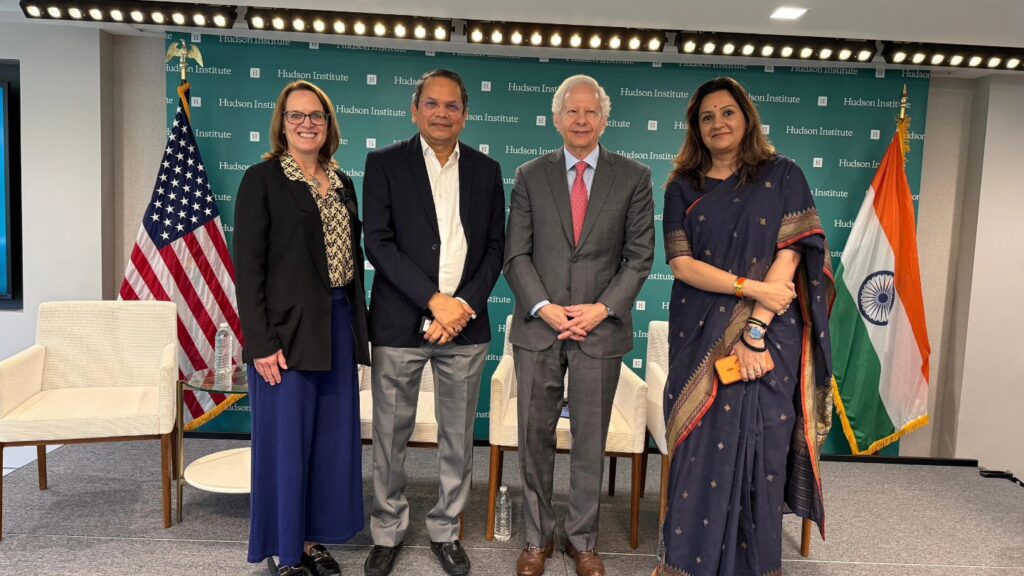
Hudson Institute’s New India Conference brought together senior officials, former diplomats, political leaders, and strategic thinkers for a daylong discussion on India’s rise and the future of US-India ties on April 23, 2026, in Washington DC.
Opening remarks were delivered by Joel Scanlon, executive vice president of Hudson Institute, and India’s Ambassador to the United States Vinay Kwatra. Panel discussions focused on three broad themes: India’s place in the world, India’s evolving economic approach, and new paths forward for US-India relations.
Speakers included Vijay Chauthaiwale, Kenneth Juster, Priyanka Chaturvedi, Ashok Malik, Richard Rossow, Nisha Biswal, Hemang Jani, Ram Madhav, Kurt Campbell, and Elizabeth Threlkeld, with sessions moderated by Lisa Curtis, Aparna Pande, and Bill Drexel.
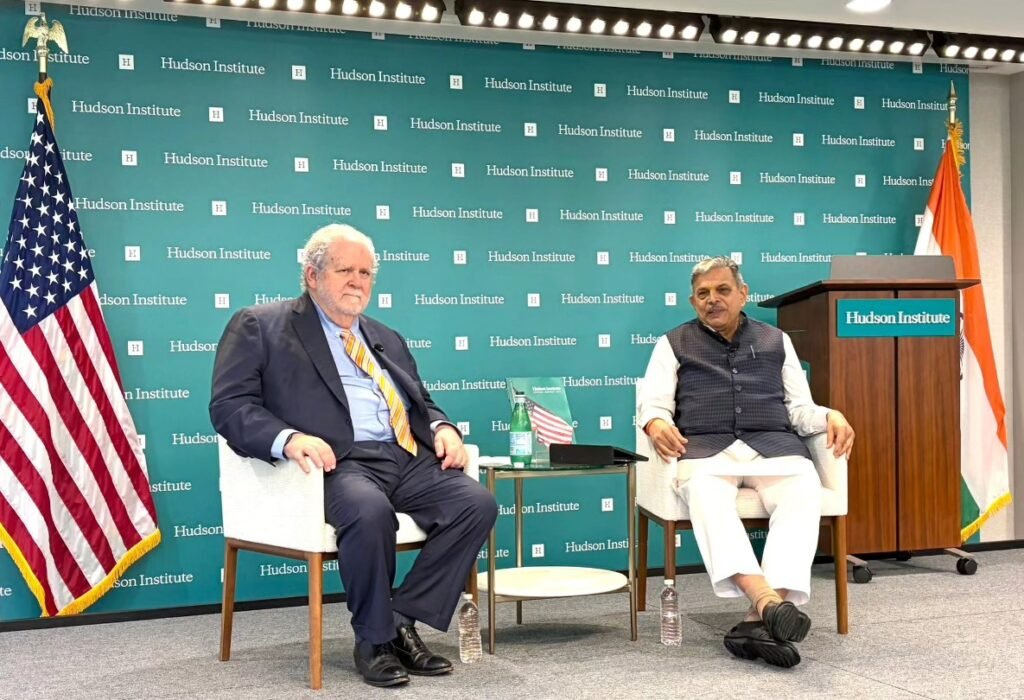
A key highlight of the conference was the fireside chat between Walter Russell Mead, Hudson Institute’s Ravenel B. Curry III Distinguished Fellow in Strategy and Statesmanship, and Dattatreya Hosabale, general secretary of the Rashtriya Swayamsevak Sangh (RSS). Hosabale’s appearance drew particular attention as it placed the RSS’s worldview before a Washington policy audience at a moment when India’s politics, civilizational identity, and global role are being closely debated in the United States.
Advertisement
Responding to questions about perceptions of the RSS, Hosabale rejected the characterization of the organization as “supremacist.” ANI reported that Hosabale said Hindu philosophy and culture see oneness in living and non-living beings, adding that Hindus have never invaded another country or enslaved people and “have nothing to apologize for.”
Hosabale described the RSS as a “people’s voluntary movement” inspired by India’s cultural and civilizational values. He said the organization works to build volunteers with character, self-confidence, service-mindedness, and a sense of social unity through daily and weekly gatherings. He also spoke of RSS-linked work in education, health, rural development, disaster relief, and civic institutions.
Addressing India’s place in the world, Hosabale said stronger India-US ties required mutual trust, a level playing field, and deeper people-to-people connections. He argued that cultural values and modernization need not pull in opposite directions and said societies such as India, Japan, and China had modernized while retaining civilizational confidence.
Hosabale also responded to questions about the relationship between the RSS and the BJP, including Prime Minister Narendra Modi’s long association with the organization. He noted that the BJP’s founders had chosen to retain ties with the RSS when the party was formed, while also maintaining that the RSS does not involve itself in day-to-day government decision-making.