Rashtriya Swayamsevak Sangh (RSS) General Secretary, Dattatreya “Dattaji” Hosabale said that Indians across the world have consistently contributed to nation building in their host countries.
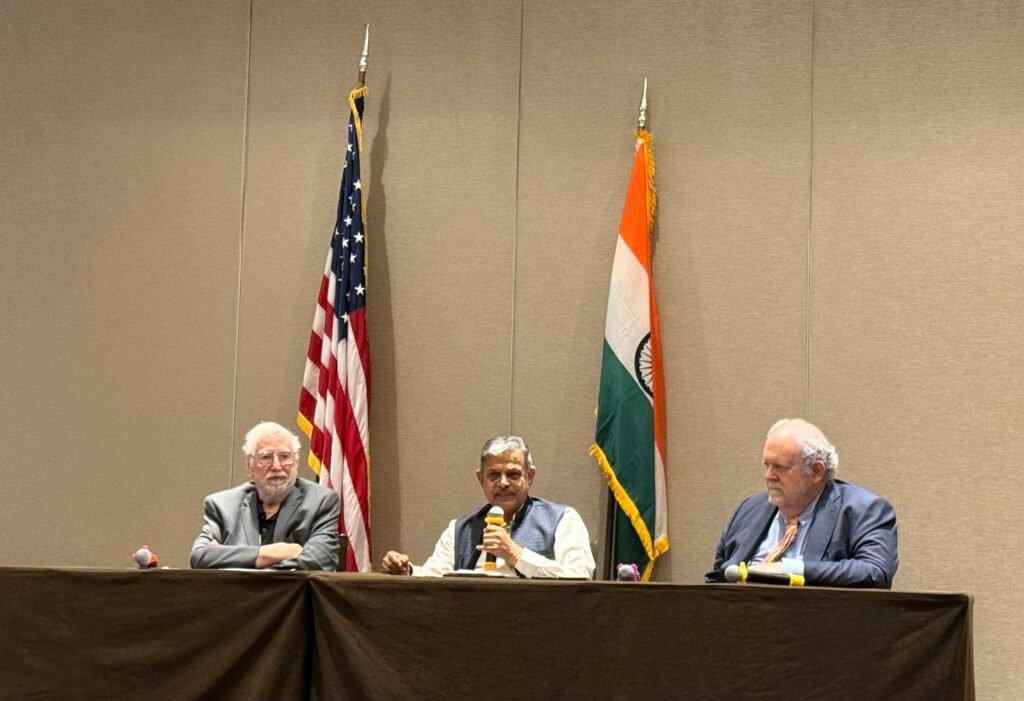
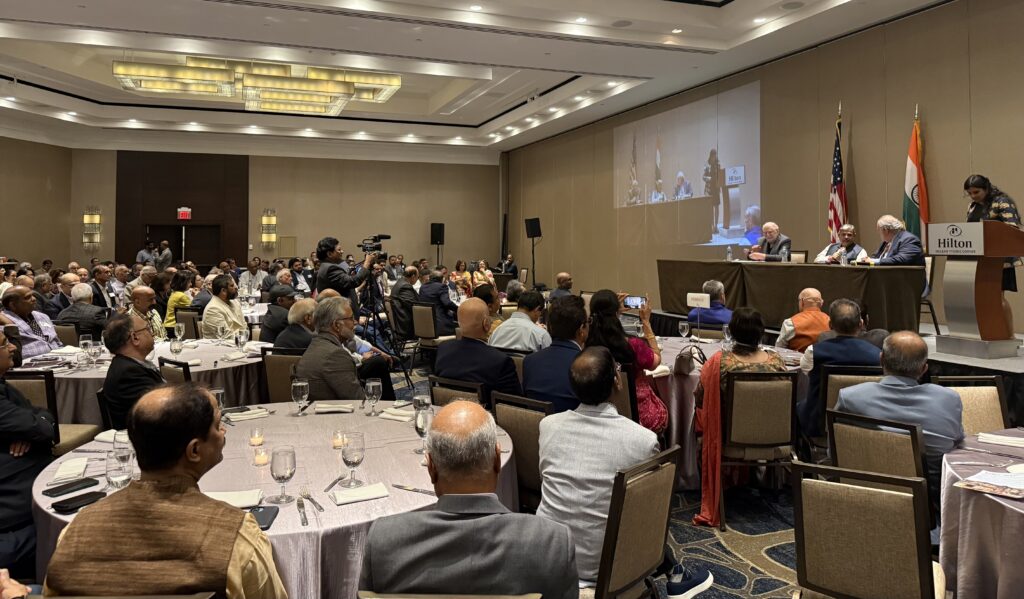
Speaking at a discussion titled “India’s Global Vision and Role in the Emerging World,” Hosabale joined author and former academic and State Department official Prof. Walter Andersen, and foreign policy scholar Walter Russell Mead of the Hudson Institute and The Washington Post.
The event was hosted by the Indian American Community of DMV in collaboration with UHJT, Rajdhani Mandir, VHPA, Indo Jewish Organization, US-India Security Council & American Hindu Coalition.
The RSS leader said that Indian communities abroad have maintained strong relationships with their host societies and, drawing on cultural and civilizational values, have lived in peace while contributing to the welfare of those countries.
Advertisement
Hosabale emphasized that India must evolve into a “self-confident” and “prosperous society,” supported by a united and harmonious population rooted in its cultural ethos and civilizational values. He said such a foundation would enable India to play an influential global role through sustained engagement with other nations and societies.
In his remarks, Andersen said that given the broad presence of the RSS across Indian society, the organization is likely to remain a “stabilizing influence” in the country. Reflecting on its evolution, he noted that the RSS began as a small unit in Nagpur and has expanded significantly, with a presence across all states and Union Territories and tens of thousands of participants.
Andersen said the RSS today plays an influential role not only in politics but also across various sectors of Indian society through its affiliates. Recalling his early research, he said he had been told the RSS would become a “major factor” in Indian politics, a lead he followed eventually shaping his academic work. “And I’m glad I did,” he noted adding that ever since then, the RSS has grown tremendously.
He identified several factors behind the organization’s growth, including its emphasis on a core belief system that gives individuals a sense of purpose beyond themselves, its commitment to a politically and socially unified India, and the opportunities it provides for demonstrating loyalty to its ideals.
Andersen also discussed the RSS approach to nation building, noting that while it did not directly participate in India’s independence struggle in the same way as some other groups, it focused on building a cadre of workers. These individuals were trained to foster a “sense of self confidence” and a “common brotherhood,” which he described as essential to strengthening national unity.
“And the idea was to project a brotherhood that would enhance self confidence in themselves, as well as loyalty to India,” he said, adding that these were seen as prerequisites for a successful movement toward independence.
He further noted that the RSS has maintained internal cohesion over decades, attributing this to its shared “core ideology,” which he described as “patriotism.” At the same time, he acknowledged that the organization will face future challenges as India continues to evolve rapidly, suggesting that its long-term success will depend on its ability to adapt and respond to emerging societal needs.
Russell Mead, in his remarks, stressed the global importance of a “vibrant, developed, harmonious, strong” India rooted in its long history, philosophy, culture, and faith. He said India’s rise would have far-reaching implications beyond tourism or economic growth, reshaping global dynamics.
“A strong, fully developed, self-confident, outward looking India, in touch with itself and its values, sends a message to our friends in China…” he said, adding, “It says this without fighting, without war. Indeed, if India reaches the state, the chance of war in Asia goes down dramatically, because the Chinese will understand this is going to be a fact of life.”
Russell Mead said that a peaceful and prosperous Asia would be the most stable path forward for the world. He added that faster economic and social development in India could reduce the likelihood of conflict in the region.
“And the faster India achieves this level of growth, the shorter the period of potential conflict is, the less chance there is a war,” he said. “I believe that India’s growth, India’s fulfillment of its destiny, isn’t just good for Indians, it is critically important for all of humanity.”