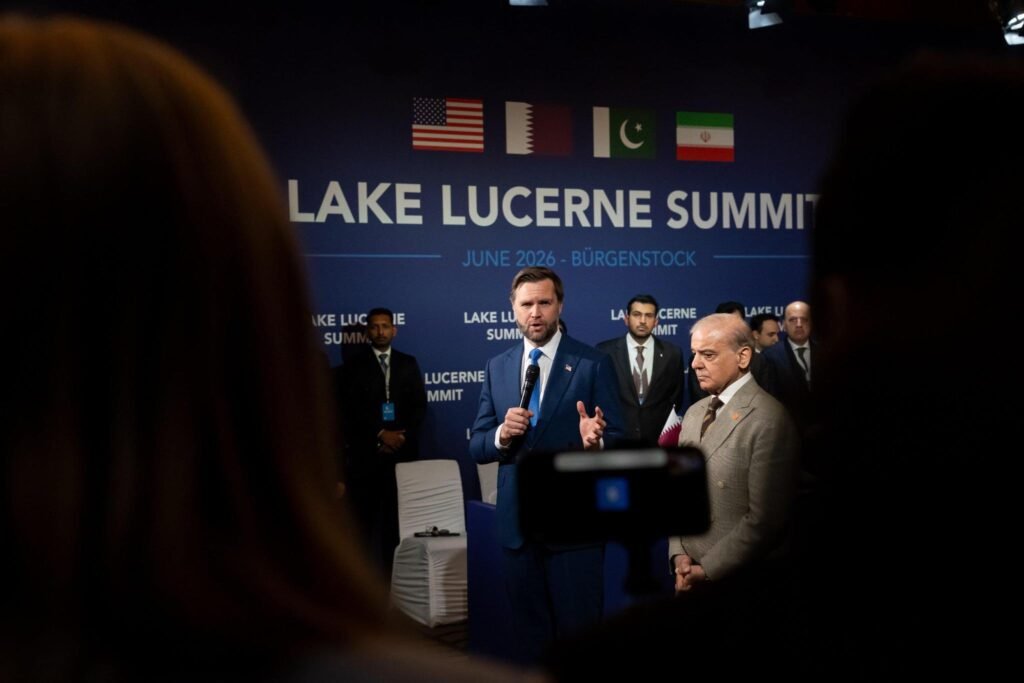
It is not surprising that negotiators are plugging along in Switzerland playing deaf to the bluff and bluster of their political bosses back home knowing full well that at the end of the day they will be setting motion a path that has profound implications for global order. And not to be left behind are the historians, military strategists and academics poring over the lessons of the Iran war, especially the ones that have not been learnt from earlier disasters in Korea, Vietnam, Afghanistan and Iraq, not to forget the newer one by way of Ukraine.
Certainly, the last word on the conflict in the Middle East has not been said; and many wonder if this indeed is just an interval before Round Two at the end of a self-declared ambitious sixty-day time frame. But inferences and flashbacks are doing their rounds, the first of which being that the Trump administration was not the first to have believed that a massive show of military might or air power would be sufficient to have the enemy come back crawling.
There have already been comparisons between the war in Iran and other American conflicts, notably in Vietnam, Afghanistan and Iraq, principally on the tendency to use massive force as a way to subdue the enemy. Presidents Johnson escalated Vietnam not just through induction of ground troops which at the peak of the conflict exceeded one-half million, but also through his carpet bombing of Viet Cong and North Vietnamese positions. And in pledging to end the war if elected President, Richard Nixon expanded the war into Cambodia by starting the bombing runs of the Ho Chi Minh trail. American massive air power also came by in the First Gulf War in 1991; and President Bill Clinton’s thinking that Slobodan Milosevic will get down to his knees when the first bombs fell on Belgrade in 1999. That came some 78 days later.
In Iran, Defense Secretary Pete Hegseth’s threat of “death and destruction from the sky” did not rattle the Ayatollahs or the Islamic Revolutionary Guards. In the first month of a war that started on February 28, Israel and the United States are said to have hit some 13,000 targets with the United States unleashing more than 850 cruise missiles. The focus on targets as opposed to strategy or any fine-tuned objectives meant that Iran’s military may have been degraded and its top brass hats, religious and political leaders may have been killed but that did not appear to have dented either the nuclear program or pave the way for a regime change. In fact, an emboldened Iran closed the Strait of Hormuz and horizontalized the conflict by attacking American allies and assets in the region.
Advertisement
It is not for the first time that Washington ran into the resilience of the opposition or in the “enemy” matching the superiority of armaments by an assortment of sheer will power or rudimentary assembly of weapons that have come to terrify major powers. In Vietnam the villagers braved the bombs by hiding in huts, underground trenches and fought back with whatever they could lay their hands on from the then Soviet Union and China. But Iran of 2026 was a different cup of tea than of the 1960s: reports have it that in the first two weeks or so the United States and its allies had fired upwards of 1700 Patriot missiles each costing about US$ 3 million or THAAD missiles that cost four times as much. Iran came up with its Shahed Drones that cost US$ 35,000 or Ukraine was more than happy to fork out its US$ 1000 interceptor drones, reflecting the changing character of modern warfare that even Moscow is forced to take note of in its war with Ukraine.
Comparing Vietnam war to the other conflicts that followed including Iran may not be totally appropriate as the former was pegged to the relics of the Cold War that had deep ideological underpinnings: the containment of Communism and any failure having implications for Asia and beyond. Furthermore, it had a strong domestic constituency as no American President wanted to go down in history as the one who “lost” Vietnam to the communists.
In all that identification of objectives, the inability of American leaders to distinguish between Nationalism and Communism and that Ho Chi Minh was first a nationalist before a communist meant that the United States paid a highly tragic price with nearly 59,000 of its soldiers killed, thousands maimed and still impacting political and social discussions in the country.
When it comes to the Iran war, the first question that is being asked and one that will be around for a very long time is what necessitated this conflict; or what were its prime objectives. It started with the bombing of Iran’s nuclear sites by the United States which was soon followed by an assassination spree by Israel; then came the closure and mining of the Strait of Hormuz by Iran which also expanded the war to involve other Gulf nations. The shifting of objectives has also brought back the important question of whether Iran can be cajoled to rollback its nuclear program by talking; or if only B 2s can do the job.
Former President Barack Obama who embarked on a two year-plus journey of trying to goad Tehran to give up its nuclear weapons ambition would seem to pin hopes on diplomacy. Or as he put it, “We pulled it off without firing a missile. We got 97% of their enriched uranium out… There’s no dispute that it worked…and we didn’t have to kill a whole bunch of people or shut down the Strait of Hormuz.” The question now is if the Trump administration will be able to get a better deal than what it walked out of in 2018 on grounds that the 2015 Joint Comprehensive Plan of Action was “the worst deal ever,” “horrible and one-sided” and “defective to its core.”
Disclaimer: The opinions and views expressed in this article/column are those of the author(s) and do not necessarily reflect the views or positions of South Asian Herald.