India and the United States have set an ambitious goal of expanding bilateral trade to $500 billion by 2030, placing renewed emphasis on commerce, technology, education, and people-to-people ties.
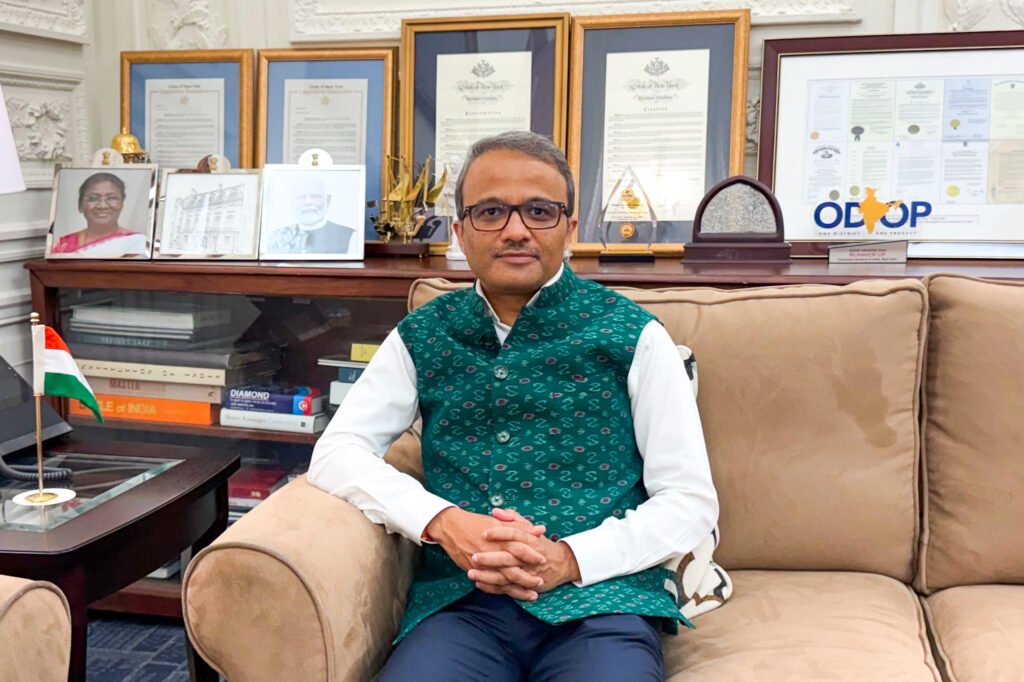
In this exclusive interview with South Asian Herald, on July 31, 2026, at the Consulate General of India in New York, Consul General, Ambassador Binaya Pradhan discusses the Consulate’s role in advancing trade and investment, the launch of the India–USA Trade Facilitation Portal, engagement with the Indian diaspora, modernization of consular services, and the growing scope of educational and technological collaboration between the two countries.
How is the Consulate General of India in New York contributing to the promotion of India–U.S. bilateral trade and investment?
India–U.S. bilateral trade currently stands at approximately $240 billion, covering both goods and services. A closer look shows that trade in goods accounts for the larger share, while services make up a comparatively smaller portion. Prime Minister Narendra Modi and President Donald Trump have set a target of expanding bilateral trade to $500 billion by 2030. Achieving that goal means more than doubling the current trade volume over the next four to five years. The New York Consulate plays a significant role in this effort. Nearly one-third of the total bilateral trade falls within our consular jurisdiction, largely because of the strategic importance of the Port of New York and New Jersey, which also serves as a major transshipment hub for the Caribbean.
Advertisement
How important is New York as a strategic hub for advancing these important objectives?
New York is ideally positioned to promote trade, investment, and technology cooperation between India and the United States. We work closely with a broad range of stakeholders, including trade organizations, financial institutions on Wall Street, investment groups, universities, and technology companies to strengthen bilateral collaboration. The Consulate regularly hosts Indian business delegations, connecting them with the appropriate partners and industry leaders in the United States. We also facilitate the participation of key American stakeholders in major trade fairs and exhibitions held in India.
In addition, we organize a variety of promotional initiatives to showcase Indian products. Last year, for example, we celebrated 200 years of Assam Tea to highlight India’s tea industry. We also participate in major beverage exhibitions to promote Indian wines and whiskies, which are steadily gaining recognition in the U.S. market.
Can you highlight some of the key trade facilitation initiatives and digital platforms recently introduced by the Consulate to support businesses and investors?
One of our most significant initiatives is the India–USA Trade Facilitation Portal, which was launched on April 8, 2026, during Foreign Secretary Vikram Misri’s visit to Washington, D.C.
Within just three months, the platform attracted around 3,000 registered members, including approximately 2,700 verified Indian exporters, authenticated by India’s Export Promotion Councils, and 300 major American importers. Membership continues to grow. The portal serves two primary purposes. First, it connects Indian exporters directly with major U.S. buyers. We have organized webinars and business engagement sessions with companies such as Costco, Walmart, Amazon, and Lockheed Martin, enabling Indian exporters to better understand procurement requirements, product specifications, and business opportunities. For example, Costco interacted with nearly 450 Indian exporters, outlining the products it sources from India and explaining its procurement process.
The platform is powered by artificial intelligence, allowing registered businesses to connect and interact independently. At the same time, the Consulate actively facilitates direct engagement between Indian exporters and leading American companies. The second objective is to support exporters through digital exhibitions. Participating in trade fairs in the United States can be expensive, particularly for micro, small, and medium enterprises (MSMEs), due to travel costs, visa requirements, and exhibition fees. The digital exhibition model enables businesses that cannot travel to the U.S. to showcase their products virtually and engage directly with prospective buyers.
Can you share details about any latest digital exhibition?
Our most recent digital exhibition focused on the apparel and garments sector. The event brought together 30 Indian exporters and 40 American importers, who interacted virtually for nearly four hours. Several participants are already in the process of concluding business agreements. The concept is designed to replicate the experience of a physical trade exhibition in a virtual environment, allowing exporters to present their products and connect with buyers in real time without the need to travel. Through the India–USA Trade Facilitation Portal, we are expanding these trade promotion initiatives with a particular emphasis on supporting India’s MSME sector.
How do you view the role of the Indian diaspora within the Consulate’s jurisdiction in strengthening India–U.S. relations?
The Indian diaspora in the United States, now numbering approximately 5.4 million, plays an indispensable role in strengthening India–U.S. relations. Members of the diaspora have made significant contributions across government, business, academia, technology, and many other sectors. Their success has enabled them to become influential advocates for stronger bilateral ties.
A good example was the response following the terrorist attack in Pahalgam. Members of the Indian diaspora actively engaged with their elected representatives, resulting in more than 150 Members of Congress publicly condemning the attack. Similarly, after the abrogation of Article 370, diaspora members helped explain the policy and its significance to lawmakers and other stakeholders.
Beyond public policy, the diaspora continues to serve as an important bridge between the two countries by promoting Indian culture, expanding business partnerships, advancing technological collaboration, and strengthening people-to-people connections. Their contributions have been invaluable in deepening the India–U.S. partnership.
What role does the Consulate play in engaging with second- and third-generation Indian Americans and helping them stay connected to their Indian heritage?
Of the 5.4 million-strong Indian diaspora in the United States, more than one million are second- and third-generation Indian Americans. We see many of these young people actively participating in cultural programs and preserving India’s rich traditions. Learning Indian classical music, dance, or other cultural art forms while growing up abroad requires dedication, and I commend both the children and their parents for sustaining these traditions. Much of this has happened organically through the efforts of the community.
Going forward, however, we need to connect the younger generation with India in a broader and more meaningful way. They should see India not only as part of their cultural heritage but also as a land of economic opportunity. Government initiatives such as the Overseas Citizen of India (OCI) program have made it easier for people of Indian origin to work, live, and invest in India. Many OCI cardholders are already pursuing business and professional opportunities there. While these young people are proud American citizens, they should also recognize the unique advantage of their Indian heritage and leverage it to strengthen ties between the two countries.
Could you share the latest updates on consular services, including the rollout of e-Passports and the e-OCI initiative?
Both the e-OCI initiative and the introduction of e-Passports represent significant steps toward modernizing India’s consular services. They are very positive developments. The newly introduced digital OCI card eliminates the need to carry a physical document. OCI cardholders can now update information such as changes to their name or passport details online, without having to visit the Consulate. Previously, many travelers faced inconvenience after forgetting to carry their OCI card, particularly when making last-minute travel plans to India from a third country. With the digital version, they can access their credentials electronically and travel more conveniently.
Similarly, the e-Passport is a chip-enabled passport that offers enhanced security while enabling smoother immigration procedures at airports around the world. Although it remains a physical passport, the embedded digital chip significantly improves both security and efficiency.
The Government of India has also introduced an expedited immigration system, similar to the Global Entry program. Once preregistered, Indian nationals and OCI cardholders can clear immigration at participating Indian airports through automated electronic gates in approximately 60 seconds, and the service is provided free of cost.
To improve accessibility, we have also expanded our network of satellite consular centers. Within my jurisdiction, new centers have opened in Columbus, Ohio, and Edison, New Jersey, bringing consular services closer to communities with large Indian populations.
Another important development has been the growing use of e-Visas. Last year, nearly 95 percent of U.S. passport holders traveling to India used the electronic visa system, with most visas being issued within 48 hours.
How is the Consulate contributing to the strengthening of India–U.S. educational collaboration, particularly between academic institutions, researchers, and students in both countries?
India–U.S. educational collaboration has evolved significantly over the years. Previously, the relationship was largely centered on student mobility, with Indian students coming to the United States for higher education. While that remains an important component, the partnership has now expanded into several new areas. Today, more than 341,000 Indian students are pursuing higher education in the United States. At the same time, American universities are increasingly looking to establish campuses in India. For example, the Illinois Institute of Technology in Chicago is scheduled to open its campus in Mumbai this September, while several other U.S. institutions are in discussions to establish a presence in India.
This is an encouraging development because it allows Indian students to receive an American education without necessarily having to relocate abroad. Overall, around 20 foreign universities, including institutions from the United States, Europe, and Australia, are setting up campuses in India. We are also seeing universities introduce courses such as “Doing Business with India,” reflecting growing global interest in India’s economic opportunities. Beyond student exchanges, collaboration now includes joint research projects, faculty exchanges, technology partnerships, and dual-study programs, allowing students to pursue part of their education in India and part in the United States. These emerging models of academic cooperation are creating deeper institutional partnerships between leading universities in both countries.
At the same time, the Consulate remains actively engaged with Indian students across universities in our jurisdiction and continues to prioritize their welfare and well-being.
Looking ahead, what are the Consulate’s key priorities in the coming months?
The Consulate General in New York is the largest and busiest Indian Consulate in the world, serving a diaspora of approximately 2.2 million people within its jurisdiction. We also receive a steady stream of high-level visitors from India. During my two-and-a-half years in New York, we have hosted visits by the Prime Minister, Finance Minister, Commerce Minister, External Affairs Minister, several Chief Ministers, and numerous private-sector and trade delegations. One of our key responsibilities is to facilitate meaningful engagement between these visiting delegations and their counterparts in the United States across government, business, academia, and civil society.
Looking ahead, one of our foremost priorities is to further strengthen and expand the India–USA Trade Facilitation Portal, making it an indispensable platform for businesses in both countries. We also remain committed to making our consular services more efficient, accessible, and user-friendly, while continuing to deepen our engagement with the Indian diaspora across our jurisdiction.
(This interview has been edited for length, brevity and clarity)