Bangladesh has been offered a place in the Pax Silica economic security architecture designed to reshape the global supply chains underpinning artificial intelligence, semiconductors and critical minerals, away from China.
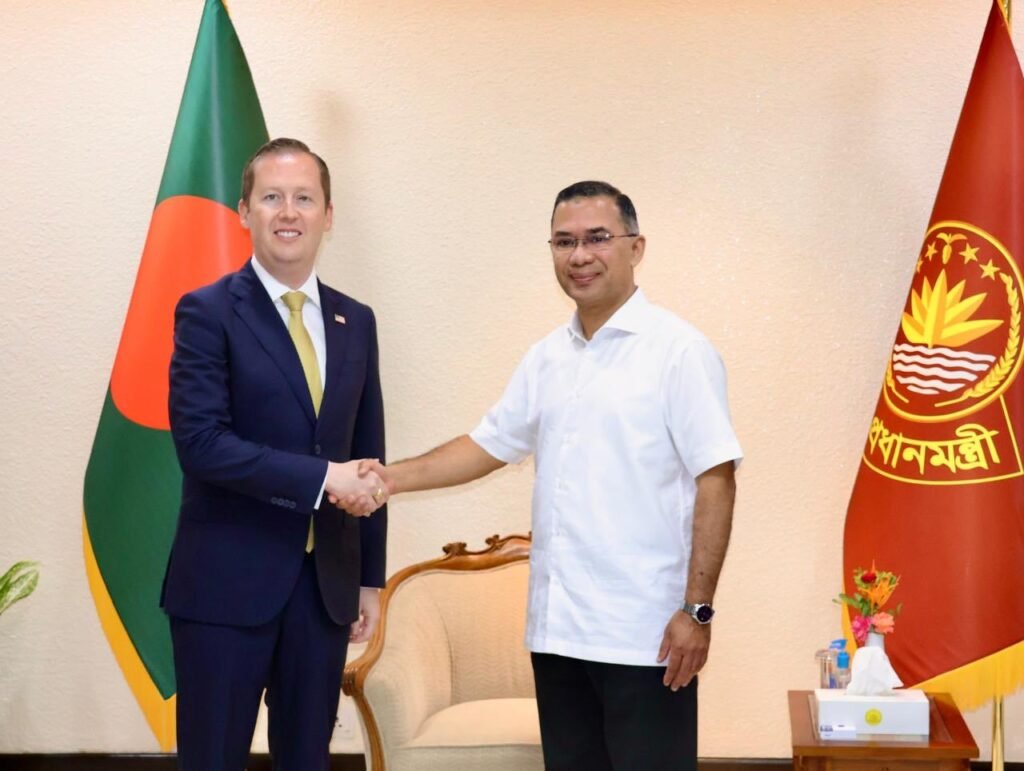
US Special Envoy for South and Central Asia Sergio Gor has proposed that Bangladesh join the US-led Pax Silica initiative at a meeting with Prime Minister Tarique Rahman on Saturday.
Significantly, Gor met Indian High Commissioner Dinesh Trivedi in Dhaka a day earlier. Since India is already a full-fledged member of Pax Silica, a pact which seeks to establish a strategic economic supply chain avoiding China, top sources in Dhaka said it is “more than likely that the issue was discussed with the Indians before the offer was made to Dhaka” in a bid to wean it away from Beijing’s influence about which both Delhi and Washington are concerned.
“It’s a good proposal. If Dhaka joins the Pax Silica, it will bring Bangladesh into an important economic and strategic ecosystem and network and be to its advantage.” Pinak R Chakravarty, former Secretary (Economic Relations) in the Ministry of External Affairs told UNI.
Advertisement
It is well known that Pax Silica is not a simple conventional free-trade agreement, rather it is an economic-security framework in which participating countries – USA, India, Japan, UK, Australia, and South Korea – are consciously building a new supply chain for trade and investment in the world of critical minerals and AI where China will not play a role.
Though for India and US, Bangladesh’s joining Pax Silica could mean weaning it away from China, for Bangladesh the attraction will be less about geopolitics but sheer realpolitiks in the world of economic survival. Ties with Pax Silica and the US could mean continued easy access to the US and Indian markets, access to capital and technology from western-controlled multilateral institutions.
Tha Americans have subtly tied continuation preferential textiles tariffs and duty-free treatment on pacts related to defense and other non-trade issues, giving Washington a direct lever for strategic alignment away from Beijing.
Joining Pax Silica is seen by many analysts as a vote against a Chinese-led economic order and in Bangladesh’s case also result in investment in new areas such as data centers, advanced manufacturing and digital services.
“To start with India’s semi-conductor complex being built in Assam and Japan’s Matabari port in southern Bangladesh can be nodes in this chain with many high value downstream and upstream industries cropping in Bangladesh as a result,” top officials in the Ministry of External Affairs said.
How Rahman deals with the offer will shape Bangladesh’s fortunes and politics in the years ahead. Pro-Beijing ministers and aides in Rahman’s own coterie as well political parties which have close ties with China are unlikely to be too enthused by the promise of tech advancement or investment in a trade-off between the “dragon and the eagle.”
Some may also argue that Bangladesh’s economic interests demand relationships with both Washington and Beijing and that Beijing is the riverine nation’s counter-poise with which to extract concessions from both India and the US.
China also remains a major lender, project contractor and trading partner for Bangladesh, while the US and India are important export market and potential sources of technology and investment. Annoying the US or Gor may not be something which the Bangladeshi leadership would risk at this crucial juncture, when the nation’s economy and political flux continues to reign in the streets of Dhaka. (UNI)