The negotiations between Iran and the United States in Switzerland were never passed off to be either friendly or without high dramas; and as expected the first day reportedly had the Iranian delegation officially walk out protesting “threats” from President Donald Trump. The anger is said to have followed President Trump’s claim he had told Iranian officials that they would not have a country should the Strait of Hormuz be closed again. In an interview to Fox News, the American President said, “We may take over the Strait, if we have to. If they don’t make a deal, we’ll collect tolls.”
But President Trump went further. “You close it and you won’t have a country. You won’t even make it back to your f**king country,” a remark that has been seen as threatening to kidnap Iranian negotiators. What followed in Burgenstock was a formal protest and a demand that the “bullying” must be brought under control. Hormuz was not the only issue with President Trump. “Iran must immediately stop their highly paid proxies in Lebanon from causing trouble. If they don’t, we’ll hit Iran very hard again,” he wrote in a social media post.
Lebanon has always been a tricky and sensitive issue for both Tehran and Washington. After the near decimation of the Hamas in the Gaza, the Hezbollah remains a major Iranian proxy in the region which Israel has vowed to get rid of. In fact, Prime Minister Benjamin Netanyahu has repeatedly said that there will be no let up on the bombing pressure on the Hezbollah fighters and that Israeli troops will stay put in the southern parts of Lebanon. At times President Trump has expressed exasperation at Prime Minister Netanyahu’s campaign in Lebanon stressing that it is taking place at a wrong time and in the process reflecting poor judgement.
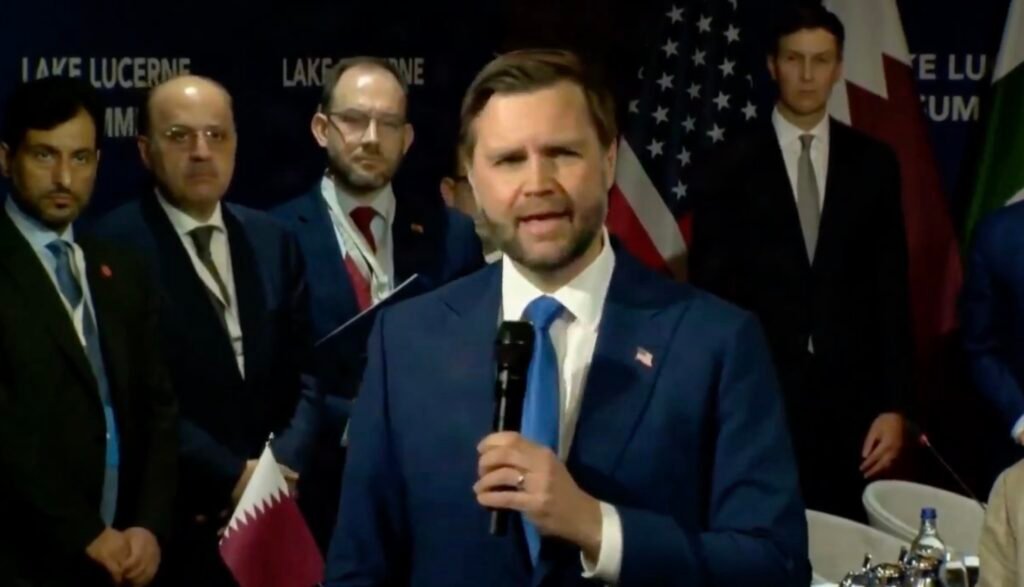
On more than one occasion Iran has made it known that Lebanon is a crucial part of anything that transpires with Washington. The strategic importance of the Hezbollah aside, Iranian negotiators are perhaps forced to play a high drama to offset domestic backlash from hardliners who are already upset over the framework for a peace deal. Iranian outrage and walkout on Day One is tied to this domestic gallery scenario. As opposed to the harsh tone of President Trump, his Vice President, J.D. Vance, the chief US negotiator at Switzerland maintained that progress is being registered on ending hostilities in Lebanon. “These things are always a little bit messy,” he remarked.
Advertisement
The sixty-day negotiation period to agree on a Memorandum of Understanding has senior Iran officials as a part of their team—Speaker Mohammad Bagher Ghalibaf and Foreign Minister Abbas Araghchi. Aside from Lebanon the two sides will have to get over the conflicting claims and views on the Strait of Hormuz, a permanent ceasefire, frozen Iranian assets, sanctions and above all addressing the sensitive Iranian nuclear program. It is said that Iran insists all other issues must be addressed first before the two sides start negotiating on nuclear matters.
Lebanon is not the only problem President Trump faces from Prime Minister Netanyahu. The bigger challenge could come from the nuclear issue: Washington maintains that Iran cannot and will not have a nuclear weapon leaving open the question whether Tehran will be allowed to walk the civilian nuclear path. Tel Aviv, on the other hands, insists that Iran should have nothing concerned with Nuclear, period. In the interim negotiators will have to sort out other details like handing over the 500 kilograms of Uranian left with Iran; and the role of the International Atomic Energy Agency (IAEA), if any.
The fact of the matter is that both President Trump and Prime Minister Netanyahu have a political problem on their hands by way of elections in October and November. Political critics of both leaders have started sharpening their knives with some in Israel arguing that Prime Minister Netanyahu has really been left in the cold with nothing to show for in the agreement between Washington and Tehran. And President Trump is being taken to task from even within the hawks of the Republican Party for giving away too much in return for nothing.
President Trump is also aware that no matter kind of arrangement is worked out finally on the nuclear issue, that would be compared to President Barack Obama’s 2015 Joint Comprehensive Plan of Action, JCPOA, which President Trump walked out of in his first tenure in 2018. The Europeans and the IAEA were literally pleading with the then Trump administration not to abrogate a treaty that was so meticulously put together and that Iran was in full compliance. Iran’s enrichment level in 2018 was said to have been at 3.67 percent; and eight years later is pegged at 60 percent. A bigger problem now is that the remaining Uranium is said to have been put in containers and ringed with mines to prevent any U.S. special forces operation for retrieval.
A parallel political problem for President Trump is the kind of pressure he is willing to put on Prime Minister Netanyahu without risking support of Jewish voters. In an anticipated tough election scene for the House of Representatives, and perhaps even the Senate, Republican law makers will be looking for every vote to facilitate re-election.
Disclaimer: The opinions and views expressed in this article/column are those of the author(s) and do not necessarily reflect the views or positions of South Asian Herald.