India’s approach to the Arctic and Antarctic can no longer be confined to scientific research as climate change, geopolitical rivalry and the race for critical resources rapidly transform the polar regions into strategic frontiers, a parliamentary committee has warned.
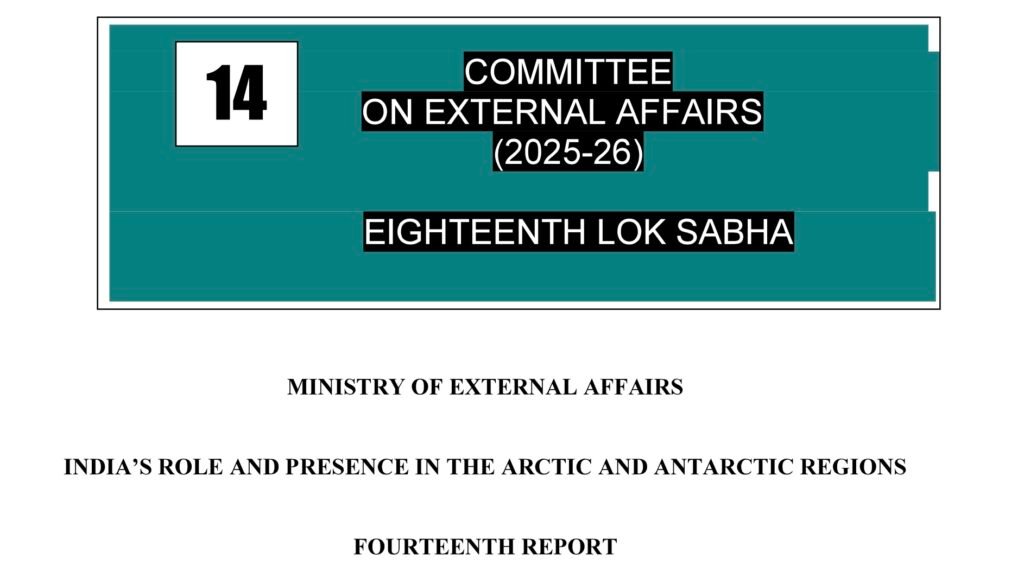
In a strongly worded report tabled in Parliament on June 30, the Lok Sabha Committee on External Affairs said New Delhi must fundamentally recalibrate its polar engagement, arguing that the country’s current science-led presence is inadequate for an era marked by competition over shipping routes, energy resources, rare minerals and global influence.
The committee cautioned that the Arctic is emerging as one of the world’s most consequential geopolitical theatres, where melting ice is opening new sea lanes and exposing vast reserves of hydrocarbons and critical minerals, even as military and strategic competition among major powers intensifies.
“Developments in these areas have great impact on India’s strategic, commercial, environmental and scientific interests and therefore call for active Indian engagement,” the report said, adding that India must assume a proactive leadership role and establish itself as the voice of the Global South in polar governance.
Advertisement
The warning reflects growing concern that India’s existing engagement remains disproportionately focused on scientific expeditions while other countries are building diplomatic, strategic and economic influence in the rapidly changing Arctic.
The committee said India should expand beyond climate research by strengthening diplomacy, building indigenous polar infrastructure, investing in ice-class vessels and a dedicated Polar Research Vessel, expanding international partnerships and preparing for future commercial opportunities arising from new Arctic shipping routes.
It also questioned whether India’s institutional framework is keeping pace with the changing strategic landscape.
While several Arctic nations and observer countries have appointed dedicated Polar or Arctic Ambassadors, India continues to manage polar affairs through a Polar Cell within the Ministry of External Affairs. Experts appearing before the committee recommended a more robust institutional mechanism to integrate scientific research with foreign policy and strategic planning.
The report also underscored the limitations imposed by India’s Observer status in the Arctic Council. Although India has participated actively in scientific working groups since joining the Council in 2013, it remains excluded from decision-making, cannot vote on governance issues and faces restrictions on proposing projects independently.
The Ministry of Earth Sciences acknowledged before the committee that India’s objectives are “significantly constrained” by its observer status, even as scientific cooperation continues.
The committee argued that the urgency extends beyond geopolitics.
It noted that Arctic warming is already affecting India’s climate through disruptions in monsoon patterns, increased extreme weather and rising coastal risks. Experts told the panel that continued melting of Arctic sea ice could have cascading consequences for India’s agriculture, water security and economic resilience, making polar developments a domestic policy issue as much as a foreign policy challenge.
While acknowledging India’s achievements—including research stations in Antarctica and the Arctic, its Arctic Policy of 2022 and growing international scientific collaborations—the committee made clear that these alone will not secure India’s interests in an increasingly contested polar order.
Its central message was unequivocal: the polar regions are no longer distant laboratories for scientific discovery. They are becoming arenas where climate, commerce, diplomacy and strategic competition intersect—and India must ensure its engagement evolves accordingly.