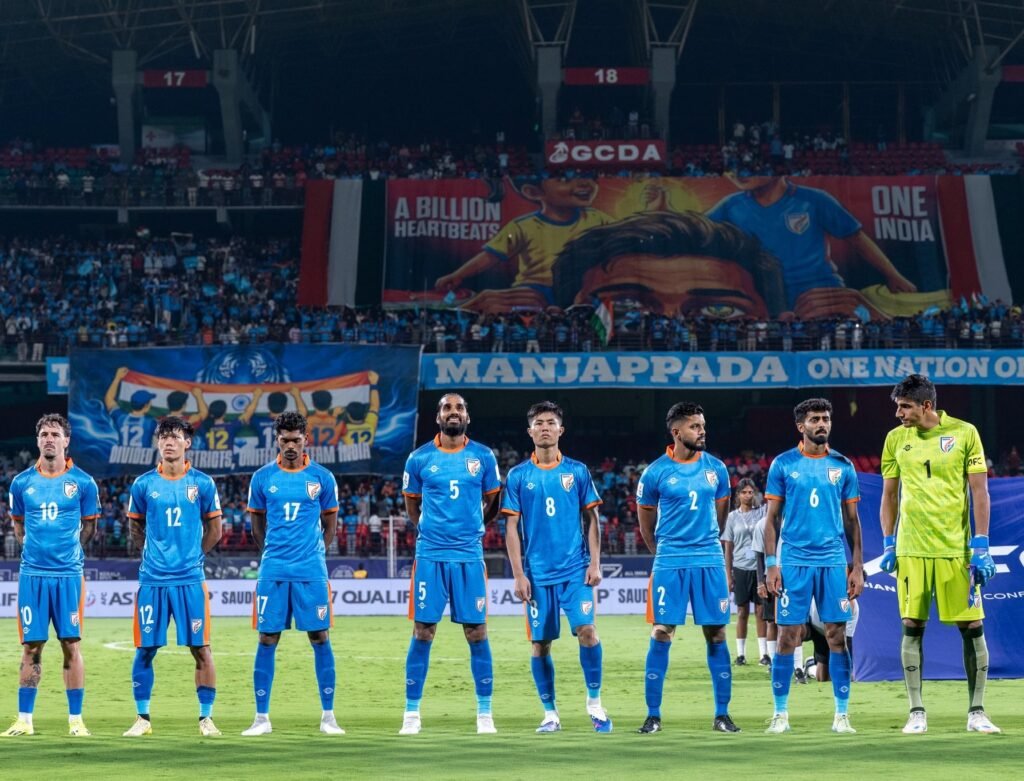
The Indian national football team will visit England after 24 years as they are set to participate in the 2026 Unity Cup, which will be played at The Valley, home of Charlton Athletic F.C., in London from May 26-30. The tournament will feature Nigeria, Zimbabwe, and Jamaica, with India set to play Jamaica in its opening match on May 27.
“It’s good to know that we’ve been there before,” said Indian captain and goalkeeper Gurpreet Singh Sandhu about India returning to play in England, in an exclusive interview with South Asian Herald.
“I’m sure it’s not only my dream, but a lot of players who would have dreamt about playing in England in any way or form professionally, so I think everyone is excited about that opportunity.”
It has been an eventful 12 months for Indian football. India’s premier football league, the Indian Super League (ISL), was briefly suspended by the All-India Football Federation (AIFF). As for the national team, India missed out on qualifying for the 2027 AFC Asian Cup after making it to the previous two editions, with its FIFA ranking dropping from 102 to 142 within two years while rotating through three coaches during that span.
Advertisement
It’s not all negative, though, as India secured a third-place finish at the CAFA Nations Cup in September 2025, finishing behind World Cup-caliber sides Uzbekistan and Iran. Now, going up against two more teams with strong international pedigrees, Jamaica and potentially Nigeria, both of whom narrowly missed out on a spot at the 2026 World Cup, this is the kind of exposure India needs to improve its game.
“Before the tournament if you would have said that India would go on and bag a bronze medal in that tournament, chances are they’d say ‘I don’t think so’ with a sarcastic smile, but we did that,” said Indian defender Sandesh Jhingan about India’s performance at the CAFA Nations Cup, exclusively to South Asian Herald.
“If you don’t put up against the big teams you’ll never understand where you stand, how far you can go, what is your true potential as a team, as an individual so it’s very important for us to continue regardless of what the scoreline is.”
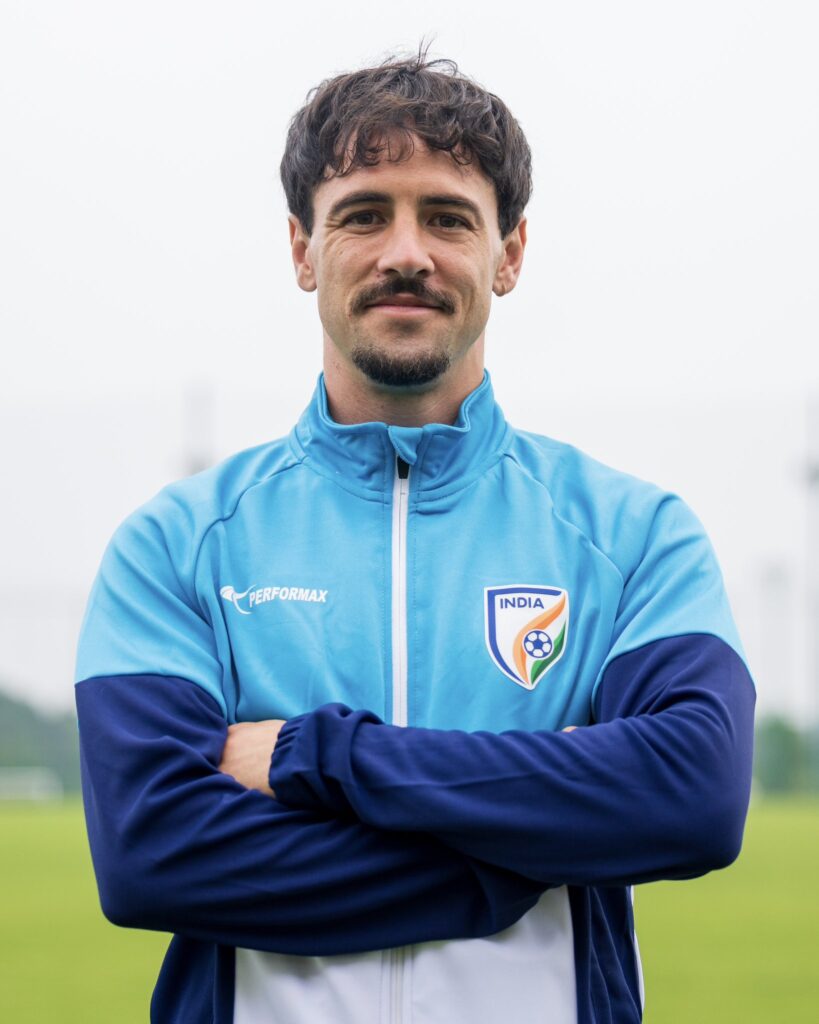
In March of this year, India took a major step forward with the debut of former Australian international Ryan Williams. Through his Anglo-Indian mother, Williams chose to represent India, giving up his Australian passport and earning his first minutes in the Indian blue, where he scored against Hong Kong in a 2-1 win.
“I think more than what he did on the pitch, I think he’s a great guy off the pitch,” said Jhingan about Williams.
“His quality is something you know, there’s no point going back into it, he’s shown it in his time in UK and India, but the way he gelled with the group, I think that was really commendable.”
“I’ve shared the dressing room with Ryan (Williams) at Bengaluru FC, and he lives close by as well, so we used to drive to training together,” said Sandhu about Williams.
“The whole process of him choosing to give up his nationality and going through that process, I was in the driving seat, and he was in the passenger seat.”
“I heard about the whole process, his feelings and why he wants to do it, and I was very excited not because he’s a good player but also a great teammate to have and also his Indian roots, his Indian heritage makes him feel for the country, so that’s a great plus.”
Williams is the first Overseas Citizen of India (OCI) to represent India on the international stage since Arata Izumi in 2013, possibly signaling a new era of OCIs and Persons of Indian Origin (PIOs) playing for India. But in looking toward the diaspora, does that mean a complete abandonment of focus on homegrown talent?
“There’s no straight answer to it,” expressed Sandhu when asked that question.
“We have 1.5 billion people almost and we have a plethora of talent in our country that we need to exploit and extract, but at the same time like we do know that there are players like Ryan Williams out there who have that Indian connection and might want to explore the possibility of representing the national team over here, so I feel like we if possible should have the best of both worlds.”
“My personal idea is to get the best 20 youngsters, under 13s or under 14s and then send them to Europe,” he continued.
“Let them be there for five or six years, once they have trained with European talent day in day out, obviously they’ll become better and once they are ready, then you can bring them back to the national team and make us you know grow in ways that we are not able to do as of now.”
That European exposure is something both Sandhu and Jhingan understand well, as they are among the few Indians to have played in Europe, in Norway and Croatia respectively. From their time there, the biggest difference they noticed between Indian and European football is the grassroots structure, which they believe India can learn from.
“There were four, five-year-old kids who were already in academies,” said Jhingan about what he observed during his time with HNK Šibenik.
“Of course, they were not doing any tactics or any shape at that age but it’s just so cool to see all of them in proper uniforms, coming in at a certain time, and just having a kick about at that young age.”
“I have asked many families back here in India if they look to put their kids in a proper footballing club at the age of four or five, but it’s not a very normal thing right now.”
“The main difference between what I have experienced in Norway and in India is basically the culture for sports,” said Sandhu about his perspective during his time at Stabæk.
“In Europe you can walk down the street and you can play in a park and stuff like that and there are people watching football, people enjoying the sport, who knows a scout is walking by and there’s a kid and you know like there are stories like that.”
Grassroots development and sporting culture are certainly areas where Indian football needs restructuring, and that restructuring will need to begin with inspiration, which falls on the national team to create. Competitions such as the Unity Cup are the perfect platform to ignite passion among football fans in India, and having such a tournament in the UK, where there is a large Indian diaspora and strong football culture, makes this an ideal opportunity.
“To all the Indians back there in UK, we need your support,” stated Jhingan in a call to action.
“After 24 years we’re coming to the country and we would like to have some Indians around us taking care of us, come for good football, have a good atmosphere and come support the country, let’s sing the national anthem together I imagine that’d be a beautiful thing to do.”
“I think it’s important that we all do a bit in terms of creating awareness,” said Sandhu in his call to action.
“Witness the Indian football team. If we are doing good, please tell us, if we are doing bad, please tell us, but do tell us. You should come, that’ll be great for us, for our motivation, for our desire to fight for you and for the badge.”
The Unity Cup runs from May 26-30, with India playing its opening match against Jamaica at The Valley on May 27 at 7:30 p.m. BST (2:30 p.m. EST).