A $42 mn (Rs 400-crore) lawsuit over two Bollywood songs is the latest skirmish in a global copyright war — one that pits analogue-era agreements against a digital economy that their drafters could never have imagined.
The song was three minutes long and written on paper. The contract that governed it ran to a few typed pages, signed in 1999, in a world where a film’s musical life played out on cassette decks and satellite television. Nobody wrote a clause for YouTube. Nobody foresaw that a chorus heard during a trailer could rack up 50 million views before a single ticket was sold.
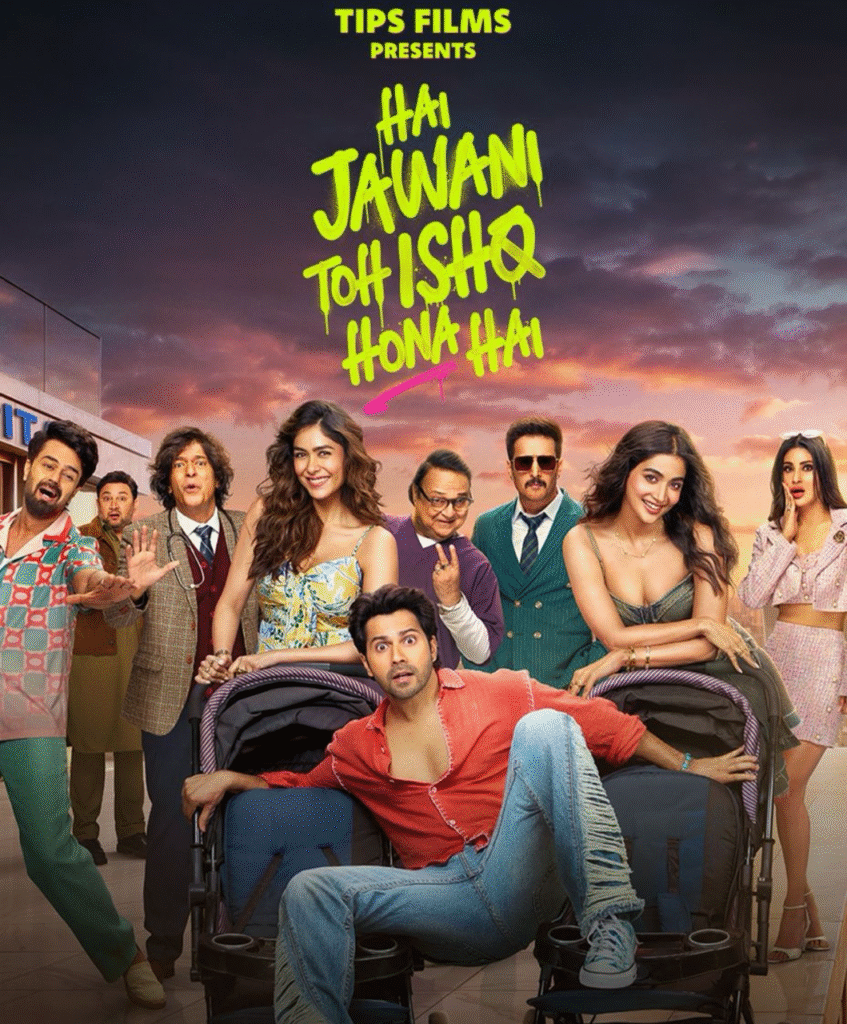
That contractual silence now sits at the center of one of the most closely watched legal battles in Bollywood. Producer Vashu Bhagnani’s Puja Entertainment has filed a Rs 400-crore suit in the Bombay High Court against Tips Industries, its promoters Ramesh and Kumar Taurani, and director David Dhawan. The claim: that the upcoming Varun Dhawan film Hai Jawani Toh Ishq Hona Hai used the iconic songs Chunnari Chunnari and Ishq Sona Hai — from Dhawan’s own 1999 blockbuster Biwi No. 1 — without clearing all the layers of rights that the digital age has quietly multiplied.
The irony is lacerating. The director being sued helped create the songs being disputed. But in copyright law, creation and ownership diverged long ago — and the gap between them has never been wider.
Advertisement
- ₹400 Cr
- Claim Filed, Bombay HC
- 26 yrs
- Since Biwi No 1, Released
- $7.4M
- Blurred Lines Verdict, US (2015)
The invisible architecture of a film song; To casual observers, music rights appear simple: someone owns the song, someone pays to use it. The reality, across both Bollywood and Hollywood, is a multi-layered labyrinth that legal scholars have compared to an archaeological dig — each layer representing a different era of commerce, each one written in the language of technologies that no longer exist.
A single Bollywood song from the 1990s can involve music rights, publishing rights, lyric rights, synchronization rights, performance rights, and the rights attached to the filmed visual sequence — potentially owned by different entities. Contracts signed in the cassette era routinely used language like “all media now known or hereafter devised.” Courts have spent two decades arguing over whether that phrase covers streaming, and the arguments are still running.
The US Copyright Office made the same point bluntly in a 2015 report. Maria Pallante, then its director, told the Hollywood Reporter that the structures built in the 20th century to govern music rights were, in her words, adequate for “discs and tapes” but were now under “significant stress.” The Copyright Office’s own language was more vivid still: American law, it said, was “trying to deliver bits and bytes through a Victrola.”
India never had a Victrola clause either.
“Classic Hollywood contracts were complicated even before time blurred ownership. Tracking who owns what today can be like tracing a family tree through lost archives.”
A global affliction, not a Bollywood peculiarity: If Indian producers are fighting over twenty-six-year-old contracts, so is almost everyone else. The transformation of music and film from physical goods into data streams did not merely change the economics of entertainment. It retroactively changed the meaning of every agreement signed before it happened.
In the United States, the landmark case arrived in 2015 when a jury found that Robin Thicke and Pharrell Williams had infringed Marvin Gaye’s 1977 song Got to Give It Up in producing their global hit Blurred Lines. The verdict — upheld on appeal at $5.3 million — sent a chill through the recording industry, not because the copying was obvious but because it wasn’t. The songs shared a “feel,” not a melody. Two songs differing “in melody, harmony and rhythm,” as a dissenting judge noted, were nonetheless judged too similar for comfort.
Led Zeppelin spent six years in court over the opening notes of Stairway to Heaven, ultimately prevailing in 2020 when the Ninth Circuit — overturning its own earlier panel — held that “a four-note sequence common in the music field is not copyrightable expression.” The court also scrapped the “inverse ratio rule,” a legal standard so counterintuitive it had confused courts for decades: the more access an alleged infringer had to a work, the less similarity was needed to prove copying.
Ed Sheeran has been sued so many times that in 2023, after winning yet another case over Shape of You, he spoke of a lawsuit culture in which claims are filed because “a settlement will be cheaper than taking it to court.” The same logic applies in Mumbai.
In 2023, Universal Music Group and major labels filed a $621 million suit against the Internet Archive for digitizing vinyl records — old music, new format, catastrophic legal exposure. The case settled in September 2025 after two years of litigation. Disney and Universal jointly sued AI image-generator Midjourney in June 2025, marking Hollywood’s first direct confrontation with generative AI — a battle over whether training data constitutes copyright infringement, a question no law written before 2020 was designed to answer.
The remix economy and who profits from memory: What makes the Bhagnani-Tips dispute particularly instructive is that it sits precisely at the junction of two revenue streams that did not exist when the original songs were made: pre-release marketing via short-form video, and global streaming royalties.
A recreated song embedded in a trailer today is not a tribute. It is a commercial asset. Seconds of a recognizable hook on Instagram Reels or YouTube Shorts can generate millions of views and, through those platforms’ monetization systems, real money — money that flows somewhere, and that someone must own. When contracts signed before 2000 specified who controlled “promotional” use of a song, they were imagining a two-minute spot on Doordarshan, not a thirty-second clip shared across 190 countries before a film’s release date is announced.
Bollywood’s nostalgia economy has accelerated this pressure enormously. From Aankh Marey to Tip Tip Barsa Pani, from O Saki Saki to the dozens of retro recreations inserted into films over the past decade, producers have discovered that old songs carry built-in audiences. They come pre-tested, pre-loved, and algorithmically friendly — streaming platforms surface the familiar. The problem is that the original rights holders, who signed deals when this calculus was unimaginable, now find their assets generating wealth for parties they never contracted with.
A timeline of the growing crisis
1994 – US
US Copyright Act pre-dates streaming. The law governing digital music barely contemplates interactive services. The Copyright Office will spend the next two decades issuing emergency guidance to fill the gaps.
2001 – INDIA
Satellite television expands. Bollywood producers and music labels begin disputing whether cassette-era contracts cover broadcast rights. Courts rule case by case; no statutory clarity emerges.
2012 – INDIA
India amends its copyright law following lyricist Javed Akhtar’s campaign. Composers and lyricists gain ongoing royalty rights — the most significant reform in modern Bollywood IP history. But the amendments say little about digital exploitation.
2015 – US
The Blurred Lines verdict awards $7.4 million to Marvin Gaye’s estate. A dissenting judge warns the ruling “strikes a devastating blow to future musicians.” Legal scholars call it the highest-water mark of copyright overreach in a generation.
2018 – US
The Music Modernization Act becomes law — the first major US copyright reform for the streaming era. It creates blanket digital licensing and protects pre-1972 recordings. Critics note it addresses mechanical royalties but barely touches synchronization or visual rights.
2020 – GLOBAL
The pandemic accelerates streaming. OTT platforms boom. Across Bollywood, Hollywood and beyond, rights holders discover their old contracts never specified whether streaming counted as “broadcast,” “home video,” or something else entirely.
2020 – US
Led Zeppelin wins the Stairway to Heaven case. The Ninth Circuit overturns the “inverse ratio rule” and refuses to protect a four-note sequence. A rare moment of clarity — but only for notes, not for the visual and social-media rights that are now Bollywood’s battlefield.
2025 – US
Disney and Universal sue Midjourney. Hollywood confronts AI. The question of what constitutes a “copy” in the age of machine learning renders every existing copyright framework uncertain all over again.
2026 – INDIA
The Bhagnani-Tips lawsuit is filed. Rs 400 crore. Two songs. A contract written before YouTube existed. The Bombay High Court must now decide what “promotional use” meant — and means.
What courts are really being asked to do; The deeper problem exposed by all of these cases — in Los Angeles, London, and Mumbai — is that courts are being asked to perform an act of translation. They must take a document written in the commercial language of one era and apply it to a revenue model that did not exist when the ink was dry. Judges trained in legal interpretation are being asked to intuit the intentions of contracting parties who could not have had any intentions about platforms that were not invented yet.
The answers are necessarily inconsistent. Different benches, different interpretations. In the United States, different circuits reached opposite conclusions on the same copyright questions for years before the Supreme Court intervened — and sometimes after. India’s courts, working with even older statutory language, face the same contradictions without a Music Modernization Act to anchor them.
Large damages claim like the Rs 400-crore figure in the Bhagnani-Tips case serve a purpose beyond their face value. They are designed to make litigation too expensive to ignore and settlement too attractive to refuse. They are also an implicit argument about the asset’s true worth — that the songs in question are not two nostalgic items from a 1999 comedy but a living revenue stream, worth hundreds of crores precisely because streaming and social media have made them so.
The industry that memory built; Twenty-six years ago, Chunnari Chunnari sold cassettes. Today it sells trailers, playlist placements, short-form content, sync deals, and the intangible marketing premium of a hook that audiences already know they love. The songs have not changed. The economics around them have transformed beyond recognition. And the contracts that were meant to govern all of this were written in a language that has no word for “algorithm.”
The Bombay High Court will eventually deliver a judgment, or the parties will settle behind closed doors, as most of these battles do. Either way, the music will keep playing. The question of who owns its echo — who profits when memory goes digital — will keep going to court.
Because in an industry built on dreams, it turns out the most valuable things are the songs everyone already knows — and nobody quite agreed on who owns them.
(Sources: Bombay High Court filings; US Copyright Office reports; Ninth Circuit opinions in Williams v. Gaye (2018) and Skidmore v. Led Zeppelin (2020); US Music Modernization Act (2018); Rolling Stone; The Hollywood Reporter; Copyright Alliance 2024 Year in Review.)
Disclaimer: The opinions and views expressed in this article/column are those of the author(s) and do not necessarily reflect the views or positions of South Asian Herald.