India’s Comprehensive Economic Partnership Agreement (CEPA) with Oman came into force on June 1, providing Indian exporters preferential access to a strategically located Gulf economy and potentially strengthening New Delhi’s energy security at a time of mounting geopolitical uncertainty in West Asia.
While the government has hailed the agreement as a transformative trade pact that will boost exports, investment and employment, analysts argue that its real significance lies in securing a reliable trade and energy corridor outside the vulnerable Strait of Hormuz, one of the world’s most sensitive maritime chokepoints.
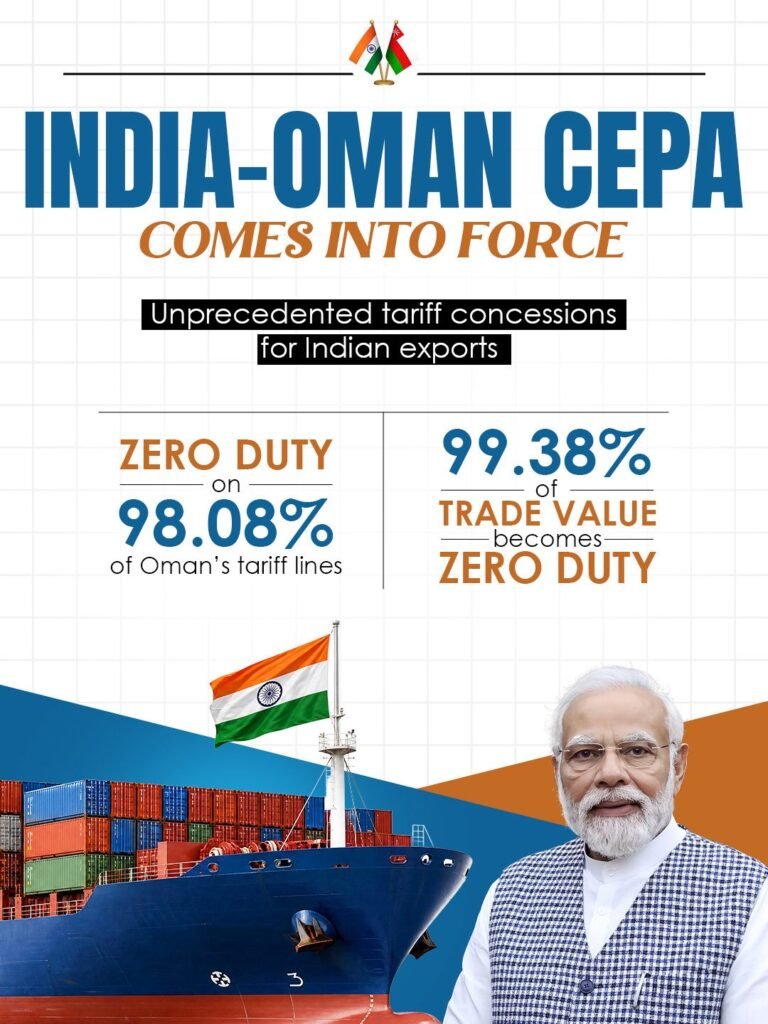
The agreement, signed in Muscat in December 2025, is India’s fifth free trade agreement implemented in the past five years and its fifteenth overall. Under the pact, Oman has granted zero-duty access on 98.08 percent of tariff lines, covering more than 99 percent of India’s exports by value.
Commerce Minister Piyush Goyal described the agreement as a “force multiplier” for India’s economic engagement with the Gulf region. Yet trade experts caution that Oman, with a population of about 5.5 million and a GDP of roughly $110 billion, is unlikely to generate the kind of export surge seen in larger markets.
Advertisement
“The importance of the agreement lies in Oman’s location rather than the size of its market,” noted Ajay Srivastava in a report released on June 1.
Unlike most Gulf economies, much of Oman’s coastline lies outside the Strait of Hormuz. Ports such as Salalah and Duqm remain accessible even during disruptions in the Gulf, enabling Oman to function as an alternative gateway for trade and energy flows.
Recent regional tensions have reinforced that strategic advantage. According to the Global Trade Research Initiative (GTRI), India’s imports from major Gulf economies fell from around $15 billion in April 2025 to $9.8 billion in April 2026 amid conflict-related disruptions, while exports to the region declined from $4.4 billion to $2.7 billion. Oman emerged as an exception. Imports from Oman surged 246.4 percent to nearly $1.5 billion, driven largely by higher purchases of crude oil and urea, while India’s exports to Oman declined by only 10.3 percent.
For policymakers in New Delhi, that experience highlights Oman’s growing role in India’s strategy to diversify trade routes and reduce vulnerability to geopolitical shocks.
The agreement also deepens India’s access to critical energy supplies. India imported $7.2 billion worth of goods from Oman in FY2025-26, including $1.6 billion of crude oil, $1.2 billion of liquefied natural gas, $843 million of fertilizers, as well as substantial quantities of methanol and ammonia used by Indian industry.
On the export side, India shipped nearly $4 billion worth of goods to Oman last year, led by refined petroleum products, machinery, metals, engineering goods and agricultural products.
Industry groups see particular promise for engineering exports, one of India’s fastest-growing export segments in Oman. According to the Engineering Export Promotion Council (EEPC India), engineering exports to Oman rose 9.1 percent in FY2025-26 to approximately $886 million.
“Industrial machinery, electrical equipment, auto components, iron and steel products, and non-ferrous metals are among the segments expected to gain substantially from the agreement,” said Engineering Export Promotion Council of India Chairman Pankaj Chadha.
The council estimates that zero-duty access across 2,123 engineering tariff lines could help raise India’s engineering exports to Oman to between $1.3 billion and $1.6 billion by 2030. Equally important, industry leaders view Oman not merely as a destination market but as a logistics platform connecting Indian manufacturers to the wider Gulf Cooperation Council (GCC) region and East Africa.
That regional gateway function may prove more valuable than direct export growth. While tariff elimination improves competitiveness, more than 80 percent of India’s exports to Oman already entered at relatively low average duties of around 5 percent before the agreement. The scope for dramatic gains from tariff reductions alone therefore remains limited.
The CEPA nevertheless addresses a range of non-tariff barriers that exporters have long identified as more significant constraints than tariffs. Oman has agreed to recognize certificates issued by India’s Export Inspection Council, reducing duplication in testing and inspection requirements. The agreement also provides faster regulatory approvals for pharmaceuticals and stronger provisions on services trade and professional mobility.
For Indian service providers, the pact opens 127 services sub-sectors and offers expanded access for professionals in information technology, engineering, healthcare, education and consulting. Such commitments could ultimately generate greater economic gains than merchandise trade, given India’s growing strength in services exports.
The broader question is whether the agreement can translate strategic advantages into sustained commercial expansion. Bilateral trade stood at $11.18 billion in FY2025-26, modest compared with India’s trade with larger Gulf economies. Expanding that figure will require stronger business linkages, investment flows and integration into Oman’s emerging logistics and industrial infrastructure.
As global supply chains are increasingly shaped by geopolitical rivalries and concerns over economic security, India is pursuing trade agreements that serve strategic as well as commercial objectives. The Oman pact reflects that shift.
In that sense, the CEPA may ultimately be judged not by the immediate increase in exports but by its ability to secure India a dependable economic and energy gateway beyond the Strait of Hormuz. The agreement strengthens India’s position in a volatile region. Whether it delivers the export boom projected by policymakers and industry groups remains a question that only implementation and market demand can answer.