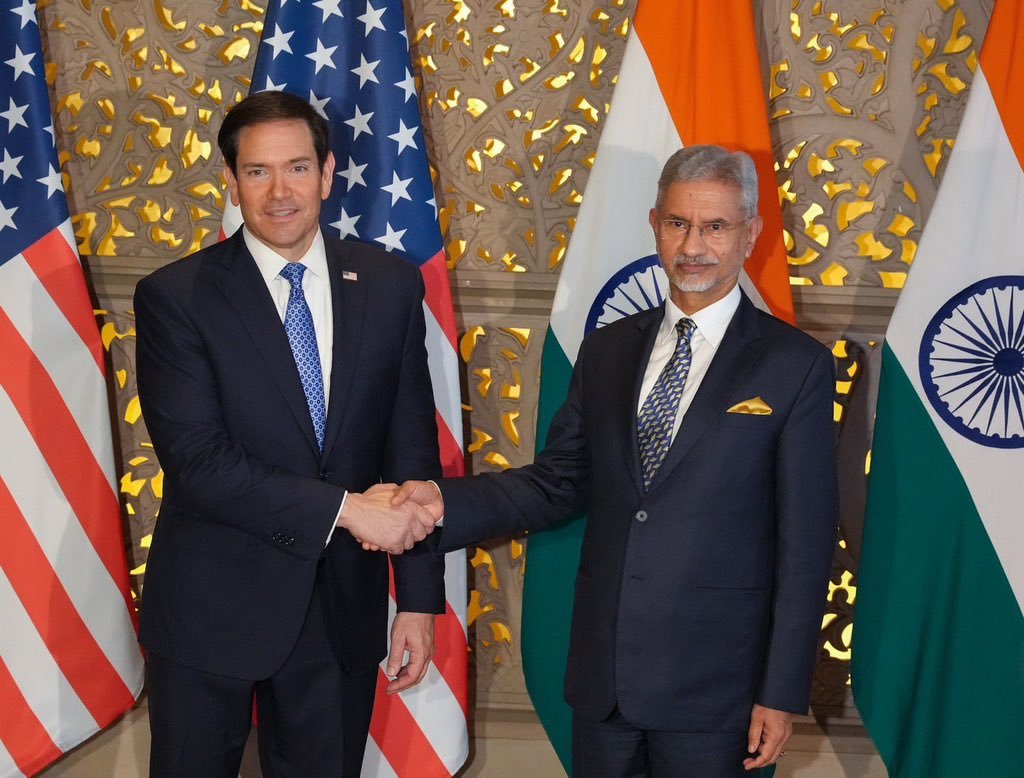
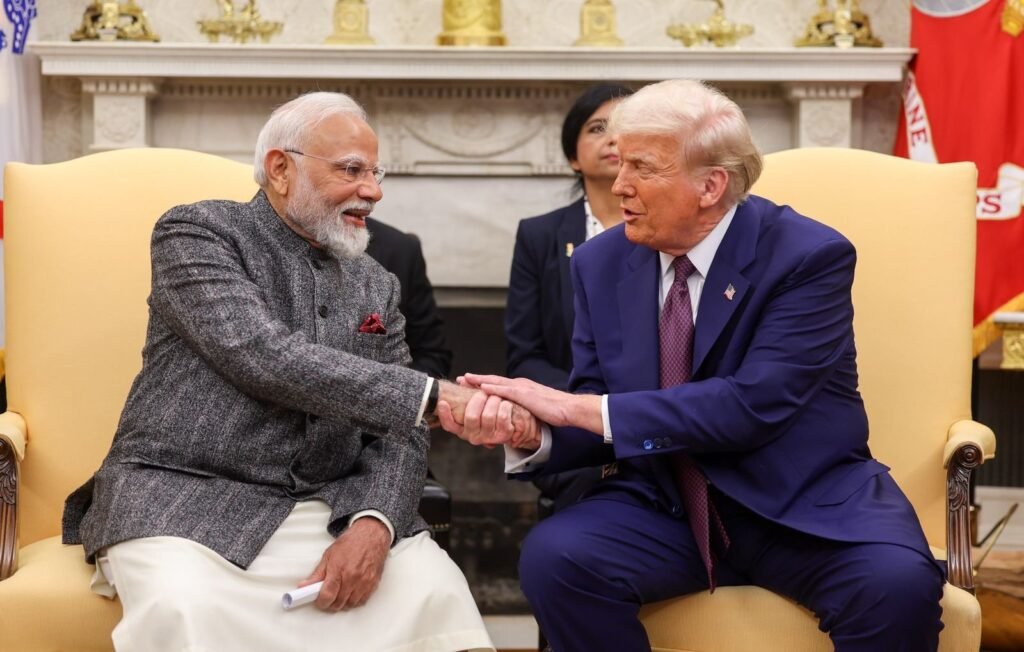
The trade relationship between the world’s largest democracy and its wealthiest nation has rarely been so volatile — or so consequential. As senior negotiators from Washington and New Delhi sit across from each other again this week in Lutyens’ Delhi, the stakes extend far beyond tariff schedules. They encompass energy security, semiconductor supply chains, defense technology, and the architectural question of whose economic orbit India ultimately inhabits.
The relationship has transformed in the last few months as the numbers bear evidence. To understand where the relationship stands today, it helps to understand how radically it has shifted in just a few years.
Total U.S.-India goods and services trade stood at roughly $212 billion in 2024, up 8.3% from 2023 — a record for the partnership. That figure represents a striking acceleration from the pre-pandemic baseline: bilateral goods trade was approximately $88 billion in 2019. By the end of the first Biden term, the partnership had deepened meaningfully through technology and defense frameworks, and both sides had resolved several long-standing World Trade Organization disputes.
Then came Liberation Day. On April 5, 2025, the U.S. imposed a universal 10% base tariff on all countries. Four days later, on April 9, a 26% reciprocal tariff specifically targeted most Indian goods. Washington’s complaint was not new — India’s average applied tariff rate sits at 17%, among the highest of the world’s largest economies, compared to a U.S. average of just 3.3%. On agricultural products specifically, India’s average tariff runs at 39% against America’s 5%.
Advertisement
But the tariff spiral did not stop there. On July 30, 2025, President Trump announced a 25% tariff on all Indian goods effective August 1, along with an additional penalty for India’s continued purchase of Russian oil and military equipment. By August 6, Trump had escalated further — an extra 25% penalty “for India’s continued Russian oil imports.” By late 2025, some Indian export categories faced effective combined duties approaching 50%.
The collateral damage was swift. India’s $87 billion in U.S.-directed exports — equivalent to roughly 2.5% of India’s GDP — came under direct threat. Industry estimates suggest a $4–5 billion drop in engineering exports alone, with projections that overall GDP growth could decline 0.2–0.5%.
The impact is easiest to read through India’s flagship export industries. Lets see what India has lost sector by sector.
Pharmaceuticals had long been a rare success story insulated from political friction. India’s pharmaceutical exports to the U.S. reached over $10.5 billion for the year ended March 2025, accounting for nearly 35% of total sector shipments. Indian generic drug manufacturers supply a substantial share of the medicines Americans take daily.
When Trump suggested in early 2025 that pharmaceuticals — initially carved out from reciprocal tariffs — would soon face “major” sector-specific duties, Indian pharma stocks fell sharply. The uncertainty alone disrupted long-term investment decisions.
Gems and jewellery took an earlier hit. Pearls, precious stones, and metals constituted $9.15 billion of India’s exports to the U.S. in 2024, making the sector one of the single largest categories. The industry is highly concentrated geographically in Gujarat and Maharashtra, employing millions in cutting, polishing, and setting operations. Tariff escalation through 2025 squeezed margins and diverted some orders toward competitors in Israel and Southeast Asia.
Engineering goods bore the heaviest absolute burden. India exported approximately $19.16 billion in engineering goods to the United States in the year ended March 2025. Steel-based products already faced separate 50% sectoral tariffs — a structural disadvantage against Mexico and Vietnam, which secured more favorable terms in their own negotiations with Washington.
The competitive damage is measurable in relative terms. Vietnam saw its tariffs reduced to 20% from 46%, Thailand to 19% from 36%, Bangladesh to 20% from 35%, and Cambodia to 19% from 36% — meaning that even as India negotiated, its rivals were locking in structural advantages that will take years to reverse.
No issue is more politically charged — or more economically rational from India’s perspective — than the question of Russian crude. The russian variable has benefitted India greatly in conserving foreign exchange as it jumps from 2% to 37%.
Before Russia’s invasion of Ukraine in February 2022, Russian oil accounted for roughly 1% of India’s crude imports. By 2024, that share had risen to 36%, while the combined share of traditional Middle Eastern suppliers — Iraq, Saudi Arabia, and the UAE — fell from 63% to 46%.
Russia’s share of India’s oil imports averaged around one-third of total intake through 2024 and 2025, with Russian oil imports running at approximately 1.7 million barrels per day, allowing Indian refiners to maintain strong margins. The economics are straightforward: discounted Russian crude lowered India’s import bill, suppressed domestic inflation, and gave Indian manufacturers a quiet cost advantage.
India’s crude oil imports from Russia reached $52.73 billion in 2024 — a figure that dwarfs many bilateral trade relationships entirely. Washington views this as implicitly subsidizing Moscow’s war machine. New Delhi views it as elementary energy economics.
Some modest adjustment has begun. After U.S. sanctions targeted Russian oil majors Rosneft and Lukoil in November 2025, Indian refiners including Reliance Industries and Mangalore Refinery began halting purchases from those specific suppliers, and Russia’s share of India’s import mix started declining between December 2025 and February 2026. But this reflects sanctions compliance more than strategic realignment. India is unlikely to abandon discounted Russian crude entirely — and both sides know it.
The February pivot left a lot of issues unresolved. But the actual breakthrough came in February 2026, when both governments stepped back from the escalatory spiral. Washington agreed to reduce tariffs on many Indian products toward an 18% baseline. India agreed to consider lower duties on selected American industrial and agricultural goods. The joint framework set a formal $500 billion bilateral trade target by 2030 — more than doubling the 2024 baseline of $212 billion.
U.S. goods imports from India had already reached $103.8 billion in 2025, up 18.9% from 2024, even as tariff tensions escalated — a sign of the underlying economic gravity pulling the two nations together regardless of political friction. The U.S. goods trade deficit with India grew to $58.2 billion in 2025, a 27.1% increase over 2024. Ironically, the tariff pressure has so far not reduced America’s trade deficit with India — the original political motivation for the punitive measures.
Yet the February framework was, by every account, a skeleton. The difficult architecture remains unbuilt. Agricultural market access, digital trade rules, rules of origin, and the precise terms of energy commitments remain contested. Even U.S. officials have acknowledged significant gaps heading into the June talks.
What is the strategic geometry beneath the numbers? The June negotiations are not primarily about import duties. They are about which economic bloc India anchors itself to as the global economy bifurcates into competing supply-chain architectures.
Washington’s objective is threefold: pull Indian energy policy away from Moscow, integrate India into trusted semiconductor and advanced manufacturing supply chains as a counterweight to China, and open India’s market to American agricultural and industrial exports. India’s average applied tariff — nearly five times the U.S. average — has long been Washington’s most-cited grievance.
For New Delhi, the calculus is more layered. India’s semiconductor ambitions, military modernization programs — spanning surveillance drones, satellite systems, AI-enabled battlefield platforms — and aspirations in quantum computing all depend on access to American technology ecosystems. Despite the tariff environment, India’s Commerce Secretary noted that “India has held fort on U.S. exports despite tariffs,” with exports to the U.S. growing 22% year-on-year in November 2025 alone. That resilience gives New Delhi some negotiating confidence, but not unlimited leverage.
Here is the timeline of a turbulent trade relationship between US and India pre Trump and post Trump. The Biden era was different, the Trump era brought unprecedented challenges.
Pre-2022: Bilateral trade grows steadily from ~$88B. Russia supplies barely 2% of India’s oil. The relationship is warm but transactional.
February 2022: Russia invades Ukraine. Indian refiners begin buying discounted Russian crude. The energy relationship quietly transforms.
January–April 2025: Trump’s second term opens with tariff pressure. A 10% universal tariff in April is followed by a 26% India-specific reciprocal tariff. Modi and Trump nonetheless announce the $500B bilateral trade goal.
July–August 2025: The most punitive phase. A 25% blanket tariff is layered with an additional penalty linked to Russian oil purchases. Some Indian goods face effective duties near 50%.
November 2025: U.S. sanctions on Rosneft and Lukoil begin shifting Indian refinery sourcing. Russia’s share of Indian oil imports starts, incrementally, to decline.
February 2026: Both sides pull back. Tariffs partially reset toward 18%. A framework is agreed. The hard negotiations begin.
June 1, 2026: Talks resume in New Delhi with the interim deal and the broader BTA both unresolved.
So what does the road to the magical $500 billion require in concrete terms? Reaching $500 billion by 2030 from a $212 billion base in 2024 would require compounded annual growth of roughly 15% over six years — nearly double the pace of recent years. It is an ambitious number, reflecting political aspiration as much as economic projection.
The most probable outcome of the current talks is not a comprehensive agreement but a pragmatic interim compact: tariff stabilization at 18% for Indian exports, incremental Indian concessions on agricultural and industrial goods, and a gradual diversification of energy sources that lets both governments claim partial victory. The semiconductor and defense technology cooperation provisions may prove to be the durable core of any deal — the layer that survives political cycles on both sides.
What neither government can fully control is the broader geopolitical environment. A shift in the Russia-Ukraine conflict, a new escalation with China, or a change in domestic political pressures in either Washington or New Delhi could redraw the negotiating map overnight.
For now, the negotiators in New Delhi are working against a clock set by both economics and geopolitics. The $500 billion number is a target. Whether it becomes a reality depends on decisions being made, sector by sector, in rooms that the public rarely sees — but whose outcomes will shape the Indo-Pacific economic order for a generation.
(Analysis based on references and stats from USTR, CNBC, PRINT, Trading Economics, and Al Jazeera.)
Disclaimer: The opinions and views expressed in this article/column are those of the author(s) and do not necessarily reflect the views or positions of South Asian Herald.