
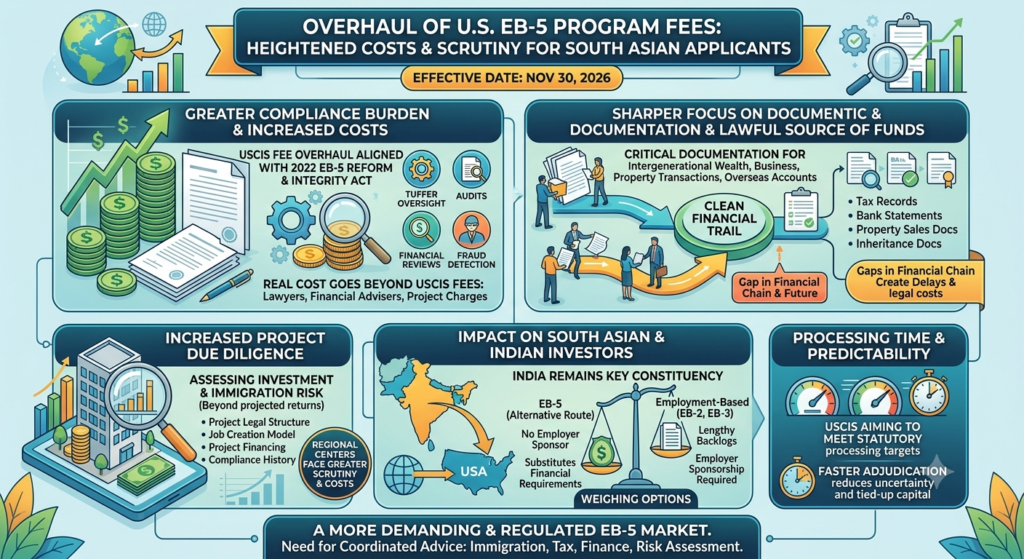
The U.S. government’s planned overhaul of fees for the EB-5 immigrant investor program is set to raise the cost of navigating an already complex investment-based route to permanent residence, with South Asian applicants likely to face a sharper focus on documentation, compliance and the overall cost of securing a U.S. green card.
The revised fee structure is scheduled to take effect on Nov. 30, 2026, as part of the Department of Homeland Security’s effort to align EB-5 charges with the cost of administering the program and the tougher oversight requirements imposed by Congress in the 2022 EB-5 Reform and Integrity Act.
For investors from India, China, Vietnam and other South Asian and Asian markets, the significance of the changes extends beyond the filing fee itself. The program increasingly requires investors to treat the immigration process as a regulated financial transaction, with greater scrutiny of the source of funds, investment structures, job creation and the activities of regional centers and project sponsors.
That could make the ability to produce a clean financial trail almost as important as the ability to raise the required investment capital.
Advertisement
Higher compliance burden
The EB-5 program allows qualifying foreign investors to seek permanent residence after investing in eligible U.S. commercial enterprises and meeting job-creation requirements. The 2022 law substantially strengthened government oversight following years of concerns about fraud, regional-center compliance and the use of investor capital.
USCIS is expected to use the additional resources generated through the fee structure for petition adjudication, financial reviews, background checks, audits, site visits and fraud detection.
For South Asian families, particularly those whose investment funds have accumulated across several generations, businesses, property transactions or overseas accounts, the documentation requirement could become a critical part of the process.
A straightforward transfer of money from one bank account to another is rarely the whole story in an EB-5 case. Applicants may need to establish how wealth was accumulated and demonstrate the lawful source and path of funds through tax records, bank statements, property-sale documents, business records, inheritance documentation and other evidence.
The greater emphasis on program integrity means that gaps in that financial chain could create more work, additional legal expense or delays.
India remains a key constituency
Indian applicants have become an important part of the U.S. employment-based immigration system, although the EB-5 program operates differently from employment-based categories such as EB-2 and EB-3.
For affluent Indian families, EB-5 can offer something that employment-based immigration often cannot: an immigration route that does not depend on a U.S. employer sponsoring the principal applicant.
That distinction could become more relevant as Indian professionals confront lengthy employment-based green-card backlogs and uncertainty over employer-sponsored immigration policies.
The EB-5 route, however, substitutes financial and investment requirements for employment sponsorship. The investment itself must qualify, the source of funds must be established and the project must satisfy the program’s requirements.
The new fee structure therefore comes at a time when some Indian families may be weighing EB-5 against other employment- and family-based immigration options.
The real cost goes beyond USCIS fees
The immediate effect of the new structure will be measured in dollars, but the broader financial impact on South Asian investors is likely to be considerably larger.
An EB-5 applicant generally has to consider the qualifying investment alongside government filing fees, immigration lawyers, financial advisers, project-related charges and other transaction costs. Where documentation is complicated, professional fees can rise further.
That means even a relatively modest increase in USCIS fees can have a disproportionate effect on applicants who require extensive documentation or multiple filings.
For investors comparing projects, the changes could also increase attention to the financial structure of regional-center offerings. The government’s stronger audit and oversight regime may encourage applicants to examine not merely projected returns, but also the legal structure, job-creation model, project financing and compliance history associated with an investment.
That is a significant shift in emphasis: the EB-5 decision is becoming less about finding a project that qualifies on paper and more about assessing the entire chain of investment and immigration risk.
Regional centers face greater scrutiny
The implications extend to U.S. developers and regional centers that depend on foreign capital, including projects marketed heavily in South Asian markets.
The 2022 law imposed additional integrity requirements on regional centers and strengthened USCIS oversight. The new fee framework is intended, in part, to finance that regulatory machinery.
For regional centers, higher compliance costs could eventually be reflected in administrative or project-related charges paid by investors. That makes transparency over fees and conflicts of interest increasingly important for prospective applicants.
For South Asian investors, this could encourage greater scrutiny of the distinction between the mandatory government charges and private fees imposed by lawyers, agents, promoters or investment projects.
Processing time will be crucial
The administration’s stated objective is not simply to collect more money but to give USCIS the resources needed to meet statutory processing targets.
That will be closely watched by South Asian applicants.
For a family committing a substantial amount of capital to an EB-5 project, the value of the program depends partly on the predictability of the immigration process. Faster adjudication could reduce uncertainty, while additional scrutiny without corresponding improvements in processing could increase the period during which investors have capital tied up and immigration plans remain unresolved.
The effectiveness of the fee increase will therefore ultimately be judged by what investors receive in return: clearer processing, stronger program integrity and more predictable administration.
A more demanding EB-5 market
The changes point towards an EB-5 market in which low-cost entry into a project is unlikely to be the only consideration.
South Asian investors are likely to face a more documentation-intensive process, while regional centers will have greater regulatory responsibilities. Lawyers and financial advisers will also have to prepare clients for deeper scrutiny of the origin and movement of investment funds.
For Indian applicants in particular, the program could remain attractive as an alternative immigration channel, but the decision will increasingly require coordination between immigration advice, tax documentation, financial due diligence and project-level risk assessment.
The Nov. 30 implementation date will therefore be more than a change in USCIS charges. It will mark another step in the transformation of EB-5 from a relatively investment-led immigration program into a more heavily supervised financial and immigration system.
For prospective South Asian investors, the practical question will not simply be how much more the government will charge, but whether the additional cost produces a system that is sufficiently transparent, rigorous and predictable to justify the investment and immigration risks involved.