Join WhatsApp Channel

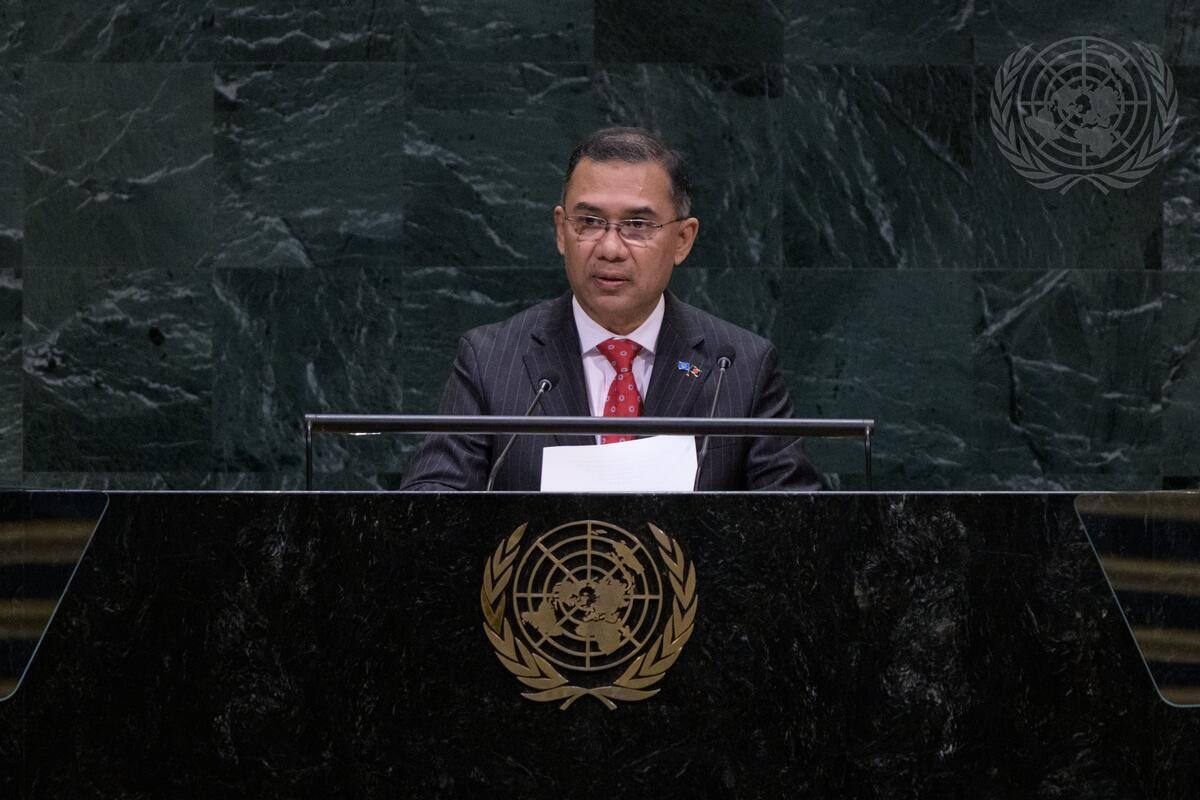
Bangladesh is free from what Prime Minister Tarique Rahman described as more than 15 years of “fascist rule and exploitation,” following a prolonged political struggle and the loss of thousands of lives.
Addressing the 81st session of the United Nations General Assembly (UNGA) on September 24, Rahman said his government is now focused on restoring democratic institutions, rebuilding the economy and creating opportunities for the country’s young people.
Rahman told world leaders in New York that voters had entrusted the Bangladesh Nationalist Party with governing the country in what he described as a free, fair and impartial national election on February 12, 2026.
“I congratulate the democracy-loving people of Bangladesh,” he said. “We believe that the people are the source of all our political power.”
The address held personal significance for Rahman. He recalled that his father, former President Ziaur Rahman, and his mother, former Prime Minister Khaleda Zia, had both spoken at the United Nations on behalf of Bangladesh. He said he was now appearing before the assembly to represent his country’s interests and express its hope for a peaceful international community.
Rahman’s account of Bangladesh’s political transition was central to his speech. He said the country had emerged in 2024 from a period marked by enforced disappearances, killings, abductions, corruption and money laundering. He described his government’s response as a three-part strategy of “Recovery, Restoration and Reconstruction.”
He said a state cannot grow strong while its citizens remain powerless. His government’s aim, he told the assembly, is to expand political and economic opportunity so that people can live safely and with equal rights, regardless of political affiliation, religion or ethnicity.
Rahman also called for diplomacy and cooperation amid wars, displacement and economic uncertainty. Conflicts, he said, are putting pressure on the global economy, while energy supply disruptions and inflation are worsening conditions for countries far from the fighting.
“We believe that every conflict should be resolved through dialogue, diplomatic processes and mutual cooperation,” he said. He urged countries to base their relations on equality, fairness, mutual interests and respect for sovereignty.
Rahman said Bangladesh regards the United Nations as central to building an international community grounded in those principles. He voiced concern that rising military spending in different parts of the world is drawing resources away from development. Bangladesh, he said, remains committed to disarmament, preventing nuclear proliferation and arms control.
He also reaffirmed Bangladesh’s support for Palestinian self-determination and an independent Palestinian state. On peacebuilding, Rahman pointed to Bangladesh’s role as vice chair of the UN Peacebuilding Commission and its continued contribution to UN peacekeeping missions. He highlighted the service of Bangladeshi women peacekeepers as part of the country’s commitment to the Women, Peace and Security agenda.
Migration and the Rohingya crisis formed another major part of the address. Rahman said migrants contribute to the economies of both their home countries and the countries where they work. Bangladesh supports regular, safe and orderly migration, he said, and wants stronger international cooperation to protect migrants’ rights and well-being.
For more than nine years, Bangladesh has sheltered more than 1.2 million Rohingya who fled Myanmar, Rahman said. Their presence has placed heavy pressure on local communities, public resources, the environment and security. He argued that the crisis originated in Myanmar and that a lasting solution depends on the safe return of displaced Rohingya to their homeland.
Until repatriation is possible, he urged the United Nations and other international partners to continue life-saving assistance. He also called for stronger international action to secure a durable resolution, warning that failure to deliver justice for the displaced population could deepen the humanitarian crisis.
On climate change, Rahman said Bangladesh is bearing severe consequences despite contributing little to global carbon emissions. He called for stronger commitments to climate justice, financing and adaptation support at COP31, while outlining measures his government says it is taking at home.
Those measures include a plan to plant 250 million trees over five years, expand the use of clean and solar energy, and excavate 20,000 kilometers of canals to address flooding and drought. Rahman said work had also begun on the Teesta Master Plan and the Padma Barrage project, which he linked to water conservation and efforts to increase freshwater flows into the Sundarbans.
Bangladesh has reaffirmed its commitment to cooperation on shared water resources by signing the 1992 Water Convention, he said. The government is also pursuing domestic measures to conserve water and prevent pollution.
Turning to the economy, Rahman said Bangladesh hopes to use its large working-age population to build a more skilled workforce. His government has begun programs aimed at expanding employment and developing the country as a manufacturing hub. He invited development partners to take part in that effort.
Rahman said the government had allocated $4 billion in the current fiscal year to support startup initiatives by young entrepreneurs, researchers and innovators. He also presented women’s economic participation as a priority, citing expanded access to financing for women in small and medium-sized industries and free education opportunities for women through the undergraduate level.
“We seek to ensure not only electoral democracy but also the democratization of the economy,” he said, describing a goal of making growth and prosperity accessible to families across the country.
The government has launched assistance programs for economically disadvantaged people through several social protection schemes, including the Family Card, Farmers’ Card, Sports Card and e-Health Card, Rahman said. The Family Card is issued in the name of a household’s female head, a design he described as a means of supporting women’s economic empowerment. The government also plans to integrate the various programs into a Universal Card.
Rahman linked those measures to the BNP’s 31-point election program. He said at least 73% of the program’s activities directly align with the UN Sustainable Development Goals, while another 27% align indirectly. He argued that implementation could help narrow disparities between urban and rural areas and advance accountability and inclusive development.
Education, health and sports are also priorities, Rahman said. He described the current education allocation as the largest in Bangladesh’s history and set out a goal of increasing education spending to 5% of gross domestic product within five years. The government is developing a curriculum that places greater emphasis on practical and technical skills alongside ethical values, he said.
According to Rahman, first-grade students are being provided with schoolbags, uniforms and free lunches. The government hopes the support will increase enrollment and improve learning. Sports has also been added to the education curriculum as a subject, he said, citing a nationwide school football tournament in June that drew more than 2 million students.
Rahman urged wider access to emerging technology, including artificial intelligence and biotechnology. Bangladesh’s young population and growing digital capabilities create opportunities, he said, but developing countries need affordable technology, research access, training and technology transfer to participate fully.
“We do not want today’s digital divide to become tomorrow’s artificial intelligence divide,” he said.
He called on the United Nations to develop an effective policy framework for the growth of artificial intelligence and social media. Bangladesh respects innovation and intellectual property, Rahman said, while maintaining that scientific advances should be accessible to countries with fewer resources.
As Bangladesh prepares to graduate from the UN’s list of least developed countries, Rahman said continued international support will be necessary. He identified financing, market access, technology transfer and capacity building as priorities for Bangladesh and other countries undergoing the transition.
Rahman closed by inviting domestic and foreign investment in what he described as a more stable and business-friendly Bangladesh. He said his government wants young people to be able to pursue their ambitions, women to lead with confidence and children to have the opportunity to reach their potential.
“Bangladesh First, Bangladesh for All,” he said, reaffirming his country’s commitment to the principles of the United Nations.
Related posts:
 Why Bangladesh’s Pivot Toward Türkiye Could Redefine South Asia’s Geopolitical Landscape
 Sheikh Hasina Says She Will Return to Bangladesh Despite Threats to Her Life
 Khalilur Rahman Assumes United Nations General Assembly Presidency
 Between Opportunity and Entrapment: Bangladesh Must Tread Carefully on the EU Partnership Deal