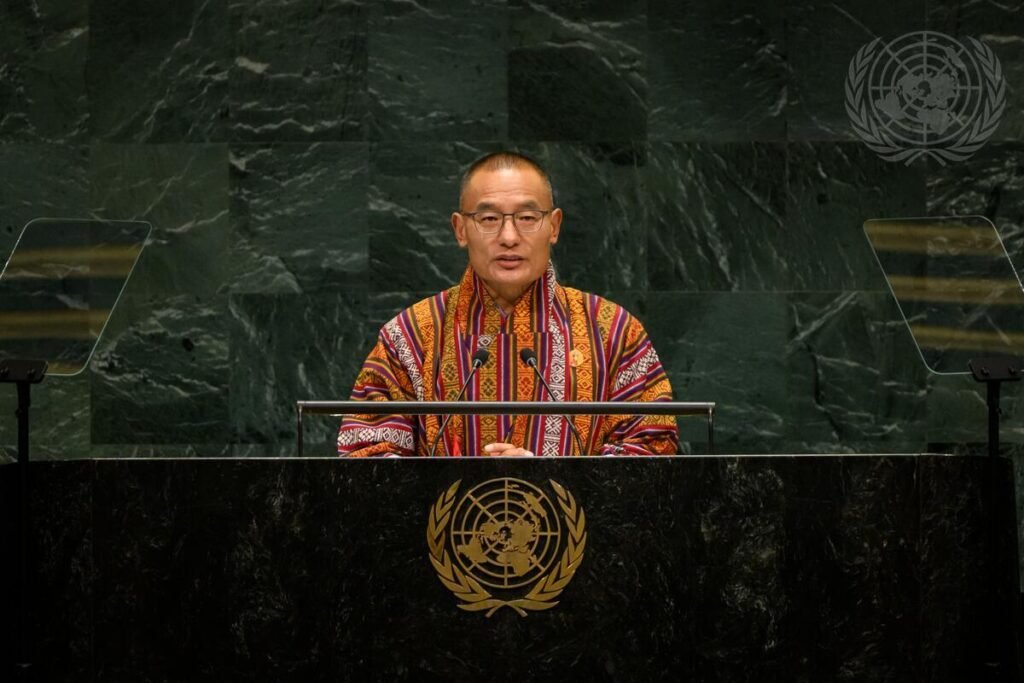
United Nations, New York: Prime Minister of Bhutan, Dasho Tshering Tobgay said Gelephu Mindfulness City, a planned Special Administrative Region (SAR) on Bhutan’s border with India, has the support of Indian Prime Minister Narendra Modi and the Indian government.
Addressing the 81st session of the United Nations General Assembly in New York on September 22, Tobgay presented India’s proximity and support as advantages for a project he hopes will attract international investment.
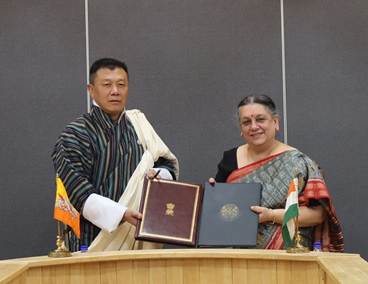
“GMC sits directly on the border with India, our closest friend and neighbor,” he said. “The vision enjoys the support of Prime Minister Narendra Modi, the Government of India and our neighbors across the border in Assam.”
Beyond the border, he said, lies the world’s most populous country and one of its largest, fastest-growing economies. He described GMC, as a potential gateway to South Asian and Southeast Asian markets.
Advertisement
“So GMC begins with what many new cities spend decades trying to acquire: access to vast and growing markets, connectivity and, in India, a trusted friend,” he said.
Tobgay used his UN address to invite governments, investors, entrepreneurs and companies to help develop the city. Conceived and spearheaded by Bhutan’s King Jigme Khesar Namgyel Wangchuck, GMC is intended to expand economic opportunities while protecting the country’s environment and cultural traditions, he said.
“I stand before you today not as Prime Minister, but as a salesman,” Tobgay said. “And I am not here to sell you a product. Or a policy. Or another declaration. I am here to sell you an idea.”
His invitation was direct: “Come and build it with us.”
Under its Royal Charter, GMC has autonomy over governance, legislation and the judiciary, according to Tobgay. The region covers more than 4,000 square kilometers, an area he said is more than five times the size of Singapore.
Tobgay said its greatest opportunity lies in the ability to design a city and its governing institutions from the ground up. Bhutan has studied legal principles, financial regulations and judicial practices used elsewhere, he said, seeking approaches it can adapt to provide businesses and investors with clarity and predictability.
“The principle is simple: Search the world for what works. Take the best. Adapt it. And make it work for GMC,” he said.
The Prime Minister tied the project to a challenge facing Bhutan: its small economy does not create enough opportunities for young people, many of whom leave to find work elsewhere. He said the country needs investment, technology and successful companies to give them reasons to stay or return.
“We cannot simply tell them to stay. We must give them a reason to stay, and a reason to return. Jobs. Opportunities. Enterprise. A future,” he said.
At the same time, Tobgay said Bhutan wants growth that preserves its forests, wildlife and culture. He described GMC as a place where businesses could benefit from clean energy and access to growing markets while employees could build their lives close to nature.
“The forests, rivers and wildlife of GMC are not obstacles to development. They are part of its value,” he said.
Tobgay said Bhutan is working to expand renewable energy capacity to 25 gigawatts by 2040. That power, he said, could support GMC and industries including advanced manufacturing, scientific research, artificial intelligence and data centers.
The city is also being developed as a global center for Vajrayana Buddhism, he said. Spiritual leaders are building monasteries, retreat centers, libraries and institutions of learning. Tobgay portrayed the presence of religious institutions alongside technology businesses as part of the city’s vision.
He told prospective partners that the project has moved beyond an idea. The Royal Charter is in force, laws have been enacted and regulators are operating, he said. GMC also has its own government, financial system and gold-backed digital currency, while a framework for an independent judiciary is in place.
Physical infrastructure is being built in stages, Tobgay said. An international airport is under construction, a connection to India’s rail network is being developed, and energy and digital infrastructure are being added as demand grows. He said artificial intelligence and data center projects are advancing and nearly $5 billion in projects are under active negotiation.
Tobgay compared GMC to a startup that already has land, clean energy, governing authority and access to nearby markets. It now needs partners willing to contribute capital, technology, talent and ideas, he said.
“Every startup needs one more critical ingredient. Co-founders,” he said.
He also sought to make clear that Bhutan wants investors to profit from the project. Those who join early could help establish industries and markets and share in the value they create, he said.
“We want you to make money,” Tobgay said. GMC, he added, is designed to use capitalism and technology without sacrificing nature, culture or human well-being.
The Prime Minister linked that approach to Bhutan’s philosophy of Gross National Happiness, saying it asks what economic growth is for. He said GMC seeks to apply that question to a modern city built through markets, technology and investment.
Closing his address, Tobgay called on potential partners to take part in shaping the project.
“Do not watch GMC being built. Come to Bhutan. Come to GMC. Help define the journey. Build it with us,” he said.