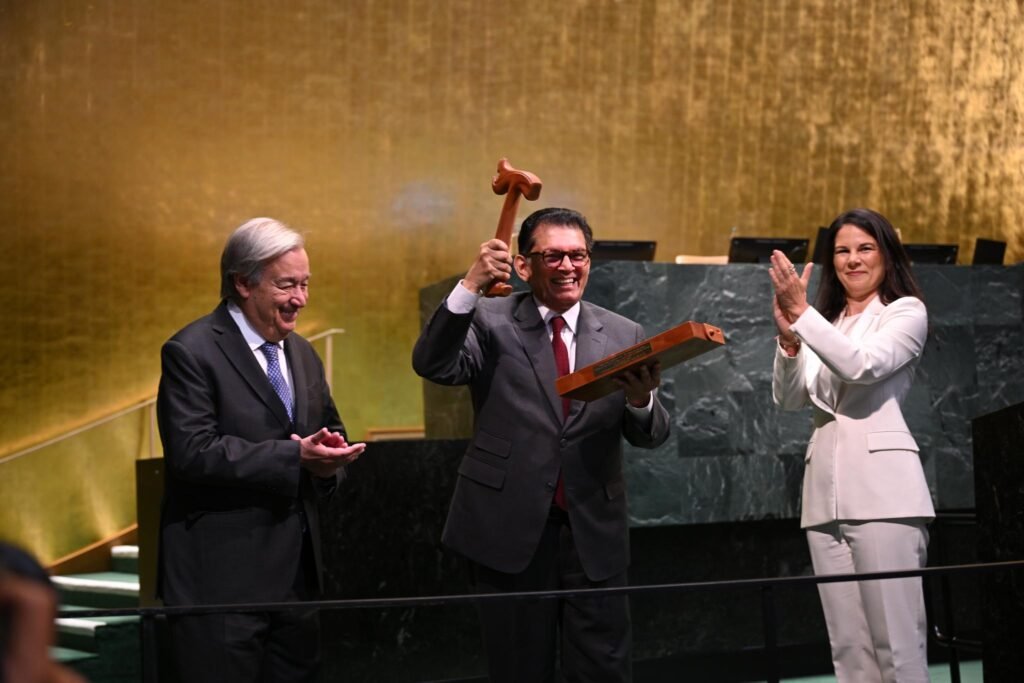
Khalilur Rahman assumed the presidency of the 81st session of the United Nations General Assembly (UNGA) on September 8, pledging to restore trust in multilateralism, advance institutional reforms and ensure that the United Nations delivers meaningful results for people worldwide.
“It’s a profound honor to stand before you as President of the General Assembly for its 81st session,” Rahman, who is currently serving as the Foreign Minister of Bangladesh, said in his inaugural address at UNGA.
He expressed gratitude to Prime Minister Tarique Rahman and the government of Bangladesh for nominating him to the “esteemed office,” and thanked member states for their trust and support.
“I will discharge my responsibilities to the best of my ability with fairness, independence, and integrity,” he said, while acknowledging his predecessor, Annalena Baerbock, who “shepherded” the Assembly through a challenging year.
Advertisement
“I thank her for the support afforded to me and my team throughout the transition. I assume this responsibility at a consequential moment for the organization,” he said.
As the United Nations enters its ninth decade, Rahman said its many accomplishments deserve recognition, particularly its role in preventing another global war.
“For more than eight decades, our organization has helped the world avoid plunging into a Third World War, arguably the very reason for its existence,” he said.
Rahman noted that the United Nations has helped shape the development visions of dozens of countries, most of which were not present when the organization was established in 1945. It has also brought emerging global challenges, ranging from climate change to the governance of artificial intelligence, to the forefront of member-state deliberations.
He highlighted the work of United Nations personnel who provide food to millions of people, including refugees and other displaced populations, while supporting peace and security, combating chronic diseases and helping countries address complex transboundary challenges.
Rahman described these professionals as the United Nations’ unsung heroes whose indispensable contributions rarely receive public attention, even though their impact is felt in communities around the world.
“It is in their tireless efforts that we see the best of the United Nations and the enduring value of multilateral cooperation. They deserve our full recognition,” he said. “At the same time, we must speak candidly about the grave challenges before us.”

Rahman acknowledged that the United Nations has often fallen short of expectations. Conflicts continue to cause immense human suffering, development gains remain fragile and the effects of climate change are intensifying, he said.
Together, these challenges have placed trust in multilateralism under “tremendous strain,” with a widening trust deficit testing confidence in international institutions and collective action.
“A deficit that we must close by working together through dialogue, renewed cooperation, and delivery,” he said. “Indeed, trust is the quiet force behind every understanding we reach, every agreement we sign, and every resolution we adopt, the understanding that each of us will shoulder our respective share of the burden.”
Rahman said the responsibility of member states is not merely to defend the United Nations but to strengthen it. He added that trust in multilateralism must be earned every day by honoring commitments and delivering results.
He pledged to work throughout the 81st session to rebuild confidence in the institution, a commitment reflected in the session’s theme, “Restoring Trust, Managing Transformation: A United Nations That Delivers for All.”
Rahman said restoring trust would require both effective delivery and meaningful reform. The United Nations must demonstrate through concrete results that it serves the 8 billion people in whose name it acts, he added.
He outlined six priorities for the General Assembly during the coming year: strengthening peace and security; accelerating sustainable development and ensuring that no country is left behind; advancing climate action, particularly adaptation and resilience; protecting human rights; ensuring that technological transformation benefits people everywhere; and restoring trust in multilateralism.
“In the days and weeks to come, I look forward to engaging with each of the main committees as we work to strengthen our organization and improve its financial stability. I appeal to every member state to pay its assessed contribution in full, on time, and without conditions,” he said.
Rahman emphasized that this appeal must be accompanied by an equally clear commitment to accountability. Resources entrusted to the United Nations come not only from the wealthiest countries but also represent the sacrifices, hopes and hard-earned contributions of ordinary people, including those living in the world’s poorest and most vulnerable communities, he said.
“We have a solemn duty to ensure that every single resource, every penny, is used responsibly, transparently, and effectively,” he said, adding that he would remind himself and his colleagues of that responsibility every day.
Rahman also pledged to deepen engagement with civil society, particularly young people, who make up most of the world’s population but have limited influence over decisions shaping their future.
“I will seek to deepen engagement with civil society, above all with young people, who make up the majority of humanity today, yet hold the smallest share of the decisions that shape their future, as well as with a range of other stakeholders, so that the United Nations draws more fully upon the ideas and experiences of the people it was created to serve,” he said.
Delivering on the six priorities would require member states to remain faithful to the values of the UN Charter while adapting the institution to a world profoundly different from that of 1945, Rahman said.
He stressed that the United Nations must remain fit for purpose and prepared for the future if it is to continue playing an indispensable role in a rapidly changing world. Its achievements should not become an excuse for complacency, while its shortcomings should not obscure its importance, he added.
“We must continually examine our work with honesty and humility, unhesitatingly identify the deficiencies, and relentlessly work together to enhance our capacity and efficiency so that our organization is able to credibly respond to the challenges of today and tomorrow,” he said.
Rahman recalled his commitment to ensuring that the Office of the President of the General Assembly reflects the diversity of the United Nations by being geographically balanced, gender-balanced and linguistically diverse.
“I promised that smaller and developing countries would have a dedicated voice and focused support within my office,” he said. “Today, I am proud to report to you that all these commitments have not merely been honored. In many cases, they have been exceeded.”
He said his office had been “deliberately” structured to be “representative, inclusive, and responsive,” emphasizing that a United Nations seeking to serve everyone must draw strength from its diversity.
“And because the concerns of small and developing countries must not be peripheral to our work, they must be heard, understood, and reflected at the center of our common agenda,” he said.
Rahman noted that women constitute 60 percent of his Cabinet, reflecting his commitment to recognizing the leadership and expertise women bring to the organization.
He also said he would be involved in the selection of the next UN Secretary-General.
“In the coming days, I will work with the presidents of the Security Council and with all of you to ensure this process remains fair, inclusive, and transparent, abiding fully by the existing rules and by Article 97 of the Charter, which is clear: The Secretary-General shall be appointed by the General Assembly upon the recommendation of the Security Council,” he said.
Rahman said he would approach the responsibility with the utmost “seriousness, impartiality, and openness,” while fully respecting the mandates of the Security Council and the General Assembly.
Rahman reiterated that trust cannot simply be requested but must be earned through action.
“It will be earned through the decisions we take, the commitments we honor, and, above all, the results we deliver for the people we serve. I’ll devote myself fully to this difficult and complex endeavor,” he said.