Join WhatsApp Channel

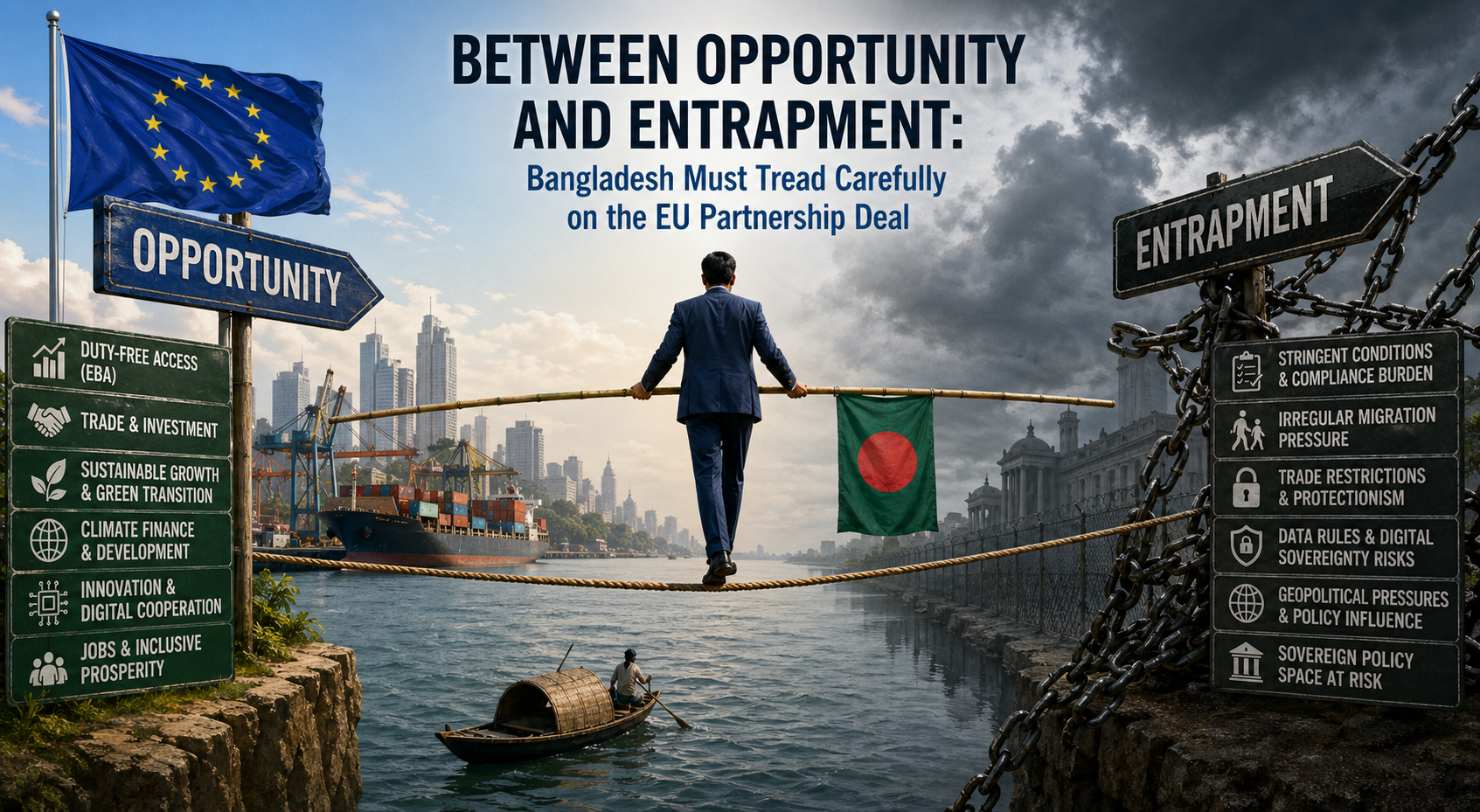
The Partnership and Cooperation Agreement recently signed between Bangladesh and the European Union has been widely celebrated as a landmark diplomatic achievement. After more than two decades, the 2001 EU-Bangladesh Cooperation Agreement is finally making way for a broader, more ambitious framework one that its proponents describe as a “comprehensive strategic partnership.” The fanfare is understandable. But beneath the diplomatic pageantry and the carefully worded press releases lies a set of questions that demand sober, unsentimental analysis. What does Bangladesh truly stand to gain? And more critically, what might it stand to lose?
The Legacy of 2001: A Deal That Delivered
To appreciate the significance of this transition, one must first acknowledge what the outgoing agreement accomplished. The 2001 Cooperation Agreement, built around the principles of development assistance and trade facilitation, served Bangladesh remarkably well. Under the Everything But Arms (EBA) provision, Bangladesh secured duty-free and quota-free access to the European single market — a privilege that proved transformative for the country’s export-oriented economy. Today, more than fifty percent of Bangladesh’s total export earnings originate from EU markets, a testament to just how deeply the two economies have become intertwined. The ready-made garments sector, which employs millions of workers the vast majority of them women owe much of its global competitiveness to the preferential access that the EBA framework provided.
Yet the world has changed dramatically since 2001. Climate change has moved from the margins to the center of international policy. Irregular migration has become a defining political issue across Europe. Energy security, maritime safety, and digital connectivity have emerged as critical areas of bilateral concern. The old agreement, apolitical by design, was simply not equipped to address these realities. In that narrow sense, the case for a new and expanded framework was not only logical but overdue.
A Deal That Goes Far Beyond Trade
The new Partnership and Cooperation Agreement ventures well beyond the familiar terrain of commerce and development. It introduces regular political dialogue, security cooperation, climate action, migration management, energy collaboration, and maritime affairs into the bilateral relationship. It also situates Bangladesh within the broader context of the EU’s Indo-Pacific strategy a geopolitical framework that has gained considerable momentum in Brussels in recent years.
Proponents argue that Bangladesh’s growing strategic importance warrants this elevation in the relationship. Geographically, Bangladesh occupies a position of considerable significance nestled between India and Myanmar, with direct access to the Bay of Bengal and the broader Indian Ocean region. As China continues to expand its footprint across South and Southeast Asia, Western powers have grown increasingly eager to draw Bangladesh into their strategic orbit. The new agreement, read carefully, reflects precisely that ambition. This is where the celebration must give way to caution.
The Geopolitical Trap: A Warning the World Has Seen Before
The current international order is defined by intensifying great-power rivalry. The United States and China are locked in a structural competition that shows no signs of abating. The war in Ukraine has deepened the fault lines between Russia and the West. Indo-Pacific alliances are being redrawn at a pace that leaves smaller nations scrambling to maintain their footing. In this environment, the old but dangerous dictum “if you are not with us, you are against us” has made an unmistakable return to the vocabulary of global diplomacy.
For a country like Bangladesh, choosing sides in this contest is not a strategic option it is a strategic liability. Bangladesh shares its borders with India, maintains deep economic ties with China, and depends on Western markets for the bulk of its export revenue. Navigating these overlapping relationships has always required dexterity. Committing to one geopolitical bloc, however subtly the commitment is framed, risks alienating the others with potentially severe consequences for trade, investment, and regional stability.
The controversy surrounding Bangladesh’s trade arrangement with the United States serves as a timely reminder of this vulnerability. When economic agreements carry geopolitical undertones, the fallout can extend far beyond the negotiating table. Bangladesh cannot afford to repeat that experience on a larger and more consequential scale.
National Interest Must Be the Compass
Any international agreement must ultimately be judged by a single standard: does it serve the national interest? For Bangladesh, the priorities at this moment in its development are clear. The country is navigating a complex transition away from its Least Developed Country (LDC) status, which will bring the loss of EBA trade preferences. It is grappling with the mounting costs of climate change, to which it contributes little but from which it suffers disproportionately. It is hosting over a million Rohingya refugees, whose prolonged presence strains public resources and tests regional diplomacy. And it is striving to attract the foreign direct investment necessary to sustain its economic momentum.
An expanded partnership with the EU can, in principle, address each of these concerns. European climate finance, technology transfer, support for a successor trade arrangement to EBA, and diplomatic pressure on Myanmar over the Rohingya crisis all of these are areas where deeper EU engagement could yield tangible benefits for Bangladesh. The problem arises not with the economic and developmental dimensions of the agreement, but with its strategic and security dimensions, which carry the potential to draw Dhaka into alignments it may later find difficult to exit.
What the Government Must Do: A Roadmap for Responsible Diplomacy
The interim government now faces one of the most consequential diplomatic tests in recent memory. How it handles the implementation and interpretation of this agreement will shape Bangladesh’s foreign policy posture for years to come.
The government must subject every clause of the agreement to rigorous legal and diplomatic scrutiny. The language of international treaties is rarely straightforward. Commitments that appear innocuous on paper can carry binding implications that only become apparent when invoked. Bangladesh must ensure that no provision of this agreement can be used to compromise its sovereignty, constrain its independent foreign policy, or obligate it to take positions on international disputes that do not serve its interests.
The foundational principle of Bangladesh’s foreign policy “friendship with all, malice towards none” must be reaffirmed not merely as a rhetorical posture but as an operational guide. Deepening ties with the EU must not come at the cost of Bangladesh’s relationships with China, India, Russia, or the ASEAN bloc. Each of these relationships carries its own strategic and economic weight. A foreign policy that tilts decisively in one direction invites retaliation from the other, and Bangladesh is too exposed economically and geographically to absorb such shocks. Participation in political dialogue and security consultations is not inherently problematic. But there is a meaningful and consequential difference between engaging in dialogue and committing to a strategic alliance. The government must draw that line clearly and hold it firmly, regardless of the diplomatic pressure it may face.
On the economic front, the government must use the momentum of this agreement to secure a concrete pathway for Bangladesh’s post-LDC trade relationship with the EU. Negotiations toward a Free Trade Agreement or access to the EU’s GSP+ scheme must be pursued with urgency and ambition. This is not merely a commercial priority it is a matter of economic survival for millions of workers whose livelihoods depend on continued access to European markets.
Climate diplomacy must be elevated to the highest levels of the bilateral agenda. Bangladesh is among the most climate-vulnerable nations on earth, yet it receives a fraction of the climate finance it needs to adapt to the changes already underway. The new agreement must be leveraged to secure binding commitments on climate funding, green technology transfer, and loss-and-damage compensation — not vague expressions of solidarity, but concrete, time-bound, and measurable commitments.
The Rohingya crisis, now entering its ninth year with no resolution in sight, must feature prominently in every high-level engagement with EU counterparts. Europe carries significant diplomatic weight in international forums and has the capacity to intensify pressure on Myanmar’s military regime. Bangladesh must insist that this leverage be used actively and consistently, not merely acknowledged in joint communiqués.
Finally, the government must resist the temptation to treat this agreement as an elite diplomatic exercise conducted behind closed doors. Parliament must be briefed comprehensively. Civil society must be given the opportunity to scrutinize the agreement’s implications. A deal of this magnitude one that touches on security, sovereignty, and the country’s long-term strategic orientation demands democratic accountability, not just diplomatic efficiency. When the stakes are this high, transparency is not a courtesy; it is a constitutional obligation.
A Test of Strategic Maturity
Bangladesh is not a great power. But it is not a passive bystander in international affairs either. Its location, its demographic weight, its economic trajectory, and its moral standing as a country that has absorbed one of the world’s largest refugee populations while continuing to pursue development give it a voice and a presence that should not be squandered in the service of someone else’s geopolitical agenda.
The EU partnership agreement, at its best, is an opportunity to deepen a relationship that has already delivered significant dividends for Bangladesh. At its worst, it is a vehicle through which external powers seek to incorporate Bangladesh into a strategic framework designed to serve their own interests in the Indo-Pacific. The difference between these two outcomes will be determined not by the text of the agreement, but by the wisdom, vigilance, and resolve with which Bangladesh’s leadership chooses to implement it.
Bangladesh is nobody’s pawn. It has its own dreams, its own priorities, and its own hard-won identity. The task before the government is to honor that identity to engage with the world on terms that reflect Bangladesh’s values and advance Bangladesh’s interests, without being swept into the vortex of great-power competition that has already destabilized so many smaller nations. In the turbulent geopolitics of our time, that is not merely a diplomatic challenge. It is a national imperative.
Disclaimer: The opinions and views expressed in this article/column are those of the author(s) and do not necessarily reflect the views or positions of South Asian Herald.
Related posts:
 Beyond a Courtesy Call: Paul Kapur’s Dhaka Visit and Bangladesh’s Rising Strategic Weight in South Asia
 India’s Expanding Defense Ties with Europe and Bangladesh’s Strategic Balancing in South Asia
 US, India Agree on Framework for Interim Trade Agreement, Set Path Toward Broader Bilateral Deal
 U.S. Seals Reciprocal Trade Agreement with Bangladesh, Slashes Tariffs to 19 Percent