Join WhatsApp Channel

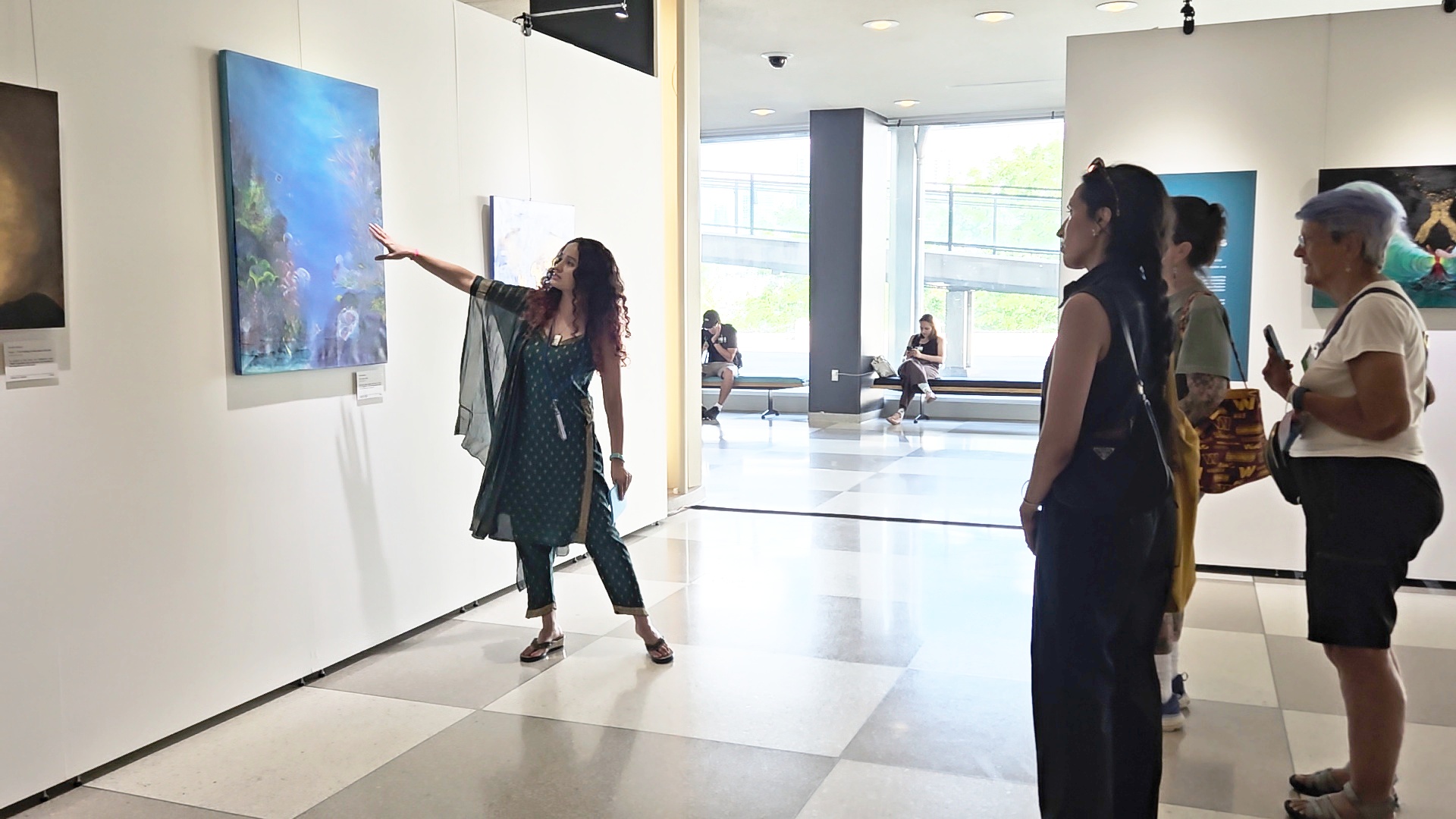
Namita Kulkarni, a self-taught artist based in Bengaluru, India, exhibited seven paintings from her series, “Colonialism and the Climate Crisis,” at the United Nations headquarters in New York from June 5 to July 15.
The series was featured as part of “Canvas of Change,” an exhibition organized by the New York-based human rights organization, the International Center for Advocates Against Discrimination (ICAAD).
“For this series, I thought of depicting the climate crisis as a human rights issue. Far too often, we see the climate crisis framed as a matter of carbon emissions that we can compensate or offset our way around. But the colonial dimensions of the climate crisis cannot be overlooked any longer,” Kulkarni told South Asian Herald.
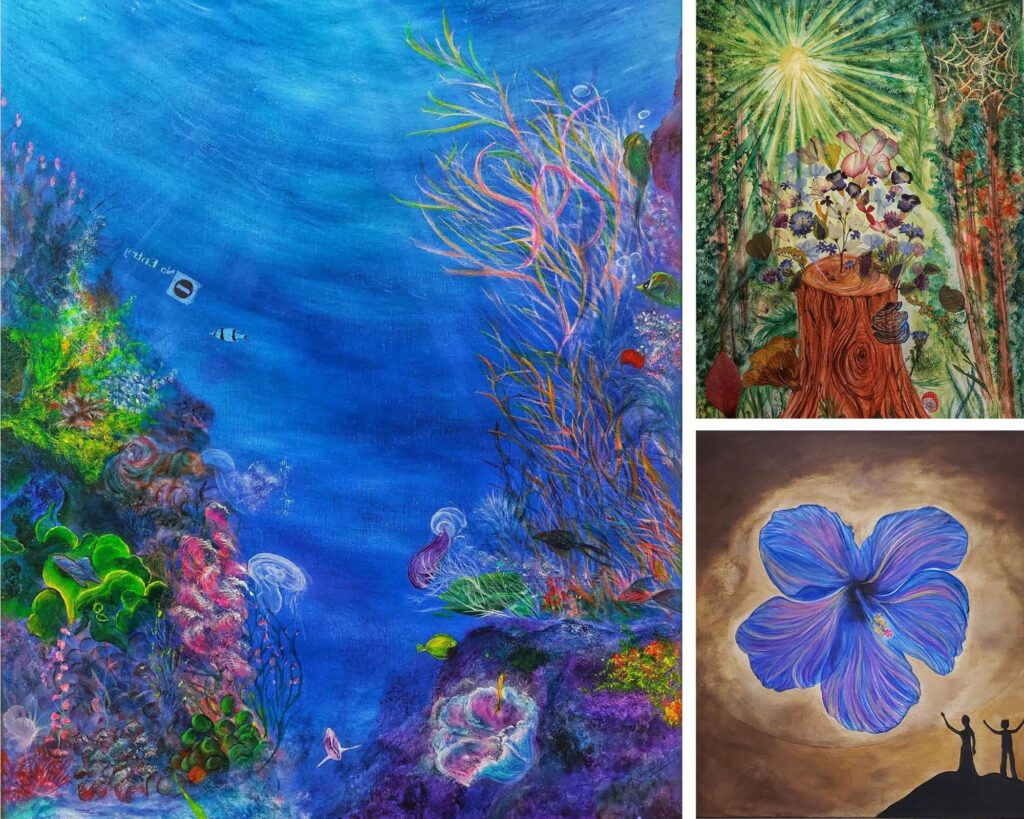
The seven works in the series are:
- Lake on Fire (acrylic on canvas)
- Woman Stands Shining (acrylic and gold leaf on canvas)
- Apocalypse as Collapse-Renewal (watercolor and pressed flowers on paper)
- Colonizer Crisis
- Bon Appétit (acrylic on canvas)
- Once Upon a Reef (acrylic on canvas)
- Yaaté: That Feeling of Awe about this Life
Kulkarni said the climate crisis must be understood within the broader context of both historical and ongoing colonization.
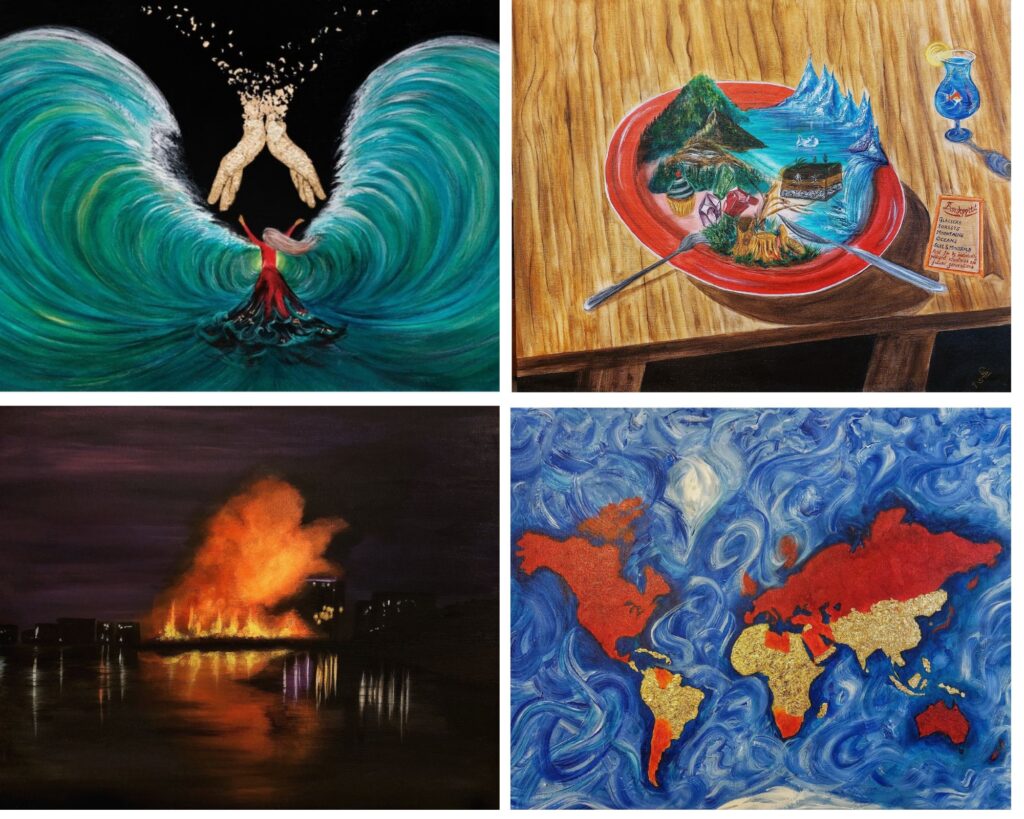
“I thought it would be interesting to create a series of paintings that make explicit the link between colonialism and the climate crisis, and also point to indigenous perspectives that dominant culture excludes,” she said. “I’m thankful to ICAAD for trusting me with this project and giving me the creative freedom and support I needed to execute all these ideas.”
Reflecting on the exhibition, Kulkarni said she had the opportunity to engage with visitors who offered their own interpretations of her work.
“I feel really fortunate and honored to have had seven of my paintings displayed at the main lobby gallery of the United Nations,” she said, noting that the exhibition was viewed by diplomats, UN staff, and representatives of organizations from around the world.
“It always surprises me the things people see in the art that I hadn’t thought of,” she said. She added that she met people working at the UN in various capacities, tourists visiting the headquarters, and attendees participating in meetings and events.
“We had many engaging discussions about the colonial dimensions of the climate crisis. And quite a few people told me they’d never thought of the climate crisis in this way before, with colonialism as the context from which it arises,” Kulkarni said. “June, an elderly lady who has always lived in New York, told me she really resonated with the messages in the art and that it brightened her day.”
Kulkarni also recalled meeting Anna Gollub, Economic Institutions Policy Analyst in the Economic Empowerment Section of the Policy Division at UN Women.
“She told me the Apocalypse painting drew her in because she’s been making music on a similar theme,” Kulkarni said.
During the exhibition, Kulkarni delivered three artist talks, discussing the inspiration behind the series and her creative process. She said the first session was attended by a group of young lawyers from the Center for Art Law in Brooklyn.
“I graduated in law many years ago, so it was great talking to them about the art as well,” Kulkarni said. She added that she especially enjoyed watching visitors spend time with the paintings, noticing their details and taking photographs alongside them.
“To me, art is a verb, so it felt great to see my paintings find a wide and varied audience at the UN.”
Kulkarni said the project began after she applied for an ICAAD grant in December 2021, having seen the organization’s call on Facebook for artists to create work focused on human rights.
“I had been thinking and reading about colonialism as the cause of the climate crisis,” she said.
She noted that a few months after she began working on the series, the Sixth Assessment Report of the Intergovernmental Panel on Climate Change (IPCC), published in April 2022, identified colonialism as a historical and ongoing driver of the climate crisis.
Kulkarni added that the same series was previously exhibited for more than a month at Bangalore Creative Circus in November 2022. It was later showcased at an ICAAD fundraising event in Manhattan in December 2025, where several paintings were auctioned live by a Sotheby’s auctioneer.
“ICAAD’s Artivism program seeks to surface issues artists themselves are concerned about within their communities. Artists have a unique ability to tap into collective imagination, often helping to chart a course for a better future. Canvas of Change asks visitors to sit with the connections between colonialism, climate, displacement, and resilience,” said Jaspreet K. Singh, co-founder of ICAAD.
According to Singh, Kulkarni’s work serves as a starting point for that exploration, “tracing how colonial over-extraction set the climate crisis in motion,” while making the case for a different relationship with the planet, one rooted in “reverence rather than consumption.”
Related posts:
 “Queenissima” Shines at Art Basel 2025 With Bold Eco-Fashion and Wearable Art Movement
 Indian Artist Natasha Sachdeva’s Watercolor Exhibition Opens at IA&A at Hillyer in Washington DC
 A Moving Museum: The Aircraft Carrying India’s Stories Across Borders
 Bay Area Artist Reimagines Ramayan Through Visual Storytelling