Join WhatsApp Channel

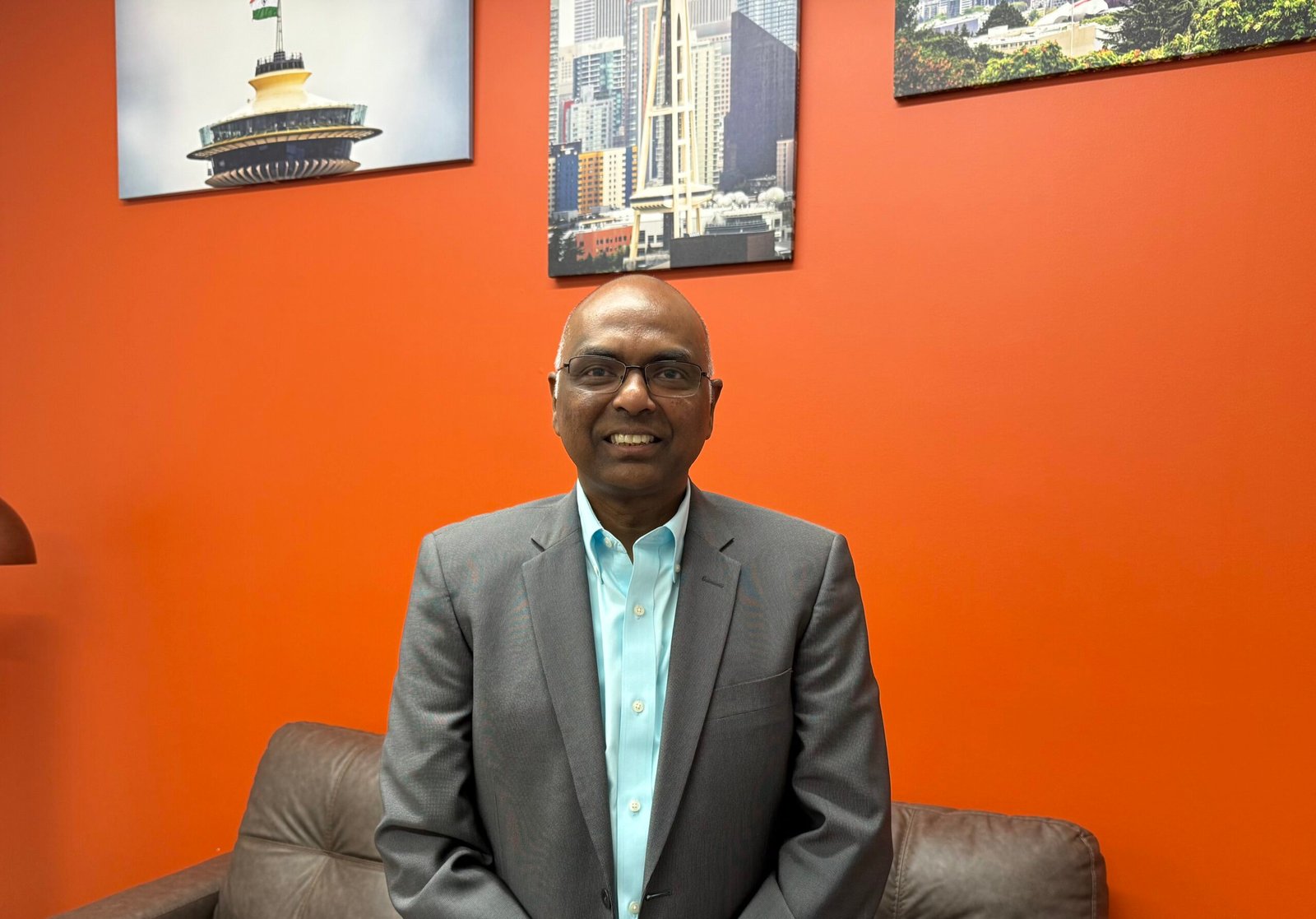
Seattle, Washington: Taraknath Woddi, Ph.D., CEO and co-founder of Anicca Data Science Solutions, has described technology cooperation between India and the United States as a permanent “Indian marriage” driven by mutual dependence and shared impact, with no room for “divorce.”
“We have to make it work. A household has to run. Tech is the one that is going to create the most impact. I call it both downstairs and upstairs,” Woddi told South Asian Herald in an exclusive interview on September 17, 2026, at the Consulate General of India in Seattle.
He described “downstairs” as the basic needs of the population, including food security, energy and clean water, all of which require technological solutions. “Upstairs,” he said, refers to advanced engineering and manufacturing, where technology is equally important.
Woddi said the United States relies heavily on the Indian diaspora to develop critical technologies at companies such as Microsoft and Google.
“The U.S. has a hefty dependence on the human resources of India’s diaspora in developing technology. It cannot be separated out. You cannot separate Microsoft and Satya, Sundar and Google. That won’t even work,” he said, referring to Microsoft Chairman and CEO Satya Nadella and Alphabet and Google CEO Sundar Pichai.
Woddi also praised Indian American entrepreneurs in the Seattle area for contributing to philanthropy, technological development and job creation. He credited Consul General of India in Seattle Prakash Gupta and Indian Ambassador to the United States Vinay Kwatra with strengthening engagement in the region.
“Their bet on Seattle is working out,” he said.
Discussing India’s technological advancement, Woddi said, “India is there and catching up.”
He placed India’s development within a broader historical cycle, noting that countries have experienced periods of economic leadership at different times. He cited China’s rapid expansion as an example, saying the country maintained economic growth of about 9 percent for three decades.
“You have to grow faster while meeting the needs of the people,” he said.
Woddi identified satellite manufacturing as one area in which India must significantly expand its capacity. He estimated that establishing a comprehensive global network for communication, navigation and surveillance could require between 80,000 and 88,000 satellites.
By comparison, he said, leading U.S. companies can produce or launch thousands of satellites annually, while India’s current capacity remains limited. Although the Indian Space Research Organisation has operated efficiently, he said India needs greater private-sector participation in building geostationary Earth orbit and medium Earth orbit satellites.
“There should be three companies today building GEO and MEO satellites. That’s what we want to see,” he said.
Asked whether India could achieve its goal of becoming a developed country by 2047, Woddi said, “Yes, it will be,” while cautioning that there is no “smooth sailing to success.”
He said economic and technological transformation would inevitably involve challenges and require successive generations to assume greater responsibility. India, he added, must identify and address problems proactively rather than wait for circumstances to dictate its priorities.
Quoting his grandfather, Woddi said, “If you do not pick your own problems, God will pick them for you, and you do not know what will come your way.”
“Start picking problems and solve them, and that’s how we will go to 2047,” he added.
Woddi said India must increase its reliance on nuclear power to meet its growing energy needs. He proposed allowing corporations to develop end-to-end energy systems, including small modular reactors, instead of depending entirely on the government for power infrastructure.
Meeting India’s projected energy requirements will require major changes in power generation and distribution, he said. Data centers alone could require between 100 and 120 gigawatts of nuclear power as the country’s overall demand approaches 900 gigawatts.
Woddi advocated for the development of 20-megawatt Bharat Small Reactors and an integrated model in which corporations build and operate their own power and water facilities.
“How much renewable energy can you put in? You cannot put in enough wind and enough solar. You cannot burn enough coal. The path is nuclear, and then go for thorium breeders,” he said. “Thorium breeders are the ones that will get the thorium cycle in action, and that cannot be done in a fast reactor. It has to be done in thermal reactors.”
He also emphasized the importance of helping the public understand the need for emerging technologies. Referring to the late Apple co-founder Steve Jobs, Woddi said, “The customer doesn’t know what he wants. When the touchscreen came, they wanted buttons. You have to teach the customer what they want. So, you have to teach the population what is the right thing.”
On digital transformation and artificial intelligence, Woddi discussed a potential collaboration with Rail Vikas Nigam Limited to create an integrated travel platform for Indian Railways similar to Expedia. The proposed system could use AI-powered voice commands to help older adults and people with disabilities manage travel itineraries and navigate digital services.
“The older population doesn’t use UPI promptly. I have seen that,” he said.
He also cautioned against government investment in data centers without clearly defined uses. According to Woddi, between 20 and 25 percent of India’s existing data center capacity remains unused because of a shortage of applications.
He said organizations such as the Defence Research and Development Organisation, Bharat Electronics Limited and the Steel Authority of India should first identify their hardware and software requirements.
India should require its industries and corporations to demonstrate which applications they intend to operate before the government supports additional infrastructure, he said.
“‘I will help you put together a data center’ should be the government’s response,” Woddi said. “The government should not put a penny into data centers until a corporation comes and says it has a model to run.”
Woddi maintained that data centers should be developed around clearly identified applications rather than built solely to expand hardware capacity. More broadly, he said India’s ability to advance in technology will depend on scaling its satellite, energy and digital ecosystems through focused public policy and greater private-sector involvement.
Woddi said his company was founded on the principles of collaboration, shared ownership and coexistence. “I built the company Anicca with the idea of building through collaboration, where there is co-ownership and coexistence. That’s the philosophy I want to push,” he said.