Join WhatsApp Channel

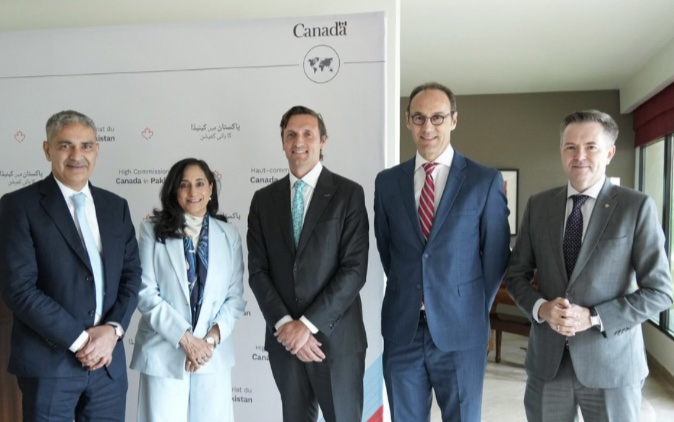
Canada’s Minister of Foreign Affairs, Anita Indira Anand, has concluded what Canadian officials described as a brief and “successful” visit to Pakistan before departing for Manila to participate in the ASEAN Foreign Ministers’ Meeting.
Anand is the first Canadian foreign minister of Indian descent to visit Pakistan. According to an official Canadian statement, the visit was aimed at deepening bilateral ties and strengthening trade and investment between Canada and Pakistan.
Minister Anand expressed her appreciation for Pakistan’s warm reception and generous hospitality and said she looked forward to continuing to strengthen the Canada-Pakistan bilateral and trade relationship.
Meanwhile, India’s External Affairs Minister S. Jaishankar is also traveling to Manila for the ASEAN summit.
“On the margins of the ASEAN-related meetings, the Minister of External Affairs will be participating in a Quad foreign ministers’ meeting with his counterparts from Australia, Japan and the United States. He is also expected to hold bilateral meetings with his counterparts from participating countries,” the Government of India said in a statement.
While the Indian government did not indicate whether Jaishankar would meet his Canadian counterpart, Anand, the ASEAN meetings are expected to provide an opportunity for bilateral engagements on the sidelines of the summit.
Jaishankar and Anand have met on several occasions in recent months, using multilateral forums to discuss geopolitical developments and Canada-India relations.
Anand’s visit marked the first trip by a Canadian foreign minister to Pakistan in nearly two decades. During the visit, she met with Pakistan’s Deputy Prime Minister and Foreign Minister Mohammad Ishaq Dar, Prime Minister Shehbaz Sharif, and Interior Minister Mohsin Naqvi to discuss areas of mutual interest.
The two sides underscored the importance of predictable market access and reliable agricultural trade to support food security. Anand welcomed progress in negotiations toward a Canada-Pakistan Foreign Investment Promotion and Protection Agreement and expressed hope that the talks would conclude at the earliest opportunity.
On behalf of Canada’s Minister of Agriculture and Agri-Food, Heath MacDonald, and the Canadian Food Inspection Agency, Anand signed an agreement allowing Canada to export canola seeds for food, feed, and processing to Pakistan. The agreement follows the completion of a negotiated protocol on phytosanitary import requirements between Pakistan’s Ministry of National Food Security and Research and the Canadian Food Inspection Agency. Canadian officials said the protocol will provide greater predictability for Canadian canola exports and further facilitate trade for growers.
Anand and Dar also agreed to encourage greater investment in Pakistan’s clean energy sector, particularly in power generation and renewable energy solutions for industry, including solar, wind, and battery storage technologies. Anand noted that Canadian company JCM Power is expected to begin development of its 240-megawatt Dhabeji hybrid wind-solar project in partnership with Karachi Electric.
The ministers also agreed to strengthen cooperation on security, including counterterrorism and combating transnational organized crime. Anand announced more than $2.2 million in new Canadian funding to support Pakistan’s efforts through projects with INTERPOL, the United Nations Office on Drugs and Crime, and the Royal Canadian Mounted Police in partnership with the Jakarta Centre for Law Enforcement Cooperation.
Addressing the challenges posed by climate change and poverty, Anand also announced, on behalf of Secretary of State for International Development Randeep Sarai, $45 million in funding for three Canadian development assistance projects. The package includes $10 million to help restore access to education for children affected by flooding through the United Nations Development Programme, $15 million to strengthen climate resilience with the Aga Khan Foundation Canada, and $20 million to expand access to reproductive health services, including family planning, through the United Nations Population Fund.
Related posts:
 Anita Anand Visits Pakistan, Invites Dar to Canada Mining Conference
 Good Neighbors and Beyond: A SEHER Perspective
 Anita Anand to Visit India, Singapore, and China to Strengthen Canada’s Indo-Pacific Partnerships
 OFIC Urges Canada to Fast-Track CEPA Talks as British Columbia Trade Mission Arrives in India