 Join WhatsApp Channel

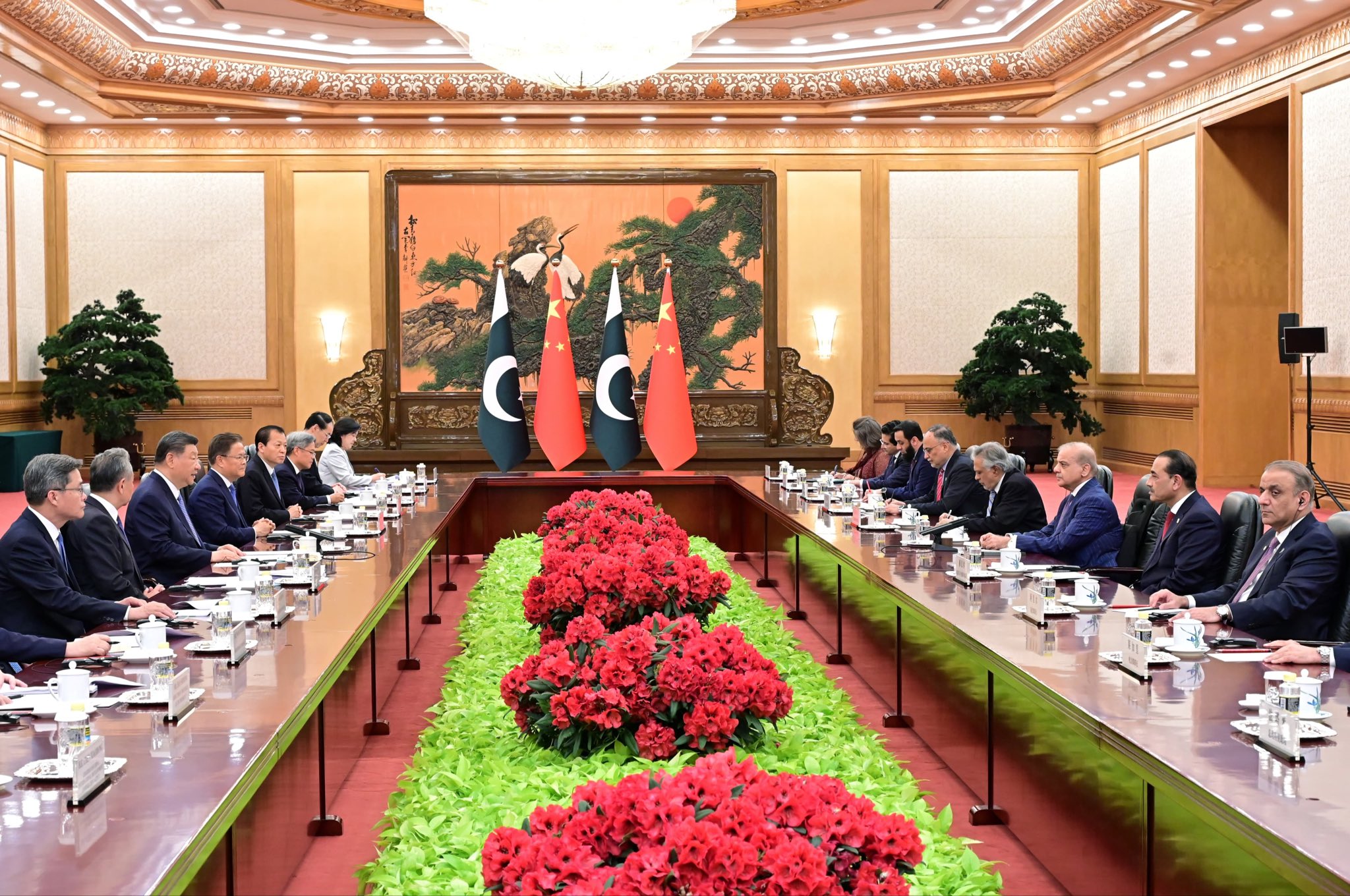
China and Pakistan have agreed on a new broad consensus to deepen their All-Weather Strategic Cooperative Partnership and accelerate the development of the China–Pakistan Economic Corridor (CPEC), including plans to transform Gwadar Port into a regional connectivity hub, according to a joint statement issued on Tuesday following Prime Minister Shehbaz Sharif’s visit to Beijing.
Sharif met both President Xi Jinping and Premier Li Qiang in Beijing, with the two sides issuing a wide-ranging joint statement that reinforced their “All-Weather Strategic Cooperative Partnership” and mapped out an ambitious agenda spanning infrastructure, minerals, digital economy, space, and regional security.
The joint statement mentions the “renewed push for CPEC 2.0, a higher-quality upgrade of the Belt and Road flagship corridor that links China’s western regions to Pakistan’s Arabian Sea coast.”
Both sides agreed to advance key infrastructure projects, including the phased and orderly realignment of the Karakoram Highway (Thakot–Raikot section), and to enhance the use of the Khunjerab Pass to strengthen land connectivity between the two countries. They also reiterated plans to fully leverage Gwadar Port’s potential as a regional trade and logistics hub, the statement said.
The two sides welcomed third-party participation in the development of CPEC under the model agreed upon by China and Pakistan. They also exchanged views on international and regional issues of mutual interest.
“The two leaders agreed to accelerate the building of an even closer China-Pakistan community with a shared future, and firmly support each other in safeguarding core interests, providing political guidance and strong impetus for bilateral relations,” the joint statement said.
The two sides agreed to steadily advance the Action Plan to Foster an Even Closer China-Pakistan Community with a Shared Future in the New Era, accelerate the development of CPEC 2.0, forge an upgraded bilateral free trade agreement, and explore cooperation in artificial intelligence, the digital economy, agriculture, and other fields.
Foreign Ministry spokesperson Mao Ning said the two sides signed multiple cooperation documents covering economy and trade, science and technology, agriculture and food, human resources, and other areas.
During the visit, the two sides held in-depth exchanges of views on international and regional issues of mutual interest. The Pakistani side expressed support for President Xi Jinping’s four propositions on the situation in the Middle East.
The Chinese side commended Pakistan for demonstrating a proactive spirit and for mediating for peace in the Middle East. The two sides agreed to firmly defend the outcomes of the Second World War, oppose any attempt to revive fascism and militarism, and jointly uphold the post-war international order, world peace and security, as well as historical truth and international justice.
The world is experiencing accelerating transformations unseen in a century. China and Pakistan have reached a new juncture and face important opportunities for their respective modernization and bilateral cooperation in various fields. As the two countries mark the 75th anniversary of diplomatic ties, Mao Ning said China stands ready to work with Pakistan to deepen high-level political mutual trust, practical cooperation, security cooperation, and international coordination to write a new chapter for China-Pakistan relations, as per the joint statement.
Both leaders agreed to stay in close communication and coordination on the issue of Afghanistan. The two sides stressed the need not to allow any individual, group, or party, including the Tehreek-e-Taliban Pakistan (TTP), the Eastern Turkistan Islamic Movement (ETIM), etc., to use the territories to harm and threaten regional security and interests, or conduct terrorist actions and activities.
Related posts:
 Viability of the China-Pakistan-Economic Corridor (CPEC) Without Gilgit
 US, India Agree on Framework for Interim Trade Agreement, Set Path Toward Broader Bilateral Deal
 Pakistan’s Ambassador to the U.S. Calls for “Meaningful” Dialogue with India; Highlights Economic Diplomacy and Investment Opportunities
 Pakistan Premier Sharif to Visit China This Week
