
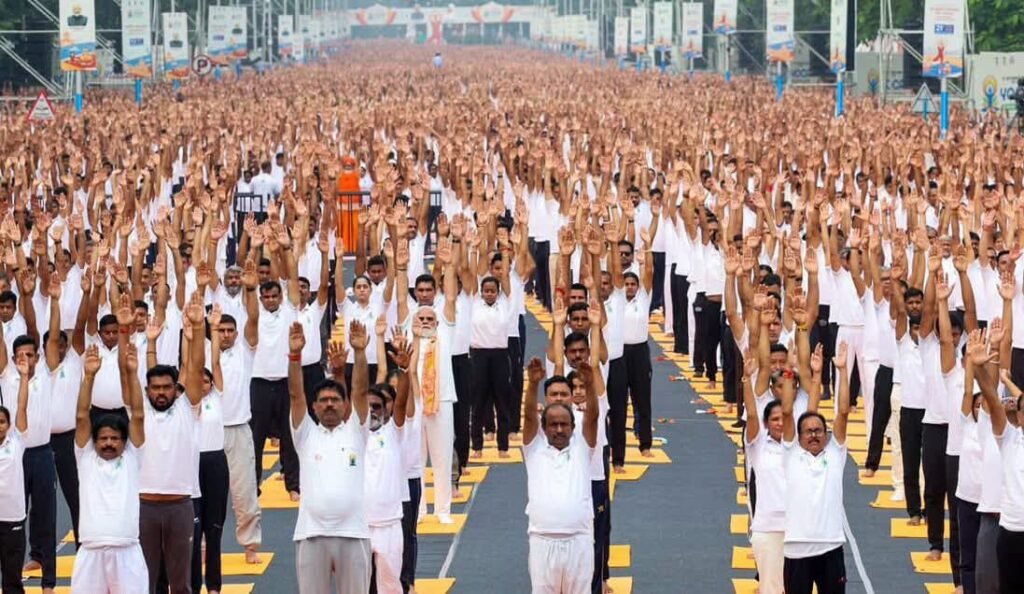
As the world marked the 12th International Day of Yoga in Kolkata, Prime Minister Narendra Modi reminded humanity of one of the most profound teachings of the Bhagavad Gita: Yoga is the path of balance. His message was not merely about physical exercise but about a philosophy of life that has guided India for thousands of years.
The Bhagavad Gita presents yoga as a way of living rather than a set of postures. In Chapter 6, Verse 17, Lord Krishna says:
“Yuktāhāra-vihārasya yukta-ceṣṭasya karmasu, yukta-svapnāvabodhasya yogo bhavati duḥkha-hā.”
This means that for one who is balanced in eating and recreation, disciplined in work, and regulated in sleep and wakefulness, yoga destroys all suffering. This timeless teaching resonates powerfully in today’s world, where stress, anxiety, burnout, and lifestyle diseases have become global challenges.
Advertisement
The Gita repeatedly defines yoga as balance and excellence in action. In Chapter 2, Verse 48, Krishna instructs Arjuna:
“Samatvam Yoga Uchyate” — “Equanimity is Yoga.”
True yoga is maintaining mental balance in success and failure, joy and sorrow, praise and criticism. It teaches that inner stability is the highest form of strength.
Another celebrated verse, Chapter 2, Verse 50, declares:
“Yogaḥ Karmasu Kauśalam” — “Yoga is excellence in action.”
This principle transforms work into worship. Yoga encourages individuals to perform their duties with sincerity, discipline, and integrity without becoming attached to the results. Such a mindset reduces stress while enhancing productivity and ethical leadership.
Prime Minister Modi rightly observed that yoga teaches us not only what to do but also what to avoid. Modern lifestyles often encourage excess—whether in food, work, digital consumption, or emotional reactions. The Gita instead advocates moderation, self-control, and conscious living. Understanding our body and mind, respecting natural rhythms, and cultivating discipline make health a natural outcome rather than a constant struggle.
Yoga also reminds us that true health extends beyond the physical body. It integrates body, mind, intellect, and spirit. Scientific studies increasingly support yoga’s role in reducing stress, improving cardiovascular health, strengthening immunity, enhancing concentration, and promoting emotional well-being. Ancient wisdom and modern science are converging on the same conclusion.
International Day of Yoga has evolved into one of the world’s largest public wellness movements. Celebrated in nearly every corner of the globe, it reflects India’s enduring civilizational contribution to humanity. Yoga has become a bridge across cultures, religions, and national boundaries because it addresses universal human aspirations—peace, health, resilience, and harmony.
In an era marked by geopolitical tensions, climate uncertainty, and mental health crises, the Gita’s message is strikingly relevant. It reminds humanity that lasting peace begins with mastering oneself. A balanced individual contributes to a balanced family, a balanced society, and ultimately a balanced world.
The message from Kolkata is therefore much larger than a celebration of yoga. It is an invitation to rediscover the timeless wisdom of the Bhagavad Gita. In a world increasingly out of balance, India’s ancient philosophy offers a modern solution: discipline over excess, mindfulness over distraction, duty over ego, and harmony over conflict.
Yoga is not merely an exercise; it is a way of life. As Lord Krishna teaches in the Gita, balance is the key to freedom from suffering. That message may well be India’s greatest gift to the twenty-first century.