When I returned from my 2016 visit to Prambanan (Indonesian: Candi Prambanan), a 9th century Hindu religio-philosophy-inspired temple compound in Yogyakarta in southern Java, Indonesia, hardly any of my friends in Mumbai or elsewhere had heard of that ancient temple complex.
For sure, they had heard of Cambodia’s Angkor Wat, a continuing marketing effort by Cambodia that has yielded great footfalls; some of my friends and even yours truly had visited the 12th century site seduced by the same marketing spiel.
Now that the Indian Prime Minister recently visited Indonesia and there is a reconstruction effort of Prambanan in the works, perhaps more fellow Indians will wake up to the uniqueness of Prambanan.
For me, Prambanan is unique. And, there are four principal reasons. First, Prambanan was, thankfully, never destroyed by religion-inspired forces; Prambanan, as per my guide at the site, was simultaneously shaken by a series of earthquakes and the devastating volcanic eruption of neighboring Mount Merapi, hardly 25 kms away, in 1006 CE. The combination of these two ‘natural’ disasters led to many of Prambanan’s original residents losing their lives, which in turn apparently triggered a gradual exodus from central Indonesia.
Advertisement
The second unique aspect about Prambanan is there is no comparable ‘as-originally-conceived’ free-standing temple, dating to the 9th century, in India. Some temples in Khajuraho, of course, come close. The reason being: All major temples stretching from the plains of India and the way to the Southern parts have been reconstructed during the late medieval period, roughly 600-300 years ago – after being subjected to rampant vandalism. In Prambanan, we get a glimpse of what early South Indian temples may have looked.
The next unique aspect is to do with the worship of Brahma, the Hindu god, who is believed to be the ‘Creator’ of this world. Indeed, the Prambanan temple complex celebrates the Trinity – Brahma, Vishnu (the Preserver), and Shiva (the Destroyer). While there are many temples in India that are dedicated to either Lord Vishnu or Lord Shiva, Brahma temples are extremely rare; the one at Pushkar, Rajasthan, being the most famous.
Brahma’s ancient worship at Prambanan suggests that he was an important deity at least till the 9th century in India and beyond before mythological tales started narrating various accounts describing his fall from grace. Such legends apart, Brahma was undoubtedly a much-revered god in antiquity; his many extant statues across Indian museums stand testimony to his ancient following.
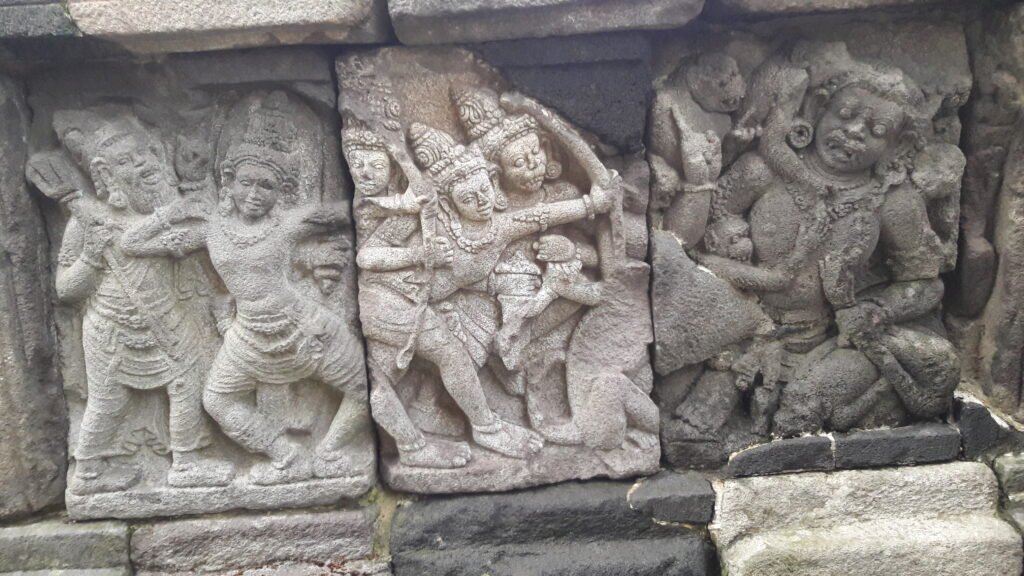
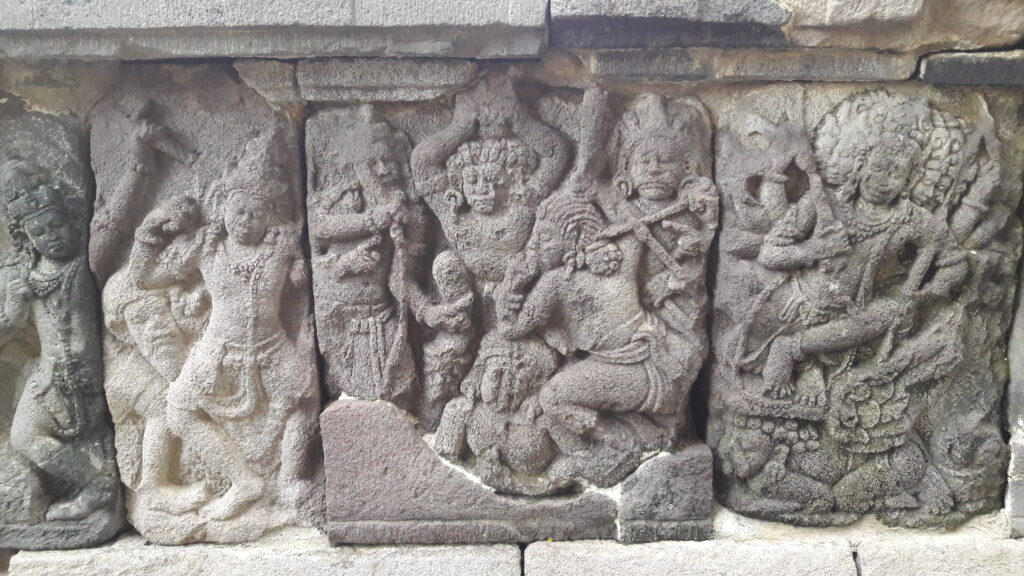
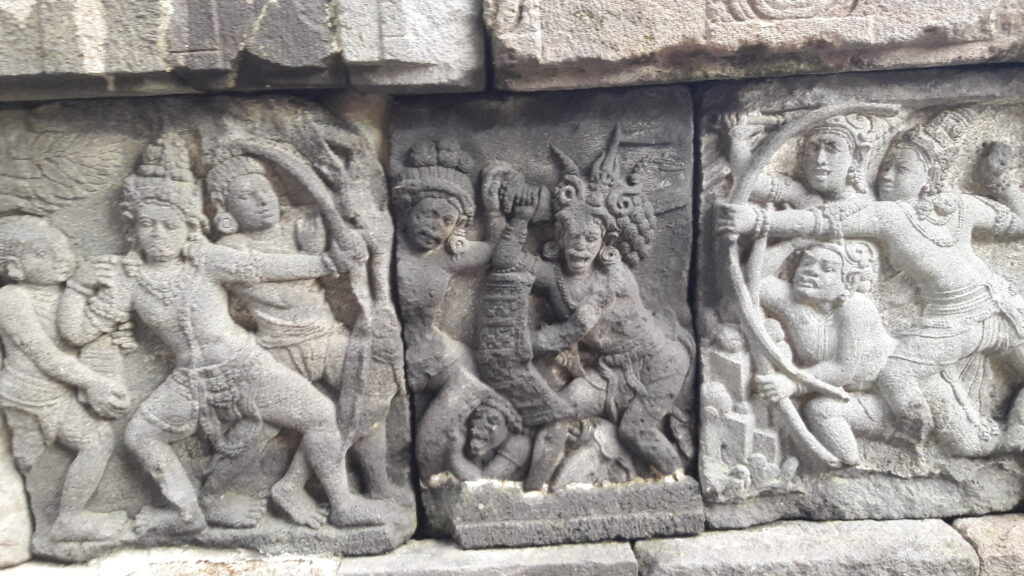
The fourth and last aspect involves the grand bas-relief panels in stone, telling the stories of Ramayana and Bhagavata Purana. Visitors to Prambanan marvel at the almost life-size bas-relief panels – running from left to right – while circumambulating the three main temples in a clockwise direction. There is no temple in India of Prambanan’s antiquity that showcases such ancient tales – so beautifully woven in stone.
Prambanan, a UNESCO World Heritage Site, is the largest Hindu temple site in Indonesia and the second-largest in Southeast Asia after Cambodia’s Angkor Wat, built some three centuries later. The temples at Prambanan are characterized by their tall and pointed spires, and by the towering 47-metre-high (154 feet) central edifice inside a large complex of individual temples. The temple compound originally comprised 240 temples, which represented the ancient Sanjaya dynasty-sponsored grandeur of ancient Java’s Hindu art and architecture. Unfortunately, much of the complex was in ruins in 2016.
Interestingly, there are three other shrines in front of the three main temples; these are dedicated to the vehicles (vahana) of the Trinity – the sacred swan Hamsa for Brahma, Vishnu’s eagle Garuda, and the bull Nandi for Shiva. We also get to see three icons related to Shiva: Mahishasuramardini Durga depicting Durga as the slayer of the buffalo demon; the much-revered saint in Southern India Agastya, and Shiva’s elephant-headed son Ganesh. The Prambanan temple complex was built to honor Lord Shiva and its original name was Shiva-griha (the House of Shiva) or Shiva-laya (the Realm of Shiva).
The temples, which we see now, had collapsed into a heap of massive blocks of stone during a major earthquake in the 16th century and were subsequently overrun by weeds and local vegetation. It was not until the middle of the early 20th century that conservation and reconstruction efforts were initiated.
In the intervening period, some members of the Dutch colonialists in Indonesia carried off sculptures as garden ornaments or memorabilia, while local villagers used the foundation stones for construction material – very much similar to how terracotta bricks from centuries-old Buddhist stupas in Eastern India – were carted away by ignorant local villagers to build their own homes.
The reconstruction used the ‘anastylosis’ method, in which a collapsed temple is restored using the original stone blocks to the extent possible. Finally, the reconstruction of the main Shiva temple was completed in 1953 and inaugurated by Indonesia’s first president Sukarno.
Today, while one looks forward to the Archaeological Survey of India doing a fine job in Indonesia, adherence to the ‘anastylosis’ method is critical to preserve the temple’s heritage and architecture that was originally envisaged by the saints and collaboration between Indonesian and Indian architects. Amen.
Disclaimer: The opinions and views expressed in this article/column are those of the author(s) and do not necessarily reflect the views or positions of South Asian Herald.