In a carefully calibrated blend of culture, commerce and couture, India’s handloom sector is stepping onto an unlikely but high-visibility stage — the glitz of the Femina Miss India finale — as the government seeks to reposition traditional textiles within the vocabulary of global fashion.
The Ministry of Textiles, through the Office of the Development Commissioner (Handlooms), has, for the first time, partnered with the pageant platform to launch “Vishwa Sutra – Weaves of India for the World,” an initiative that attempts to translate centuries-old weaving traditions into contemporary, internationally resonant design narratives.
At the heart of the showcase is an exclusive handloom collection to be unveiled during the finale, where contestants representing States and Union Territories will don ensembles rooted in their region’s textile heritage but reimagined through the aesthetic lens of different countries. The concept, officials say, is deliberate — a symbolic weaving together of India’s local identities with global fashion idioms, aimed at making handlooms legible and desirable to younger, international audiences.
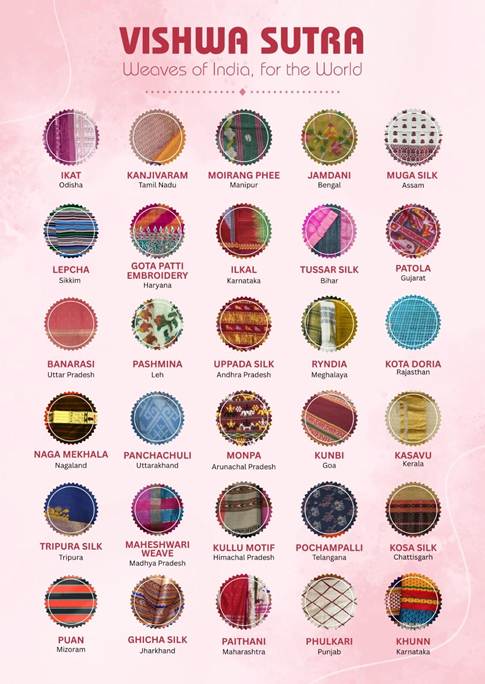
The garments themselves draw from a dense tapestry of India’s textile legacy: the intricate opulence of Varanasi brocades, the geometric precision of Patola, the airy lightness of Kota Doria, the temple-border elegance of Kanchipuram silks, and the fine muslin tradition of Jamdani, among others. From the understated sophistication of Maheshwari and Uppada to the vibrant storytelling of Phulkari and Paithani, the collection attempts not merely representation, but reinterpretation.
Advertisement
Behind the spectacle lies a more strategic intent. India’s handloom sector — employing over 3.5 million weavers and allied workers, making it the country’s second-largest source of livelihood after agriculture — has long grappled with structural challenges: fragmented supply chains, competition from power looms, and limited market access. Yet, in recent years, a surge in demand for sustainable and eco-friendly textiles has begun to alter its prospects, particularly in premium and export markets.
Officials involved in the initiative frame “Vishwa Sutra” as part of a broader policy shift — one that seeks to reposition handlooms not as relics of heritage, but as viable, future-facing products within the global “orange economy” of culture and creativity. By embedding handlooms within a high-visibility, youth-driven platform like a national beauty pageant, the government is effectively attempting to collapse the distance between craft clusters and consumer consciousness.
Dr. M. Beena, Development Commissioner (Handlooms), described the collaboration as an effort to expand the sector’s visibility beyond conventional markets, particularly among younger consumers and fashion stakeholders. The underlying message, she indicated, is twofold: handloom as heritage, but equally, handloom as a forward-looking industry aligned with sustainability and design innovation.
The initiative also dovetails with the government’s larger economic narrative — from the “Vocal for Local” campaign to the 5F framework that traces the value chain from farm to fibre, factory, fashion and finally, foreign markets. In this formulation, handlooms are not just artisanal products, but strategic economic assets capable of generating employment, preserving cultural capital, and enhancing export competitiveness.
Yet, the experiment raises a deeper question: can spectacle translate into sustained demand? While runway visibility offers a powerful narrative shift, the long-term impact will depend on whether such initiatives can create durable market linkages for weavers — beyond episodic showcases — and address the persistent gaps in pricing power, branding and global distribution.
For now, “Vishwa Sutra” signals an evolving approach — one where policy, culture and fashion intersect — as India attempts to carry its handloom legacy from the quiet rhythm of village looms to the glare of the global runway.