Join WhatsApp Channel

In the high-vaulted corridors of Lutyens’ Delhi, the air is thick not with the heat of the coming summer, but with the scent of an ending.
As the dust settles on the five state assembly elections of May 2026, the data points to a paradox: the Bharatiya Janata Party (BJP) remains the sun around which Indian politics orbits, yet its gravitational pull is undeniably weakening.
If the decade from 2014 to 2024 was defined by the “Modi Wave”—a singular, irresistible force of nature—the decade beginning in 2026 will be defined by “Disaggregation.”
India is no longer a monolith. It is becoming a patchwork of localized mandates, internal party fractures, and a restive youth demographic that is outgrowing the slogans of the past. The “Long Unravelling” has begun, and the roadmap to 2029 suggests that while the BJP may still hold the center, it will be a center that barely holds.
The 2026 Verdict: A Fractured Mirror
The results from the 2026 “mini-general election” offer a Rorschach test for India’s future. In Assam, Himanta Biswa Sarma has perfected a sub-regional brand of “Hindutva-Plus-Governance” that makes him the most successful BJP franchise outside of the Prime Minister’s own shadow.
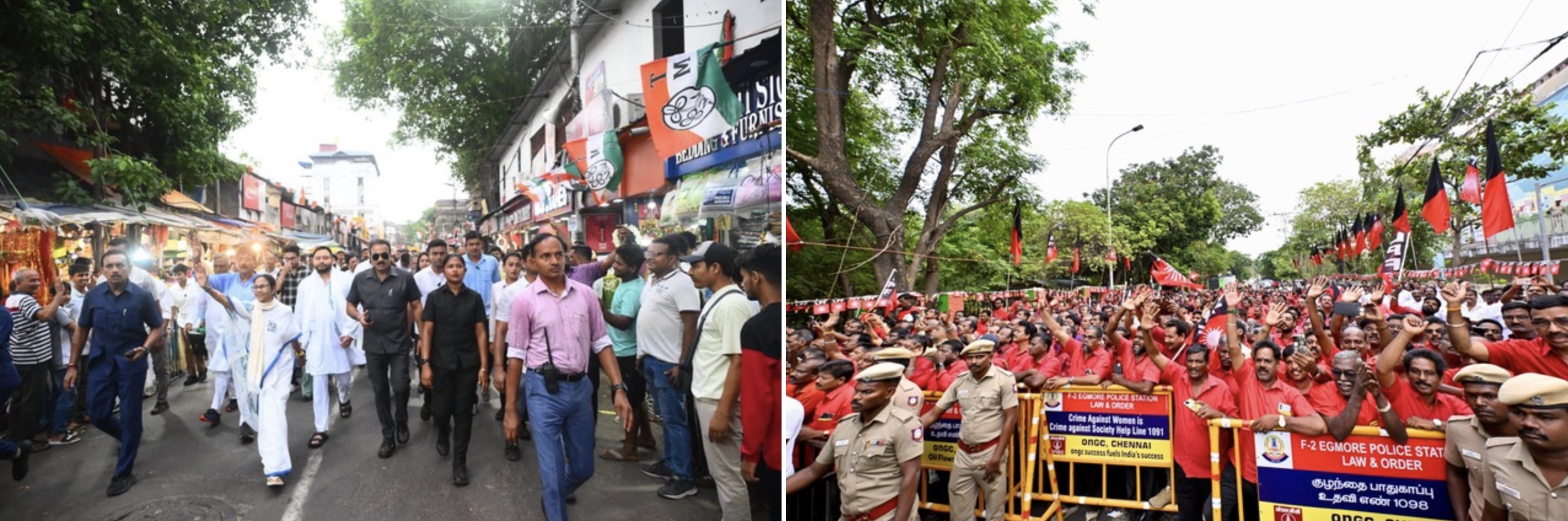
In contrast, Bengal remains the BJP’s “Great White Whale.” Despite exit polls hinting at a breakthrough, the Trinamool Congress’s resilient welfare machinery—powered by the silent, formidable “Lakshmi Bhandar” sisterhood—suggests that centralizing nationalism still hits a wall at the borders of the East.
In the South, the story is one of structural exclusion. Tamil Nadu’s M.K. Stalin has not just survived; he has transformed the DMK into a federalist fortress. Even the emergence of Vijay’s TVK serves more to cannibalize the opposition than to aid a BJP breakthrough.
The message from the Peninsula is clear: the BJP’s “One Nation” narrative is being rejected in favor of “Many Indias.”
The UP Crucible: Yogi, Shah, and the Succession War
The most potent threat to the BJP, however, is not the opposition, but the internal “tectonic rub” within its own engine room. The 2024 Lok Sabha setbacks in Uttar Pradesh were more than a polling error; they were a systemic failure of the “Double Engine” government. The rumored friction between Home Minister Amit Shah’s central command and Chief Minister Yogi Adityanath’s Lucknow establishment has shifted from a whisper to a roar.
As we look toward the 2027 UP elections, the stakes are existential.
The Adityanath Stance: Unlike other regional satraps, Yogi Adityanath possesses a personal base and an ideological purity that rivals the Prime Minister’s. In the face of the 2024 “PDA” (Backward, Dalit, Minority) coalition surge led by Akhilesh Yadav, Yogi has doubled down on a localized, aggressive Hindutva.
The Modi Mediation: Prime Minister Modi, ever the pragmatist, finds himself in a delicate balancing act. At 78, he cannot afford a rebellion in the state that provides his parliamentary majority. Expect a public display of “Modi-Yogi” unity, but one that masks a fierce battle for the party’s soul.
If Yogi wins UP in 2027, he becomes the de facto successor. If he loses, the BJP enters 2029 as a headless giant.
The RSS and the “Age of Exit”
For the Rashtriya Swayamsevak Sangh (RSS), the ideological mothership, the “Modi Era” has been a period of unprecedented success—and unprecedented anxiety. The RSS prefers a collective leadership over a personality cult. As the Prime Minister approaches 80, the Sangh’s quiet calls for a “generational transition” are growing louder.
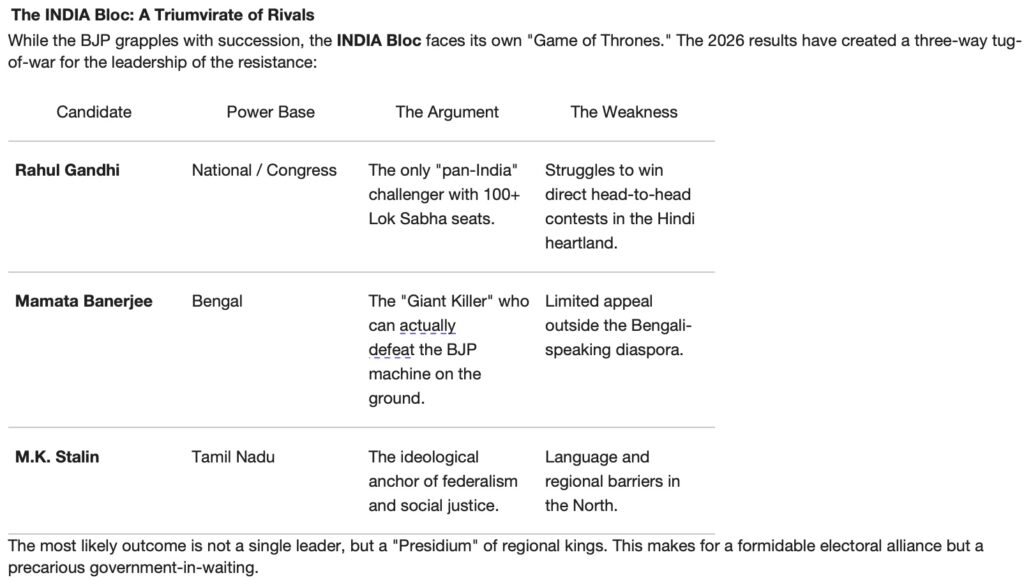
The BJP’s current dilemma is that its cadre is addicted to the Modi brand, but the “brand” is increasingly disconnected from a youth population (65% under 35) whose primary concerns are not the civilizational grievances of the 1990s, but the AI-driven job shortages and inflationary pressures of the 2020s. The Sangh knows that a party that cannot speak to the “Post-Modi” voter will eventually become a relic.
The New Vanguard: From J&K to Maharashtra
The next decade will see the final exit of the “1947 Generation” and the rise of a more transactional, technocratic young leadership.
In Maharashtra, the fragmentation of the Shiv Sena and NCP has cleared the path for younger leaders who prioritize urban infrastructure over old-school Maratha identity politics.
In Jammu & Kashmir, the post-370 generation is moving past the binary of “Resistance vs. Integration” toward a politics of “Restoration and Rights.”
In the Hindi Belt (Bihar, Uttarakhand, Himachal), the old caste-math of the 1990s is being replaced by a “New Aspirant” class that is less interested in Mandir-Masjid and more in the quality of their digital degrees.
Conclusion: The 2029 Horizon
The year 2029 will not be a referendum on a man, but a referendum on a system. The “Modi Guarantee” was a promise of stability; the “Post-Modi” reality will be one of negotiation.
India is returning to its natural state: a noisy, federal, and multi-polar democracy. The BJP may continue to be the largest party, but the era of the “Super-Majority” is likely over.
For the London investor or the Washington diplomat, this means a more complex India—one where power is diffused across state capitals rather than concentrated in a single office in the South Block.
The “Most Uncertain Decade” is not a threat to Indian democracy; it is the sound of its gears finally resetting.
Disclaimer: The opinions and views expressed in this article/column are those of the author(s) and do not necessarily reflect the views or positions of South Asian Herald.