
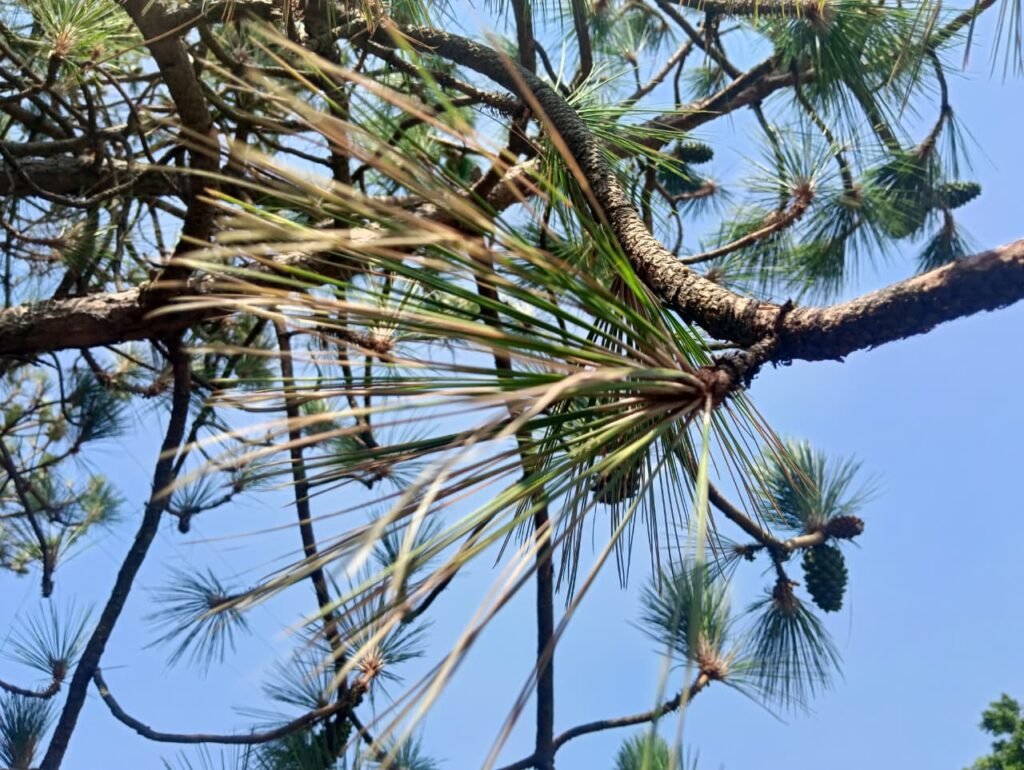
There was absolutely no planning, but you may like to say – we just walked into serendipity’s embrace one fine weekend.
Our drive coincided with the sun celebrating the Indian summer as we traversed up the Gangetic plains cruising through vast stretches of sugar cane plantations, shocking green pastures and mango orchards as the route took us to the Himalayan foothills where the journey began to fill us with history, cultural diversity and stunning landscapes.
As we narrowed our distance between Delhi and Lansdowne covering about 250 kilometers in 6 hours the all-familiar strong purr of the car engine became more audible as the climb towards the breathtaking vignettes of the hills began. The ACs were switched off just as the windows were downed and the sunroof was off its slide forcing the blast of fresh, invigorating and salubrious mountain air with strong notes of the pine scent pervading the senses. All this under the gaze of these very majestic trees peeping out quietly like monks on these slopes all squinting against the afternoon sun.
We disembarked and repaired into our pine lodges to gear up for a hike. It was almost dusk when we picked up one of the meandering trails taking us higher and higher until we saw that panoramic view of the valley below that took our breath away. The distant lights were magical yet soothing and we listened to the breeze as it welcomed us. It was not much of a realization that Lansdowne is an escape into tranquility especially for us urban rats as gusts upon gusts of zephyr created that ethereal symphony —a soft, airy distinct whisper rather than the heavy rustle of broad-leafed trees.
Advertisement
A quick note here—the sound generated amongst the pine is known as psithurism (pronounced sith- err-iz-um) which comes from the Greek word psithuros, meaning whispering. It is also known by another name ‘soughing’ of the pines–a resonance that has been floating and wafting in these lush verdant tracts for tens of thousands of years. The first pine trees had emerged in the Himalayan region, according to experts about 50 million years back!
Lansdowne may not have the dramatic peaks to show-off on its nearest horizon, but it does have something subtler, more sacred, a rhythm that settles into your skin. This hidden gem of Uttarakhand cradles you gently in pine-scented arms, asking nothing but your presence in return. Layered in poetry, other trees that stand alongside chirpine that we encountered in these forests were deodar, fir, oak, and rhododendron who stood monks in meditation. In monsoon, everything drips green. And in winters as the locals say —- the trees sigh under a soft frost!
We soon realized listening to the pines can be an experience as turbulent as the wind raging over myriad cliffs or as tranquil as listening quietly to the rustling of pines. Of course, without the wind, the pines cannot sough, but these trees do not purportedly attract the wind, nor does the wind mean to seek out the pine—It’s just that the sun-loving pines do not grow in dense thickets, but allow the air to flow freely around them. Thus, anywhere pines grow, there is almost sure to be soughing when the wind rises. When the wind passes among pines it seems to take on form, and the waving branches seem to stretch out even longer. From a musician’s sensitive ear, the voice of the pine is multifaceted—when the wind grows stronger, the pines howl and roar like an angry tide crashing and recoiling, or like thunder reverberating on the countless valleys.
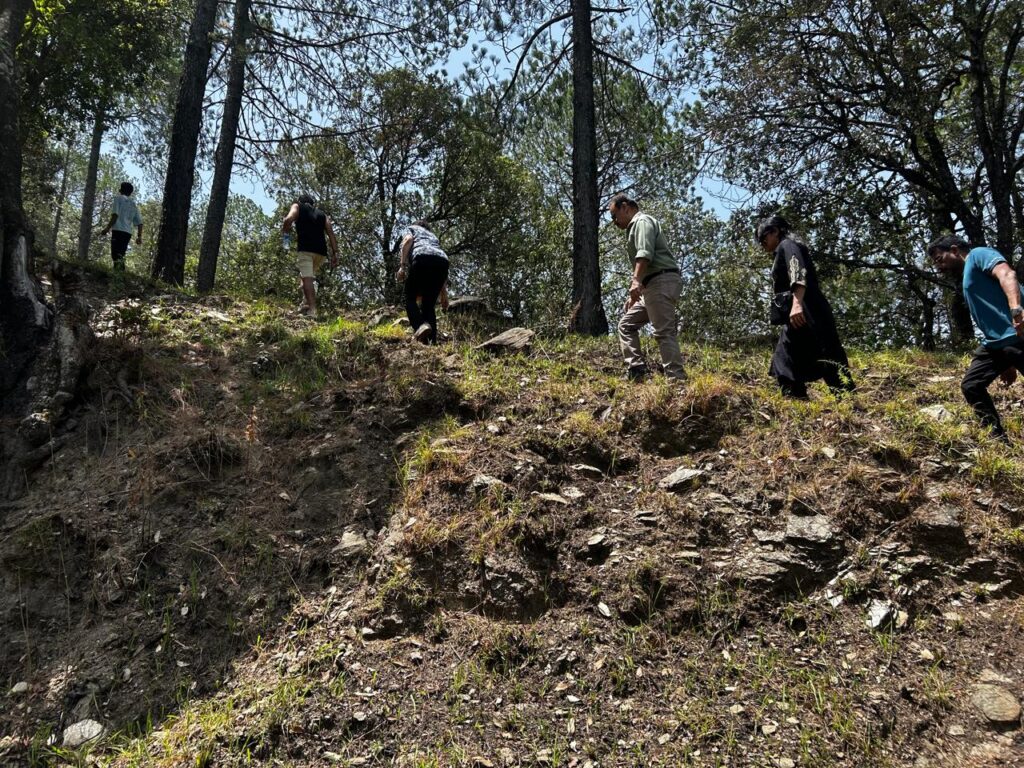
Pine trees can be seen all over the Himalayas and have great vitality and are adapted to hostile conditions. The pine seeds grow wherever they fall: in cracks in rocks, on precipices. Thus, they appear in tenacious postures, even clinging crazily to sheer crags. In late autumn, when other trees have shed their leaves and the flowers have all withered, often all that is left is the lone pine on a ridge. This unyielding courage in adversity gives the pine a special place in poetry and painting. A translation of an ancient Chinese poem is apt out here —
“A faint moon appears between the pines/ Her pure light reminds me of you; The hustle and bustle of human life is fleeting, and of no consequence to the lonely pine growing among the mountains and rivers; When all passion has subsided, nothing remains but the bright moon and the eternal pine in loving companionship.’’
Forming a pure forest, Pine trees in India native to the Himalayan and sub-Himalayan regions, dominate the landscapes of Himachal Pradesh, Uttarakhand, and North Bengal. Some of the most common species are the Chir Pine (Pinus roxburghii) which we encountered in the Uttarakhand areas lower elevations and the Blue Pine (Pinus wallichiana) at much higher altitudes. Chirpine has an elongated crown and thrives at an elevation of up to 500 to 2000 meters, with a girth of 3.5 meters forming a straight cylindrical bole. These majestic trees reach a mature height of 100 to 160 meters.
These trees (pines) appeared 350 million years ago on earth and is a gymnosperm, a flowerless plant family as opposed to the angiosperms like oak which is a flowering tree which evolved later amongst the line up of the tree species. Today, there are about several varieties of pines in the region (8 native and 21 exotic species of pine) since the first pines appeared as noted earlier about 50 million years ago. As of today, pinus roxburgii or chirpine are the commonest of the trees which makes over 16 % of Uttarakhand’s forest cover. While at the upper elevation the lower altitudes have a spread of Sal, Kahir, Harad, Bahed amongst other varieties. Chirpine locations are also spread across Afghanistan, Pakistan and Nepal.
Its mass-scale regeneration happened during resin tapping in the British period but contrary to popular belief, it was not introduced by the British. Over the decades it received favorable conditions to grow and entrenched itself on these mountainous landscapes with as many as 8 native and 21 exotic species of pine in India. It was always beneficial for the government to grow pine for its resin, which is used in turpentine oil, soap, paper, paint and chemical industry. It has been an important revenue-earning source for the government since the colonial period. Even now, the Uttarakhand government earns a sizable sum annually from the resins.
It must be recalled here that in the early 19th century to channelize the commercial benefits of the resin from these trees the British established a factory unit in Kashipur, Uttarakhand, one of the first British enterprises in the Himalayas. By the mid-19th century, the expansion of the railway network from about 30 odd kilometers to about 50,000 coincided with the unfettered expansion of pine in the Himalayan forests, as other wood species like teak, oak, deodar and sal from these forests were cut for fuelwood and construction purposes. Since Chir Pine was less sought after as wood compared to other trees, they were largely left undisturbed.
Degradation of oak forests, especially on south-facing slopes, and frequent fires in oak forests also could have led to the expansion of pine. Dr. Gopal Singh Rawat, an eminent wildlife biologist, botanist, and conservationist, explained that the exploitation of forests and other resources in India did not stop even after the British left. He said sal and deodar usually do not share the habitat with pine so it may not be correct to say that commercial extraction of sal and deodar during the British period may have led to expansion of pine. But there is no doubt that the mid-elevation broadleaf tree, oak, locally known as baanj (Quercus leucotrichophora) has been the most favored fuel wood and fodder species for the local people in Uttarakhand.
But chirpine has earned the sobriquet, of a dangerous beauty too, let’s look at some of them:
It is an established fact that pine needles are highly inflammable and are one of the main causes of forest fires. Foresters say chirpine is the key culprit for infernos and is not good for biodiversity.
The groundwater recharge rate in oak forests is 23 per cent, compared to 8 per cent in pine forests as pine trees contribute more to depleting underground water, says a study conducted by the Geography Department of Kumaun University.
Since the pine tree sheds loads of needles (pirul) and are known to be mildly toxic they are avoided by foraging animals as these needles are known to cause toxicity and indigestion to cattle, sheep and goats. They also take time to decompose into humus and soil. Every year, pine needles keep layering over the previous layers and in the absence of a natural decaying process mimic the properties of a plastic sheet accelerating the rainfall runoff in these areas.
Pine is an aggressive species. It does not require much soil to germinate. Thus, it keeps expanding through the natural process. The forest fires near the oak forests dry up their soil thus making them suitable only for the germination of pine, as it can grow even without much moisture.
Pine plantations were encouraged by the forest departments during and even after the British rule for its resin, which was used for turpentine oil for the paint industry. It was stopped only in 1993, after local people protested that pine trees were drying up underground aquifers.
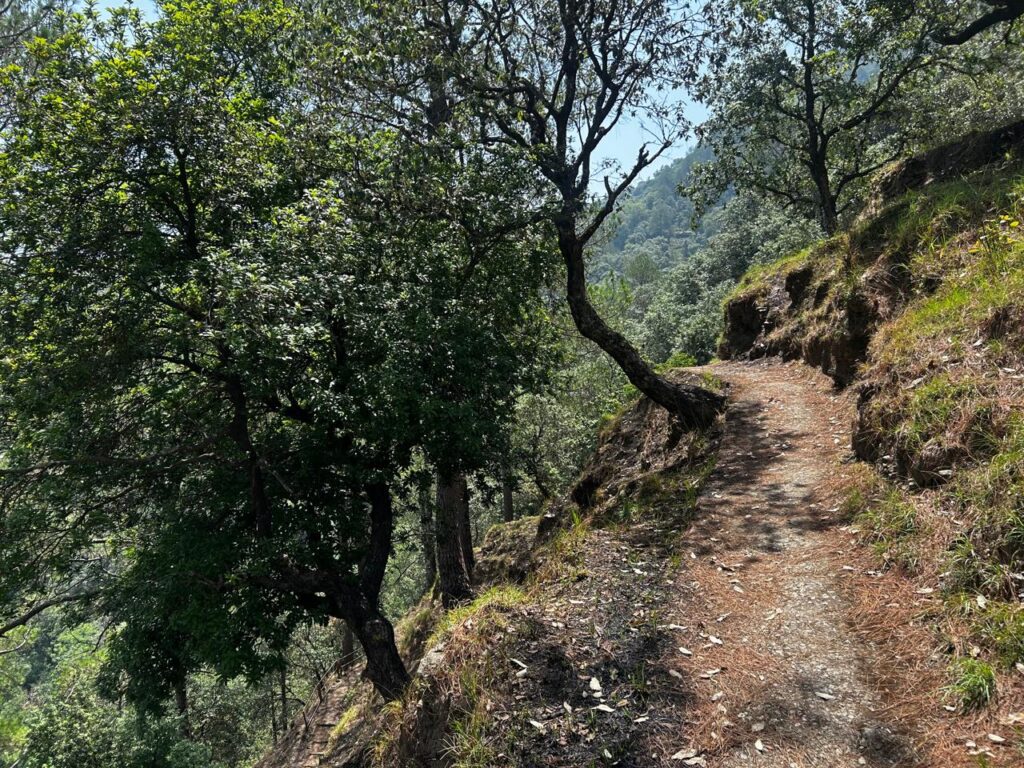
Well aware of these above conclusions we trail hiked through the hills encountering charred pathways and blackened pine trunks. A burnt smell occasionally interjected the air and we also sighted many smoldering pine needles (that contain combustible resins) on the ground with light plumes of smoke billowing. These dry, resin-rich chirpine needles (pirul) are highly flammable and blanket vast areas of the Garhwal Himalayas, fueling aggressive fires while over (95%) of these fires are anthropogenic (caused by human negligence or agricultural clearing). Once ignited, the loose structure of the needle beds allows flames to travel quickly across these steep slopes of the hills.
However, considering pine as the only source of malady is misleading and flawed. Pine has always been an integral part of India’s mountain forests cover since the Himalayas first formed. Primarily the Chir pine trees are a total bonanza for the locals from time immemorial. Product of the soil Chirag Panthwal, son of Rajesh Kumar who hails from Holi village in Pauri district, a bright youngster who is on the verge of joining Garhwal Rifles, explained the multifarious usage of pine, ‘’ It is used for timber, fuel wood, torch wood, funeral wood and furniture.
While its leaves are used for livestock bedding and field mulching, the bark is a source of charcoal, resin and coal tar. It supports the livelihood of the region and is used in our daily domestic activities.’’ It is also the main source of revenue through resin tapping for forest corporations for which special resin depot and processing units are created. Chir pine is the prime species of Uttarakhand Himalayas and is still preferred by the local community as without this people would not be able to meet basic need for timber and wood. At present, no other substitute of chirpine is available across the state of Uttarakhand that could substitute the use of chirpine, Panthwal explained.
The resins from Chir pine yields two key products—turpentine oil (about 70 per cent), and rosin (about 17 per cent). Rosin is extensively used in soap, paper, paints and varnishes, pinoleums, sealing waxes, oil cloth, inks and disinfectants while turpentine is chiefly used in preparation of paints and varnishes, polishes, chemicals and pharmaceuticals. It is also used for dissolving fats, resin and for domestic purposes. Its cones are also used for decorative and handicraft purposes. In addition, the indirect benefits of chirpine in providing ecosystem services and aesthetic beauty to the area cannot be ignored. Chirpine is a big source of in situ association of microbes, particularly mycorrhiza, explains Panthwal.
Another critical key role that these pine trees play are its therapeutic benefits as India’s oldest tuberculosis sanatorium in Bhawali, Nainital 1912, is a testimony to the role that chirpine forests play in curing respiratory problems.
The emphasis should now be on how chirpine needles can be used as resources instead of just burning them. An irony is that while the Uttarakhand forest department wants to wipe out chirpine citing fire, the Himachal Pradesh forest department is promoting the tree and is adopting borehole methods for resin extraction. It is, therefore, failure of fire control and management strategies and not abundance of chirpine trees that is to blame for fires. Rather, chirpine is protecting the hills from being eroded like other barren hills.
Forest scientists have already developed uses of chirpine needles for compost, boards, tiles, briquettes, among others. The emphasis should now be on how chirpine needles can be used as resources instead of just burning them. An irony is that while the Uttarakhand forest department wants to wipe out chirpine citing fire, the Himachal Pradesh forest department is promoting the tree and is adopting borehole methods for resin extraction. It is, therefore, failure of fire control and management strategies and not abundance of chirpine trees that is to blame for fires. Rather, chirpine is protecting the hills from being eroded like other barren hills.
Creation of forest self-help groups or FSHGs and local Forest Special Purpose Vehicle or FSPV can help to convert “hazardous leaves” into resources that can be used in products like bio-briquette, compost or vermi-compost, composite boards, panels and tiles. Scientific resin tapping by borehole method can help to minimize spread of resin on tree trunks. The modern fire-fighting techniques like Doppler radar could be options to fight the fires.
In this era of climate change and ecosystem, it is not advisable to cut down thousands of chirpine trees without weighing all the options, according to Arvind Bijalwan, faculty of technical forestry at Indian Institute of Forest Management, Bhopal. Pine is just one conifer standing among many other species in the Himalayan slopes. Focusing solely on one tree variety is a flawed approach in understanding of the larger Himalayan ecosystem that is leading to unsustainable solutions to the forest fire issue, according to experts.
A senior forest official said, “There is no harm if Chir pine leaves are used to generate employment. But collecting pine leaves does not seem to be a practical solution to address the forest fire problem. We should also not forget that pine is a part of forest ecology.”
Pine needles cover soil, retain soil moisture in heat, prevent weeds, check erosion and release nutrients into soil by decomposition albeit slowly. Although pine needles are acidic in nature, various studies have shown that they do not alter pH level of soil significantly. In fact, with all the pros and cons, these pine needles make good mulch for soil.
Enriched with these thoughts we gazed at these monumental, imposing, opulent yet sublime pine trees, one last time, before packing our bags back to Delhi a beautiful poem comes across:
“I hear you call, O dark-limbed pine; Through falling rain and blowing gale; A bridge across the mountain line; A rustic, high-up, living sail; You wear a cape of frosted snow; But hold your green with quiet grace; Where clear and cold the rivers flow; You are the soul of this quiet place.”