Fresh FY2026 employer data from U.S. Citizenship and Immigration Services (USCIS) suggests that America’s technology sector continues to depend heavily on high-skilled foreign workers despite tighter immigration scrutiny and an uncertain economic environment. But while this year’s approvals underline the resilience of the H-1B program, employers are already preparing for a far more consequential test in FY2027 as regulatory and policy changes threaten to reshape hiring strategies.
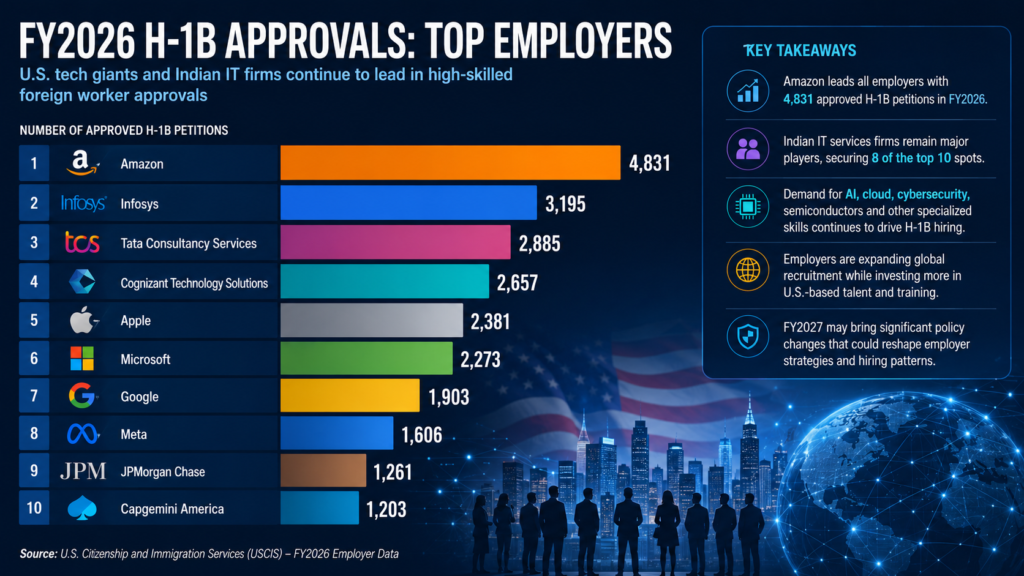
The USCIS employer dataset shows Amazon leading all employers with 4,831 approved H-1B petitions during FY2026, followed by Infosys (3,195), Tata Consultancy Services (2,885), Cognizant Technology Solutions (2,657), Apple (2,381), Microsoft (2,273), Google (1,903), Meta (1,606), JPMorgan Chase (1,261), and Capgemini America (1,203).
The rankings reinforce a familiar pattern: U.S. technology giants and Indian IT services companies remain the largest users of the skilled-worker visa program. Their continued presence at the top suggests that demand for software engineers, artificial intelligence specialists, cloud architects, cybersecurity professionals and semiconductor engineers has remained largely intact despite layoffs across parts of the technology industry over the past two years.
However, the FY2026 numbers may represent the final year before structural changes begin altering employer behavior.
Advertisement
Technology companies are accelerating investments in generative AI, advanced semiconductor design, automation and quantum computing, areas where domestic talent shortages continue to persist. As competition for specialized expertise intensifies, employers are expected to rely increasingly on global recruitment while simultaneously expanding U.S.-based hiring and workforce development programs.
Indian IT services companies face a more complicated outlook. Although firms such as Infosys, TCS, Cognizant and Capgemini continue to secure thousands of approvals, they are steadily increasing local hiring, expanding American delivery centers and investing in workforce training to reduce dependence on overseas deployments. That transition is expected to accelerate if immigration rules become more restrictive or compliance costs rise further.
Industry observers also expect employers to closely monitor potential changes in prevailing wage requirements, adjudication standards and future H-1B regulations. Any tightening of eligibility or increases in hiring costs could favor large technology companies with deeper financial resources while placing greater pressure on consulting firms that depend on large-scale mobility of skilled workers.
Geographically, California and Texas are likely to remain the principal destinations for H-1B professionals as investments in AI infrastructure, cloud computing and semiconductor manufacturing continue to expand. At the same time, financial services, healthcare technology and advanced manufacturing are emerging as important sources of future visa demand beyond the traditional software industry.
The FY2026 employer data therefore tells only part of the story. It confirms that demand for global technology talent remains robust today, but the more significant question is whether employers can sustain that momentum as evolving immigration policies, rising compliance costs and an increasingly competitive global talent market redefine how—and where—they recruit highly skilled workers in FY2027 and beyond.