A proposal by the U.S. Department of Labor to substantially increase prevailing wage requirements for employment-based immigration could make it significantly more expensive for U.S. employers to sponsor foreign workers for green cards, with Indian professionals and the technology industry expected to be among the most affected.
Although the proposed rule also applies to H-1B and other temporary work visas, immigration experts say its long-term impact may be felt most acutely in the employment-based green card system, where higher wage thresholds could alter employer sponsorship decisions, lengthen recruitment efforts and reduce the number of positions companies are willing to sponsor.
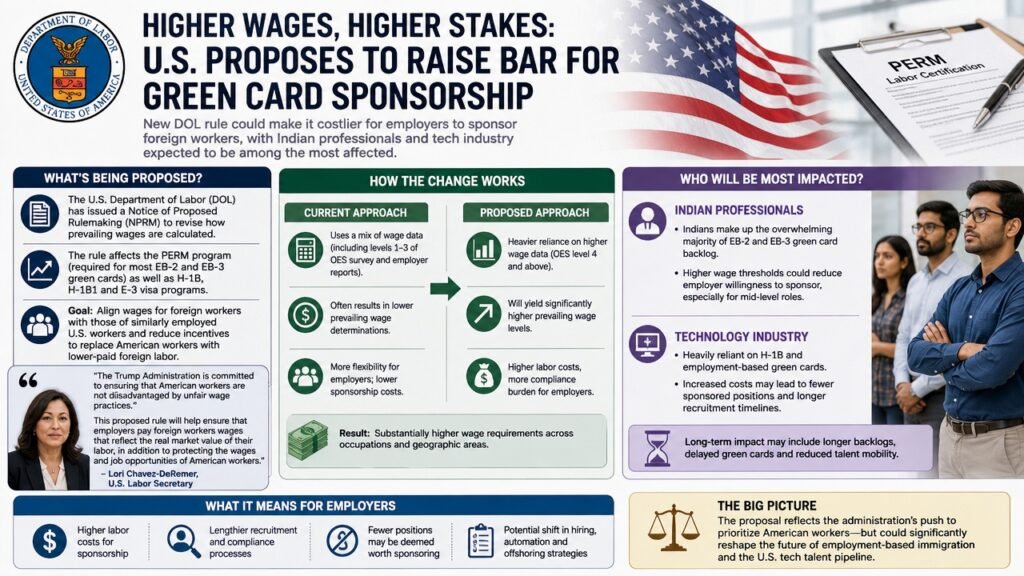
The Notice of Proposed Rulemaking (NPRM), issued by the Department’s Employment and Training Administration, would revise the methodology used to calculate prevailing wages for the Permanent Labor Certification (PERM) program—the mandatory first step for most EB-2 and EB-3 employment-based green cards—as well as for H-1B, H-1B1 and E-3 visa programs.
The Department said the changes are intended to better align wages offered to foreign workers with those earned by similarly employed U.S. workers while reducing incentives for employers to substitute lower-paid foreign labor for American employees.
Advertisement
“The Trump Administration is committed to ensuring that American workers are not disadvantaged by unfair wage practices,” Labor Secretary Lori Chavez-DeRemer said in a statement announcing the proposal.
“This proposed rule will help ensure that employers pay foreign workers wages that reflect the real market value of their labor, in addition to protecting the wages and job opportunities of American workers,” she said.
For the South Asian diaspora, particularly Indian professionals caught in years-long green card backlogs, the proposal could reshape the economics of employer sponsorship.
Indian nationals account for the overwhelming majority of applicants waiting in the EB-2 and EB-3 employment-based green card queues. Most first enter the United States on H-1B visas before employers begin the PERM labor certification process that ultimately supports permanent residency.
The Department itself notes that approximately 57.6 percent of PERM applications filed in fiscal year 2024 were submitted on behalf of workers already employed in H-1B status, underscoring how closely the temporary and permanent immigration systems are linked.
At the center of the proposal is a significant increase in prevailing wage levels.
The Department proposes raising Wage Level I from the 17th percentile of local occupational wages to the 34th percentile, Level II from the 34th to the 52nd percentile, Level III from the 50th to the 70th percentile and Level IV from the 67th to the 88th percentile. Officials argue the current methodology understates market wages and fails to satisfy statutory requirements that foreign workers should not adversely affect U.S. wages and working conditions.
For employers sponsoring green cards, higher prevailing wages could have consequences well beyond payroll.
Under the PERM process, employers must first obtain a Prevailing Wage Determination from the Department of Labor before conducting mandatory recruitment to test whether qualified U.S. workers are available for the position. They must also certify that the sponsored worker will be paid at least the prevailing wage once permanent residence is granted.
If prevailing wages rise substantially, companies may need to increase salary offers before beginning recruitment, potentially attracting more qualified domestic applicants and making it harder to demonstrate that no suitable U.S. workers are available—a key requirement for PERM approval.
The higher salary commitments could also discourage employers from initiating green card sponsorships for junior or mid-career employees, particularly at a time when technology companies continue to face pressure to control labor costs.
The implications are expected to be particularly significant for Indian IT services companies—including Tata Consultancy Services, Infosys, Wipro, HCLTech and Tech Mahindra—as well as large U.S. technology firms that collectively account for thousands of PERM filings each year. Companies may become more selective about which employees they sponsor for permanent residence, reserving green card petitions for senior or highly specialized professionals whose salaries already exceed the proposed wage thresholds.
For foreign professionals, the proposal could add another layer of uncertainty to an employment-based immigration system already burdened by decades-long visa backlogs for Indian applicants. While the rule would not change annual green card quotas or country caps, higher sponsorship costs could reduce the number of new PERM applications filed by employers, narrowing opportunities for workers hoping to transition from temporary visas to permanent residency.
The proposal also marks the latest effort by the Trump administration to tighten employment-based immigration through wage policy rather than numerical visa limits. It follows an earlier attempt during President Donald Trump’s first term to raise prevailing wages, a rule that was ultimately blocked by federal courts on procedural grounds after judges found the Department had bypassed the required notice-and-comment process. The current proposal seeks to address those legal shortcomings while advancing the same broader objective of ensuring foreign workers supplement rather than displace the domestic workforce.