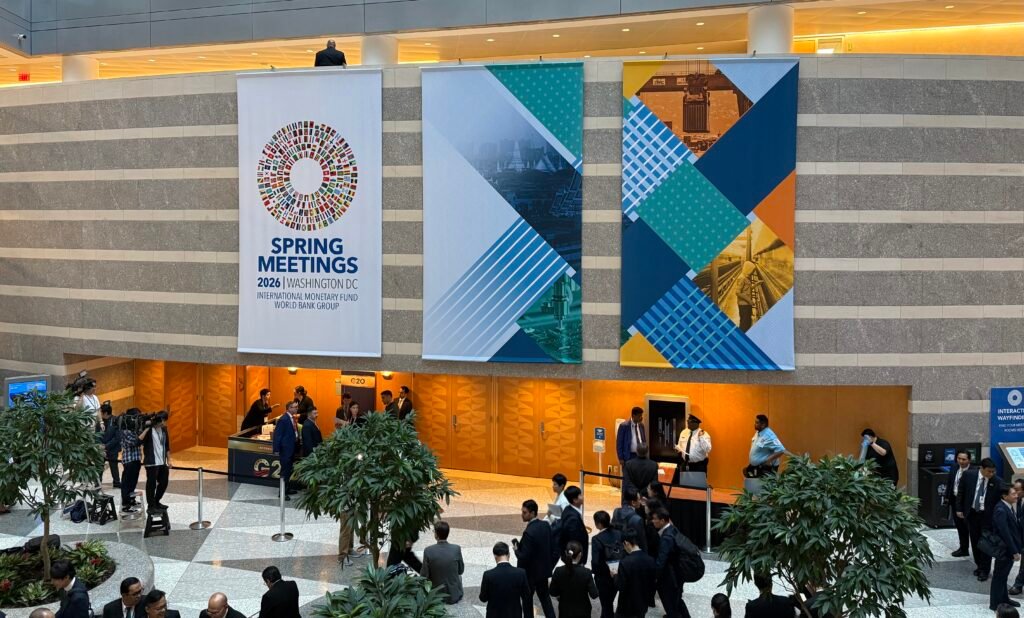
Walking into the International Monetary Fund and World Bank Spring Meetings this year, I expected to hear about inflation, growth forecasts, and policy frameworks. What I did not expect was how much of the conversation would center around uncertainty, not as a temporary phase, but as the defining feature of the global economy, something that felt far more real than anything I had studied in the classroom.
As a student of international affairs and economics, I have studied global shocks in textbooks. But hearing policymakers like IMF Managing Director Kristalina Georgieva speak about “persistent uncertainty” made those ideas feel far more real. The tone across panels was clear. The world is no longer dealing with isolated crises, but with continuous disruptions, from geopolitical conflict to energy shocks and fragile supply chains.
What struck me most was the shift in how globalization itself is being understood. In class, we often learn about efficiency and comparative advantage as the foundations of global trade. At the meetings, however, the conversation had clearly evolved. Policymakers spoke about moving from “just in time” systems to “just in case” ones, prioritizing resilience over pure efficiency.
Sitting in those sessions, it became clear that globalization is not ending. It is being reshaped by risk.
Advertisement
One moment that stayed with me was a discussion on the impact of the war in the Middle East. While headlines often focus on geopolitics, the conversations here unpacked the deeper economic ripple effects, including rising energy prices, inflationary pressure, and the strain on countries with limited fiscal space. What stood out was how uneven these impacts are. Some economies may benefit from higher oil prices, while others, especially energy importing and tourism dependent countries, face significant challenges. It reinforced something I have been thinking about more recently. Global crises are rarely shared equally.
Another insight I found particularly interesting was how constrained policymakers feel today compared to the past. With global public debt rising and inflation still a concern, governments have less room to respond aggressively to shocks. Several speakers emphasized the need for targeted and temporary policies, rather than broad subsidies. From a student perspective, this added nuance to how I think about policy trade offs. It is not just about what governments should do, but what they realistically can do given fiscal limitations in today’s constrained economic environment.
Beyond macroeconomic discussions, I was also drawn to conversations around technology, particularly artificial intelligence. There is a lot of optimism about AI’s potential to boost productivity, but what I heard at the meetings was more grounded. The challenge is not just building advanced systems. It is implementing them effectively. For many countries, especially developing ones, the costs of integrating AI into existing systems remain a major barrier. This raised an important question in my mind. Will technological progress narrow global inequalities, or widen them further?
At the same time, what gave me a sense of optimism was the continued emphasis on cooperation. Despite geopolitical tensions, there was a strong recognition that countries cannot navigate these challenges alone. Whether it was coordination between institutions like the IMF and World Bank or broader calls for collective action, the idea that global problems require shared solutions came through consistently.
From a personal standpoint, attending the Spring Meetings was more than just an academic experience. It was a reminder of why I chose to study international affairs & economics in the first place. Being in rooms where these conversations are happening, where decisions can shape economies and livelihoods across the world, made the field feel tangible in a way that no classroom ever could.
It also made me reflect on my own role going forward. As students, we often engage with theories and models, but spaces like this highlight the importance of applying those ideas in complex, real world contexts. The challenges discussed at the meetings, including economic instability, inequality, and technological disruption, are not abstract problems. They are issues that will define our generation.
My biggest takeaway was that the global economy is not becoming simpler. It is becoming more complex, more interconnected, and more uncertain. At the same time, this uncertainty also creates an opportunity to rethink existing systems, strengthen resilience, and move toward a more balanced and sustainable approach to growth in the near future.
Lastly, if there is one thing I will take away from this experience, it is this. Uncertainty does not mean inaction. If anything, it demands better thinking, stronger cooperation, and more intentional leadership.
Disclaimer: The opinions and views expressed in this article/column are those of the author(s) and do not necessarily reflect the views or positions of South Asian Herald.