
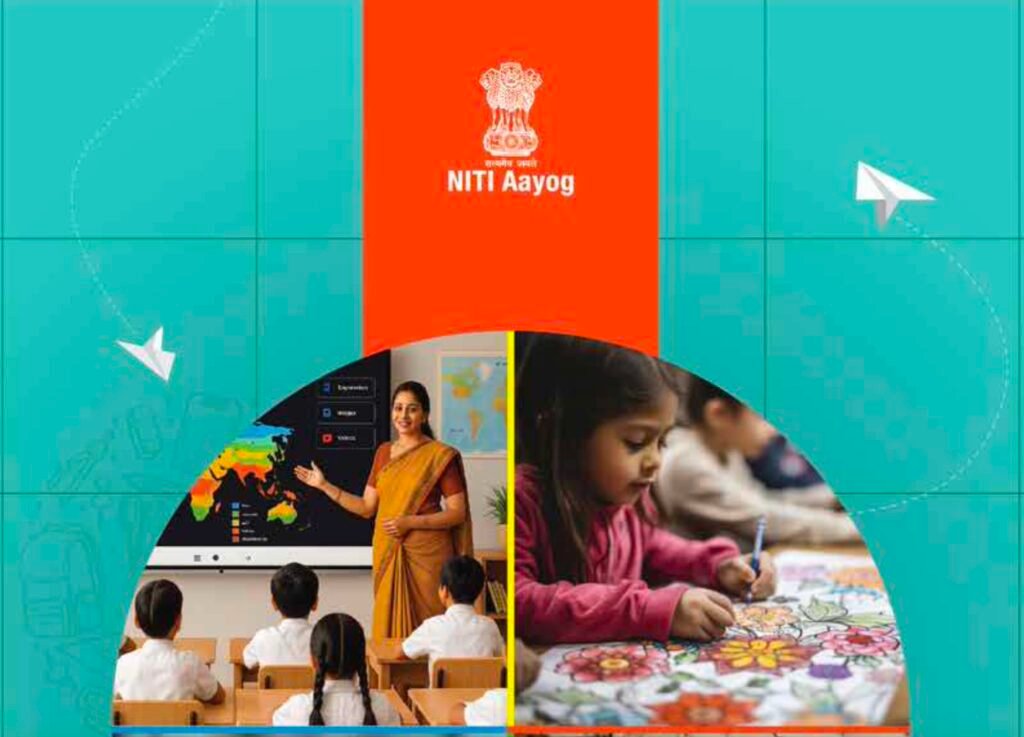
India’s bid to emerge as a developed economy by 2047 may hinge less on industrial expansion or digital infrastructure than on whether it can transform the world’s largest school system into one capable of producing a globally competitive workforce.
That is the broader implication of a sweeping new report released by NITI Aayog, which argues that despite major gains in school access and infrastructure over the past decade, India still faces a deep learning and governance crisis that could shape the trajectory of its economic rise.
The report, School Education System in India: Temporal Analysis and Policy Roadmap for Quality Enhancement, presents a decade-long assessment of India’s education sector at a time when the country is increasingly central to global growth forecasts, supply chain diversification and technology-driven labor markets.
India today operates approximately 1.47 million schools serving more than 246.9 million students with over 10 million teachers, making it the largest education network in the world by scale. Government-run schools account for more than two-thirds of all institutions and educate nearly half the country’s students.
Advertisement
The sheer magnitude of the system makes India’s education reforms globally significant. No other country is attempting to modernize an education structure of comparable size while simultaneously trying to reposition itself as a manufacturing, technology and services hub in the global economy.
The report suggests India has made substantial progress in expanding access to education. Over the past decade, the country has improved school electrification, sanitation, internet access and digital classroom infrastructure. Enrolment among girls and historically disadvantaged communities has also risen steadily across educational levels.
Yet the study’s broader assessment is more cautionary than celebratory.
The report effectively argues that India has solved much of the “schooling” problem without fully solving the “learning” problem.
While primary-level enrolment is now close to universal, educational continuity weakens sharply as students move upward through the system. The Gross Enrolment Ratio at the higher secondary stage stands at only 58.4%, exposing a significant structural bottleneck in human capital formation.
For a country seeking to become a major advanced manufacturing and digital economy, that gap is economically consequential. Secondary education increasingly serves as the minimum threshold for participation in higher-productivity sectors linked to automation, artificial intelligence and advanced services.
The report warns that India’s school system still resembles a narrowing pyramid in which large numbers of students disappear at successive educational stages, particularly after upper primary school.
To address this, the report advocates restructuring the school system around larger composite schools and integrated school complexes designed to improve resource-sharing, retention and continuity. The proposal reflects growing concern within Indian policymaking circles that fragmented school structures — including thousands of small and single-teacher schools — are limiting educational quality and administrative efficiency.
The findings also highlight the widening distinction between access to education and actual preparedness for modern labor markets.
Learning outcomes, according to the report, are improving gradually following pandemic-era disruptions, particularly in foundational literacy and numeracy. Government initiatives such as the NIPUN Bharat Mission and implementation of the National Education Policy 2020 have contributed to recovery in basic reading and arithmetic competencies.
But the report repeatedly points to deficits in comprehension, critical thinking, interpretation and application-based learning — skills increasingly essential in knowledge-intensive economies.
That challenge mirrors concerns raised globally by institutions such as the World Bank and UNESCO, which have warned of a broader “learning poverty” crisis across developing economies where students spend years in school without acquiring age-appropriate competencies.
India’s case carries particular weight because of its demographic scale.
As ageing populations in Europe, East Asia and parts of North America create labor shortages over the coming decades, India is expected to remain one of the few major economies with a large and expanding working-age population. Whether that demographic advantage becomes a long-term economic asset will depend heavily on educational quality.
The report’s emphasis on foundational learning reflects recognition that weak early-stage competencies create cumulative deficits throughout the education cycle. It calls for extending literacy and numeracy interventions beyond Grade 3 while shifting away from rote memorization toward competency-based learning and continuous assessment systems.
Technology occupies a central place in the proposed reforms, but the report also reveals the limitations of digital expansion alone.
India has significantly increased access to computers, internet connectivity and smart classrooms over the past decade. Yet large disparities persist between urban and rural schools, wealthier and poorer states, and large and small institutions.
The report advocates broader use of digital learning systems and artificial intelligence in classrooms, teacher training and educational administration. But it also implicitly acknowledges the risk that technological solutions may deepen inequalities if institutional capacity and teacher readiness remain uneven.
Teacher management emerges as another major fault line.
Despite employing more than 10 million teachers, India continues to face uneven deployment, vacancies in government schools and shortages in specialized teaching staff. The report calls for reforms in recruitment, professional development, leadership training and workforce planning, alongside stronger accountability mechanisms.
At the governance level, the study identifies fragmented administration and weak local institutional capacity as key barriers to reform implementation. It recommends stronger school management committees, decentralized planning systems and district-level quality task forces to improve accountability and local responsiveness.
The report also highlights a politically sensitive trend: the growing dependence on private education.
Although government schools remain dominant numerically, rising numbers of Indian families are shifting toward private institutions, driven by perceptions of better English-language instruction, stronger discipline and improved learning outcomes.
That shift reflects a broader pattern visible across many emerging economies, where rapid expansion of public education has not always translated into public confidence in educational quality.
Still, the report stops short of endorsing privatization as the answer. Instead, it argues for large-scale public-system reform backed by measurable implementation targets, phased timelines and over 125 performance indicators spanning federal, state and local governance structures.
The report’s larger message is that India’s education challenge is no longer primarily about building schools or increasing enrolment. It is about whether the country can redesign its education system quickly enough to match the demands of a changing global economy.
That makes the debate far larger than education policy alone.
India’s classrooms will help determine the future quality of one of the world’s largest labor forces, the sustainability of its growth ambitions and its ability to compete in increasingly technology-driven sectors.
The report ultimately argues that incremental reform will not be sufficient. What India requires, it says, is a “system-wide transformation” involving governments, communities, industry, civil society and educational institutions working in coordination.
Whether that transformation succeeds may shape not only India’s economic future, but also the global economy’s next major growth story.