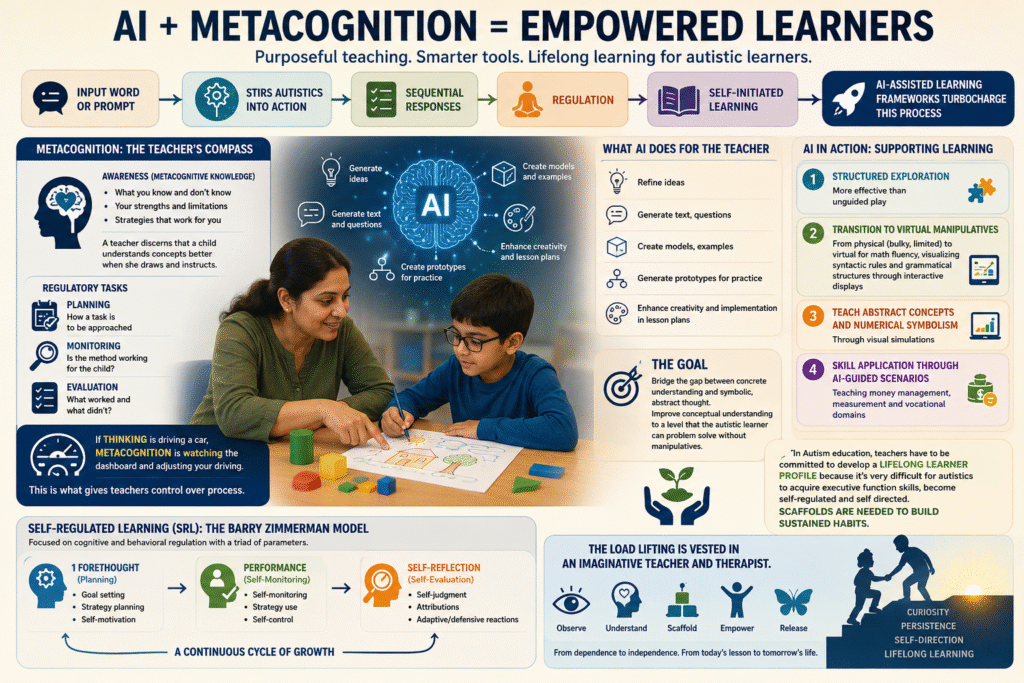
An input word or a prompt can stir autistics into action, sequential responses, regulation and even self-initiated learning. AI-assisted learning frameworks can turbocharge this process since AI architecture is based on cognitive psychology and mathematical probability. In terms of core ideas, education and therapy strategies what are the lessons for Special Educators and Therapists?
Cognition is passé; welcome to the era of metacognition. At the heart of metacognition are awareness tasks like – what you know and don’t know, your strengths and limitations, strategies that work for you. This, in a teaching environment would mean a teacher is able to discern that a child understands concepts better when she draws and instructs. This is metacognitive knowledge. From this flow all the regulatory tasks that a teacher has to perform – planning (how a task is to be approached), monitoring (is the method working for the child) and evaluation (what worked and what didn’t). To give a simple analogy, if thinking is driving a car, metacognition is watching the dashboard and adjusting your driving. This is what gives teachers control over process.
What AI does for the teacher is: refine ideas, generate text, questions, create models, examples, generate prototypes for practice and enhance creativity and implementation in lesson plans. There is support in terms of (i) structured exploration – considered more effective than unguided play (ii) transitioning students from physical manipulatives that are bulky and limited to virtual manipulatives for math fluency, visualizing syntactic rules and grammatical structures through interactive displays (iii) teaching abstract concepts and numerical symbolism through visual simulations (iv) skill application for teaching money management, measurement and vocational domains through AI-guided scenarios.
The goal is to bridge the gap between concrete understanding and symbolic, abstract thought, improve conceptual understanding to a level that the autistic learner can problem solve without manipulatives. In Autism education, teachers have to be committed to develop a lifelong learner profile because it’s very difficult for autistics to acquire executive function skills, become self-regulated and self directed. Scaffolds are needed to build sustained habits. A good method of self-regulated learning (SRL) is the Barry Zimmerman model. How we can apply SRL to Autism education; let us see. The load lifting of this model is vested in an imaginative teacher and therapist. This model is focused on cognitive and behavioral regulation and has a triad of parameters.
Advertisement
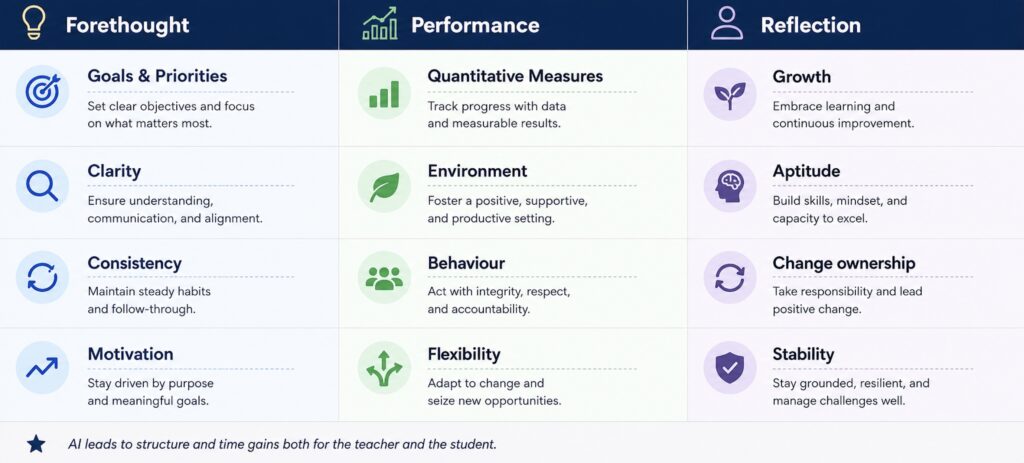
Carry out this exercise for your student and see what you find, give the data to an AI tool like ChatGpT or Microsoft Co-Pilot for IEP iteration. In learning and education, this approach is an application of metacognition, which is strongly linked to better problem solving, higher academic performance and regulation.
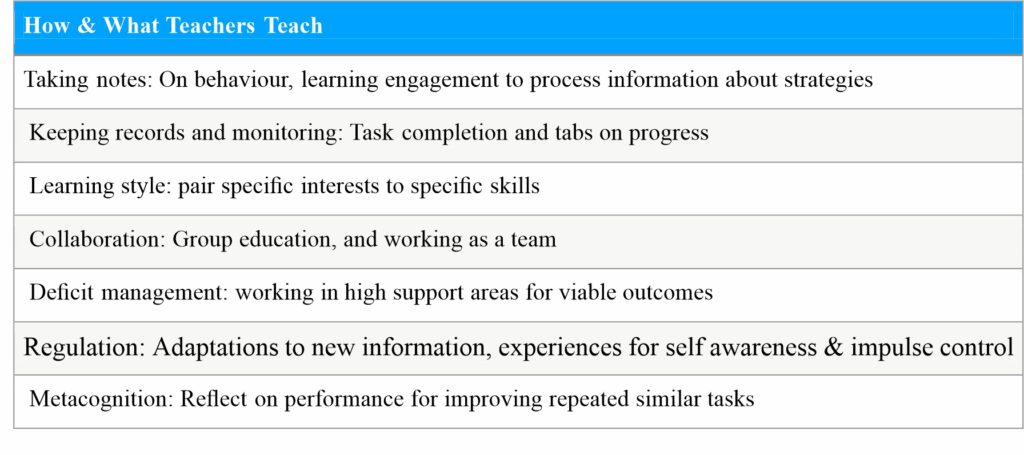
AI is a great time saver. Curriculum review is time and labor-intensive as is identifying strengths, gaps, and interdisciplinary opportunities. Teachers can move from covering subjects in silos to creating connections and concrete collaborations where subjects naturally reinforce each other, for example speech-language therapy sessions and grade level English syllabus. Skills, competencies projects and enrichment activities, course outline to IEP lesson plans and assessments – are all enhanced by AI analysis and insights. Of course, the ultimate curriculum analyst is the Teacher for it is S/he who decides explicit prompt criteria, structured output format, contextualizes and makes iterative refinements.
The EF Challenge
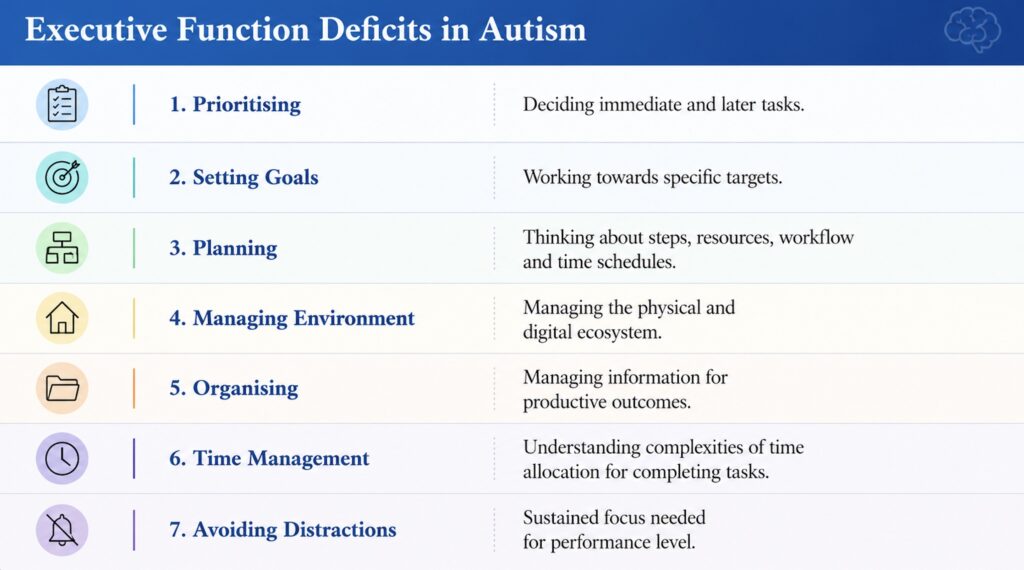
Executive function skilling are sessions on the go, permeating all domains. They help in reducing stress, distractions & burnouts. Calming oneself, not getting overwhelmed when presented with a task, learning concepts rather than cramming are the beneficial impacts of such an approach. Since EF sessions are interactive, they reinforce learning and help the autistic student develop his own agency and sense of priority.
Teachers have to expend a lot of time consistently to first introduce and then develop this capacity. Weekends and holidays should be home-based learning days facilitated by teachers, therapists and co-designed my parents. This creates joint ownership and navigation of learning programmes and a feedback loop across stakeholders. This can be customized for growing up years.
AI stack in schools
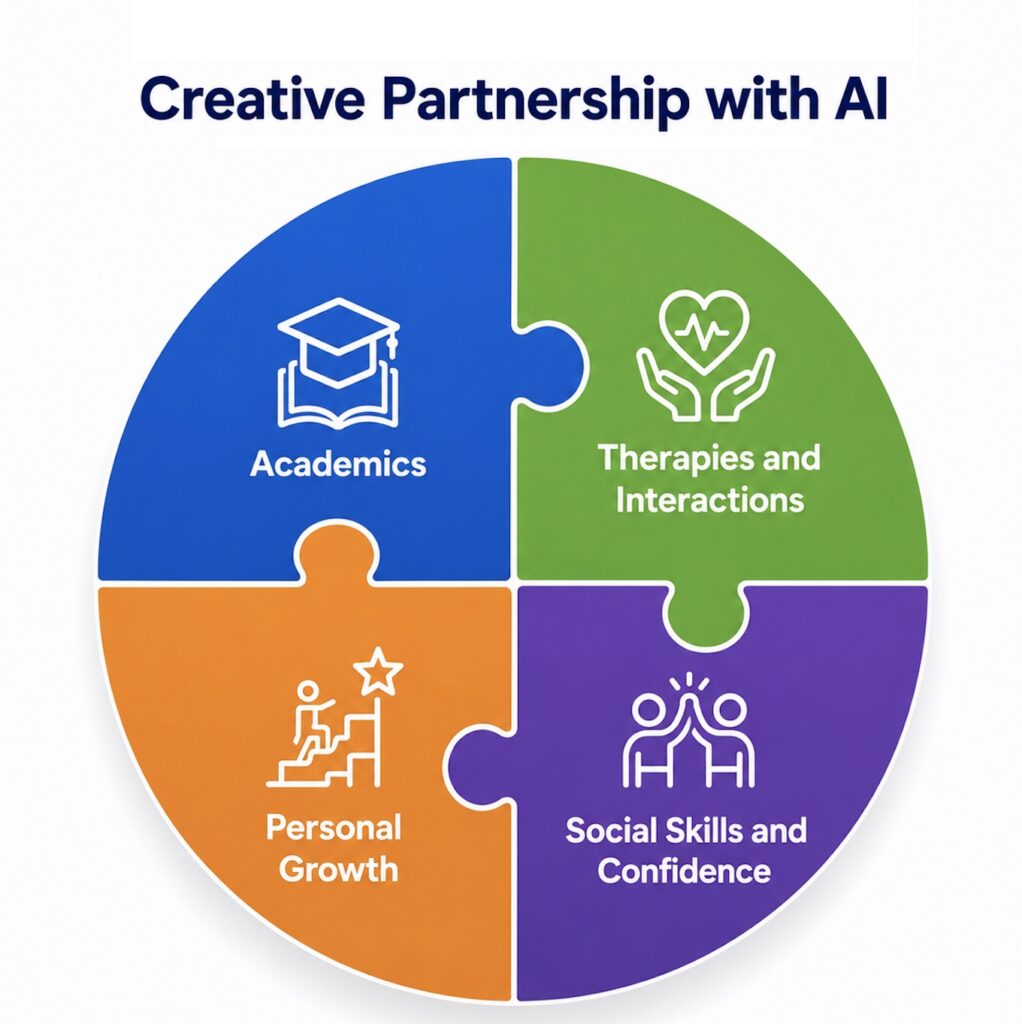
Use of AI has to be balanced with human interaction. When the teacher is at the heart of improving education, the guardrails against increased screen time are in place; skills that require protection from automation are identified. In any lesson routine, AI can be used for explaining a concept, practicing a skill, preparing an assignment, seeking improvements and exploring new domains. An autistic learner through guided design and interaction can effectively use AI and achieve closure that he struggles with for a task.
The teacher designs prompts, AI probes thinking, the autistic student engages, the teacher assesses and tracks use. AI can improve learning only because of a teacher’s design. For the autistic learner, the teacher is central to the AI-Human synergy. While AI brings practice breadth and processing speed, the teacher brings purpose, intent, emotional meaning and behavioral nuances.
Schools are uniquely human experiences, nurtured with feeling and interactions where students gather their personalities. AI is a powerful recombinant when it is embodied in this relational structure. It ought to be protected since computational gazing risks hollowing this out. Guidelines of AI policy and use thus have become an integral part of school culture. The deeper question facing special education is no longer whether AI should enter autism classrooms. It already has. The real question is whether educators will understand AI merely as software — or as a new language of learning itself. Because for many autistic learners, prompt-based structured prediction is not artificial at all. It may be one of the most natural educational architectures they have ever encountered.
So, while making a choice, educators must see that the AI stack they create is scalable, fungible and versatile. It should be able to address EIP to grade level teaching since autistics have difficulties in changing user interfaces. It has to be useable in traditional variants of pen and paper. It should serve both academic and therapeutic domains – versatility. As a teaching team, teachers and therapists benefit from a shared language and standards, lesson alignments and curriculum coverage. However, preserve manual days – work without AI on some days to retain thinking without AI. If you are a team leader, your focus should be on diversity of the total output pool. Ensure AI does not lead to echoic input strategies and identical plans.
How to measure student agency in AI-Assisted learning
Teachers/therapist can use the following framework to integrate AI in their lesson plans for IEPs, therapy sessions, projects, structured & unstructured workflows. This is not a static design. The Notes column is your context-based customisation. The goal is a tool that works for you.
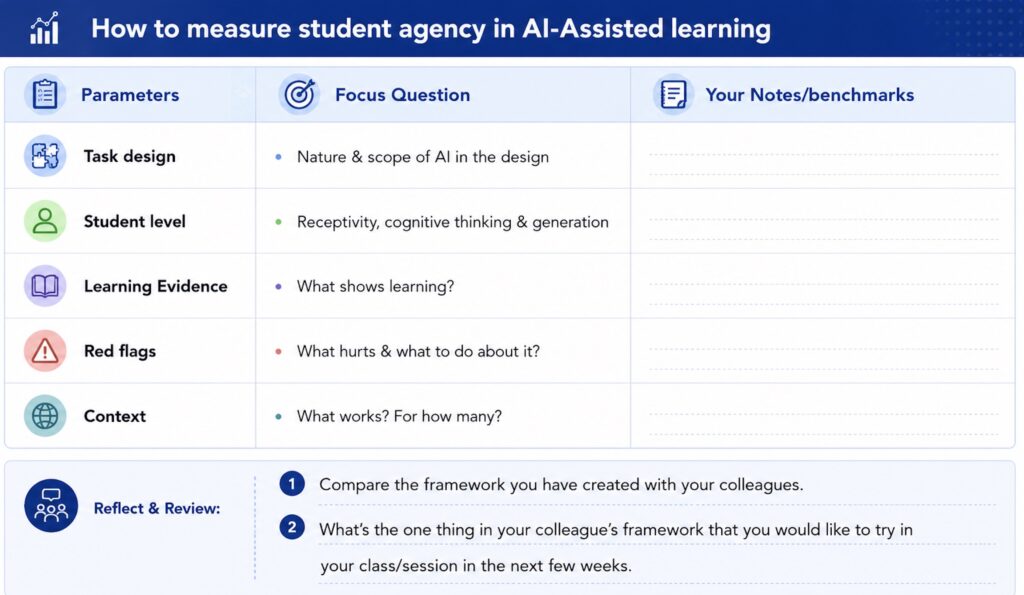
This framework creation and exchange will help teachers to use AI for acing teaching impact. AI interventions in pedagogy is beneficial when integrated with a rigorous design by teachers who exercise their mental muscles for problem framing, originality and aesthetic judgment – precisely the factors which run the risk of being lost. Teachers need to be conscious of what is a creative intent task (purposive & context based) and what is a machine efficiency task (rapid fire brainstorming for shoring up ideas and draft speed). The swap ratio is the teacher’s expertise. For example, with machine efficiency, many IEP drafts can be created but how to individualize and create resonance – that differentiator is wholly in the teacher’s ambit. There has to be an absolute clarity about what is the teaching role and what is the AI role. In the context of teaching autistic children, there are many things that AI cannot replicate or replace.
Teaching the Teachers
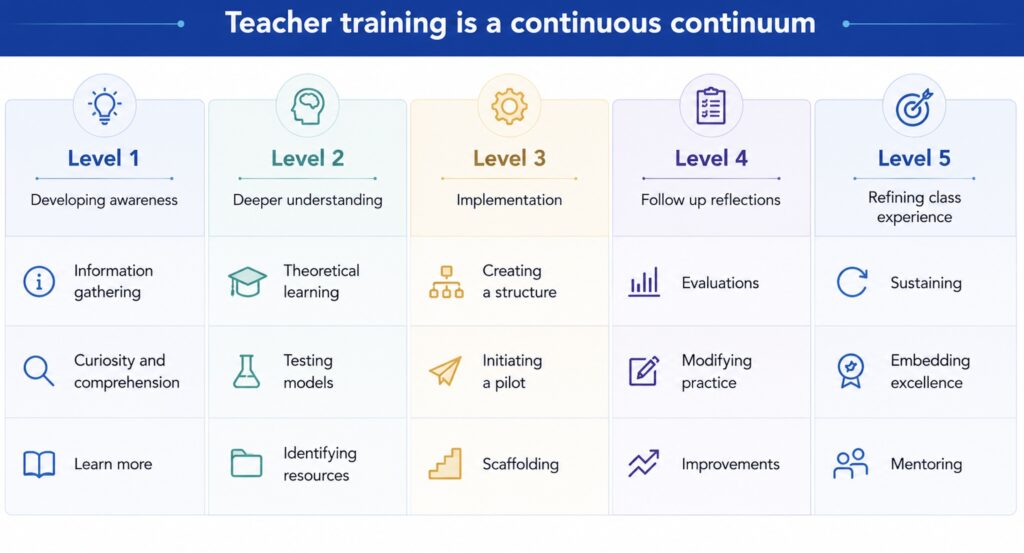
AI prompts can be used for crisis management, and preparing plans for unprecedented situations. Teachers can upload original videos of challenging behaviors, therapy, and education plans into Notebook, LM gain insights and research ideas.
Conclusion
Whilst AI gives a significant quality floor when there is a new topic or many options are to be created, in a multi-department school situation, if the human edge is lost, there is a real possibility of collective loss in terms of unique expertise, ideas, and heterogeneity of thinking. In fact, AI performance itself is dependent on this heterogeneity, deprived of this AI performance will drop significantly.
What is the one golden rule, you would like to see for AI use in your school?
Disclaimer: The opinions and views expressed in this article/column are those of the author(s) and do not necessarily reflect the views or positions of South Asian Herald.