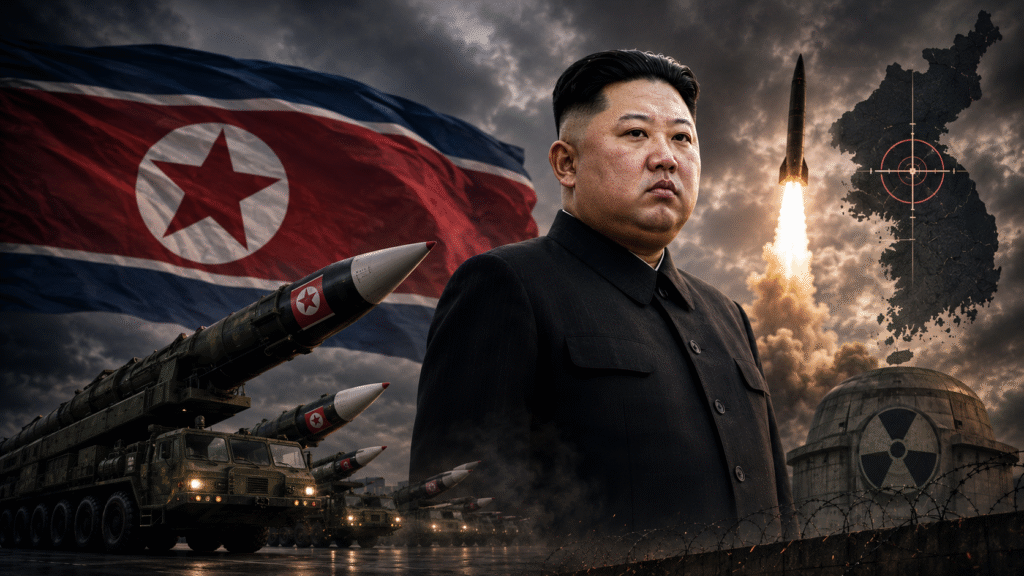
Chairman Kim Jong Un of North Korea does not have to try hard to be in the news. If he is not giving instructions how to fine tune production of missiles or busy at test launches, he is firing off a few dummies into the Sea of Japan with a view to intimidating his neighbors.
All this is not to forget his constant tirades against the United States and South Korea, principally for the joint military exercises. The war in the Ukraine gave Chairman Kim the opportunity to send hundreds of North Korean troops to fight for Russia, many of them having returned in body bags.
But the war against Iran has given the North Korean leader another ‘bright’ idea: to amend the country’s nuclear doctrine in a way to authorize “automatic and immediate nuclear retaliation” in the event Chairman Kim is killed or incapacitated, and if even the leadership is targeted. The change to the nuclear doctrine has been codified by law and given a constitutional cover and should be seen in the context of a 2022 law that allowed pre-emptive nuclear strikes if a “fatal military attack” on strategic targets is seen imminent. The change in the nuclear doctrine can also be seen as an insurance in not being targeted personally.
Chairman Kim’s obsession with nuclear weapons is a known fact and he has ruled out any negotiations for de-nuclearization. In other words, a defiant signal to the international community that Pyongyang’s status as a nuclear weapons state is irreversible. Now a formal 2026 Constitutional Amendment for retaliation should the safety of the leadership is in jeopardy. For a country that has withdrawn from the Non-Proliferation Treaty, analysts maintain that the latest protocol shows a doctrine moving away from nuclear weapons as a deterrent to full integration into a strategy aimed at preventing any wipe out of the leadership.
Advertisement
By himself Chairman Kim does not need any bright ideas, but certainly it would seem that he has taken the clean up of Iran’s military and political leadership by Israel—with or without inputs from the United States—quite seriously. What makes this development particularly chilling is that there are no windows open to errors in communication or even an ounce of time to see and analyze motives in the event of a cyber-attack, for instance. Many intelligence agencies resort to jamming operations prior to a conventional attack; in the case of North Korea a message is being sent to adversaries to not even fool around with such strategies as the consequences of interpretation could lead to a full-fledged disaster.
The changes to the nuclear protocol must be seen in the light of yet another recent constitutional change that removed all references to reunification with South Korea and in the process seeing its neighbor in the South more of a permanent-cum-hostile enemy. That would essentially remove one of the long-held ambition of many in the two Koreas of a peaceful re-unification; and of a hope in the region and elsewhere. In the past governments in Seoul and Pyongyang had taken steps to at least bring together families that have been separated with South Korea offering several economic sops to facilitate the occasional process. Now there is a big question mark on the future.
For a country that proudly flashes its nuclear badge and is said to have some fifty warheads, the recent announcements coming out of North Korea will not be taken easily by its neighbors. On the one hand it does light up tensions in the border with South Korea; and on the other hand accelerate higher defense outlays in Japan where the government is already under pressure to break away from its Pacifist Constitution. Worse, flagging the nuclear card only gives ideas to non-nuclear states to start thinking afresh on an option that will run counter to the predominant view in the region and elsewhere.
The new threat coming out of Pyongyang by itself will set the governments in South Korea and Japan thinking of how to re-adjust their military and defense strategies. And some of the thinking will also be on how to assess the response of Washington to the new developments; and in the extent to which the American nuclear umbrella would be viable or even guaranteed. As it is there is a perception that Japan is just a “screwdriver” away from assembling a nuclear weapon even if some believe that this cannot happen given the horrors of Hiroshima and Nagasaki. And it does not take much to start a nuclear debate in South Korea.
Seven decades after the end of the Second World War, there are still some nations in East and Southeast Asia who express unease with Japan given what had happened during the Imperial Era even if that East Asian economic powerhouse has fully integrated into the international system and contributed to maintaining global order. At the same time Tokyo has had to factor its strategic calculations given China’s actions in the Indo Pacific especially pertaining to navigation in the South China Seas. And Tokyo sees North Korea as a major de-stabilizing force in the East Asian neighborhood for quite some time now.
The war in the Middle East may have many lessons for world leaders, the first being to have objectives mapped before venturing, not shopping around after the fact. Gloating over the successes of intelligence agencies in identifying and eliminating adversaries is one thing: not giving ideas for that one bright flash of light.
Disclaimer: The opinions and views expressed in this article/column are those of the author(s) and do not necessarily reflect the views or positions of South Asian Herald.