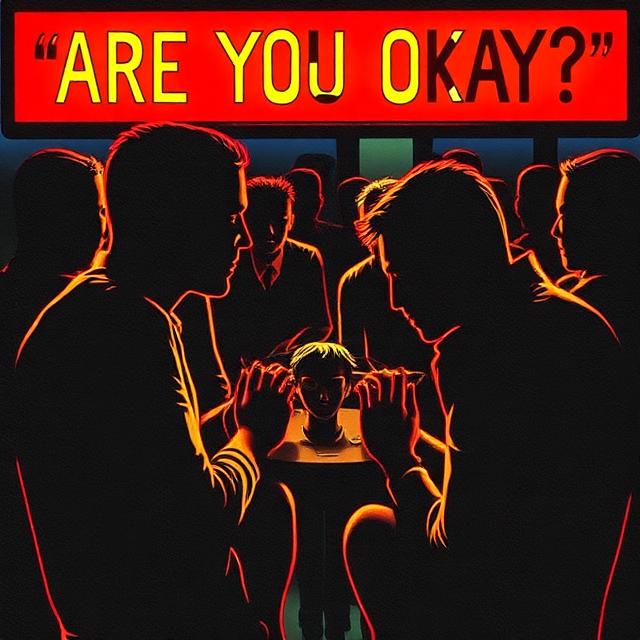
In today’s fast-paced world, where productivity is often celebrated, many people have forgotten to take a moment and ask themselves one simple but crucial question: “Am I truly okay?”
Life has turned into a constant race to achieve more, earn more, and prove our worth. While some people seem calm and composed under pressure, others quietly struggle with the weight of expectations. Yet society still finds it difficult to accept that not everyone copes the same way, and that is completely okay.
Around the world, discussions about mental health have grown louder over the years, but acceptance still lingers behind closed doors. People often learn to hide their emotions rather than express them. Vulnerability is masked by phrases like “be strong” or “move on.” Seeking therapy is frequently misunderstood as a sign of weakness rather than bravery. As a result, many individuals carry silent battles within themselves, smiling through conversations and attending work while feeling emotionally drained inside.
According to the World Health Organization, suicide is the third leading cause of death among people aged 15 to 29 worldwide, with more than 720,000 dying by suicide each year. These numbers are not just statistics; they represent lives silently burdened by pain, loneliness, stress, and emotional exhaustion.
Advertisement
Mental health awareness isn’t just about disorders or clinical terms. It’s about understanding the emotional realities of being human. Stress, grief, anxiety, self-doubt, loneliness, burnout, and fear are experiences that connect people across generations and cultures. Sometimes, the person laughing the most in a room may also be the one quietly asking for help inside.
What makes this struggle even more significant is how human connection has changed over time. Childhood evenings, once filled with laughter in playgrounds, have gradually been replaced by endless scrolling on screens. Social media and instant messaging have taken over real conversations, and despite being digitally connected all the time, people feel more emotionally isolated than ever. We are surrounded by notifications, yet many no longer take the time to sit beside a loved one and ask, “How are you… Really?”
At some point, society started expecting people to act like machines—productive, efficient, and emotionally unaffected. But behind deadlines, achievements, and carefully crafted smiles, some hearts still feel deeply. People carry emotions they often can’t explain: the pressure to succeed, the fear of failure, and the loneliness veiled by busy schedules. We forget that feelings aren’t flaws; they show we are human. Experts increasingly stress that mental health deserves the same attention and care as physical health.
This understanding is central to the work of psychologist, author, and TEDx speaker Dr. Minu Budhia, founder of Carring Minds International in Kolkata, West Bengal, India. Established in 2013, it is one of East India’s first integrated mental health care centers, offering diverse care under one roof. Through counseling, advocacy, and community outreach, Dr. Budhia has continually highlighted that emotional well-being deserves the same care and importance as physical health.
One of the most touching reflections of this perspective can be found in her book, The Death of a Caterpillar. Rather than simply focusing on pain, the book explores transformation, resilience, and the emotional evolution individuals experience through life’s challenges.
She has become a voice for the unheard, and one of her beliefs is still highly relevant today: “Mental health should be a dining table discussion.” Healing often begins not with solutions, but with conversation, understanding, and the comfort of knowing someone is willing to listen. As Lewis Carroll wrote in Alice’s Adventures in Wonderland, “We are all mad here.” Perhaps the true beauty of being human lies not in pretending to be perfect, but in accepting that it is completely okay to be perfectly imperfect.
Disclaimer: The opinions and views expressed in this article/column are those of the author(s) and do not necessarily reflect the views or positions of South Asian Herald.