Join WhatsApp Channel

“One tree alone cannot make a hill; three trees together make a high mountain.” – Vietnamese proverb
Walk through Da Nang or Hanoi today, and it is not unusual to hear Hindi, Tamil, Gujarati, Punjabi, or Telugu in hotel lobbies, cafés, airport queues, and beach promenades. Indian families arrive for holidays, couples for pre-wedding shoots, young travelers for food and nightlife, and business delegations with an eye on manufacturing, energy, and supply chains. Vietnam, once distant in the Indian imagination, now feels much closer.
Tourism often tells a geopolitical story before governments admit one. When people move regularly between countries, trade follows, habits change, and diplomacy finds firmer ground. Vietnam is no longer a sentimental entry in India’s old Asia file. It is becoming part of India’s working map of the Indo-Pacific.
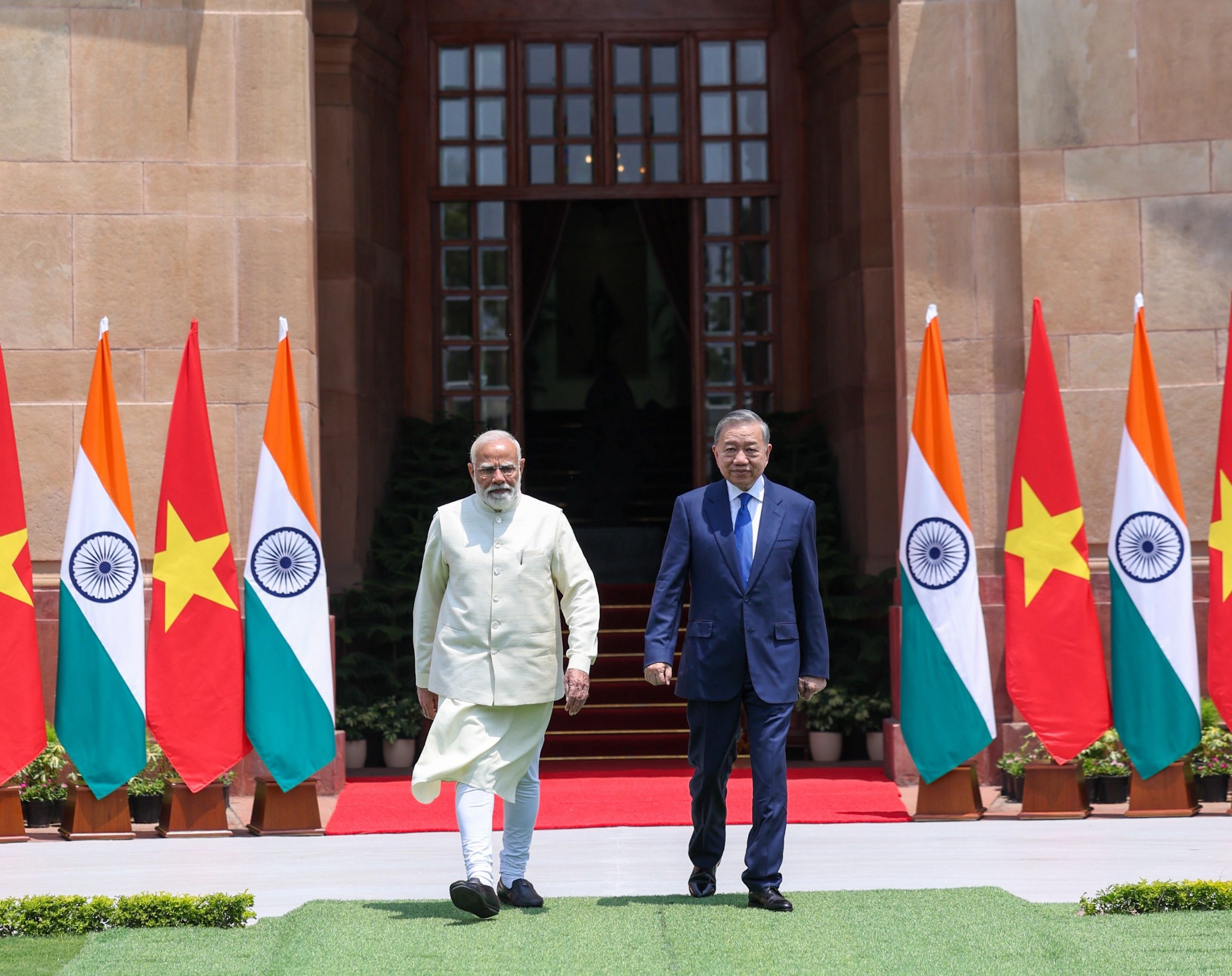
In early May, President To Lam visited New Delhi. The mood was cordial, but the agenda was hard. India and Vietnam elevated their relationship to an Enhanced Comprehensive Strategic Partnership, established a $25 billion trade target for 2030, and expanded cooperation in critical minerals, rare earths, energy, supply chains, digital services, and security. The joint statement described this new phase as one of “shared vision, strategic convergence, substantive cooperation.”
A month later, the finer details began to emerge. At the Shangri-La Dialogue in Singapore, India’s Defense Secretary Rajesh Kumar Singh confirmed the signing of a BrahMos missile agreement with Vietnam. Official financial terms remain undisclosed, but previous reports estimated the value at approximately ₹60 billion, or $629 million, including operational and logistical support. What first looked like geopolitical signaling has now moved into concrete arrangements involving financing, field support, and delivery.
BrahMos is not a side note in this relationship. For years, bilateral ties rested on cultural links, political trust, trade, military instruction, and development cooperation. Those foundations still matter, but the relationship is acquiring a sharper security edge. Given its cost, reach, and geopolitical weight, BrahMos has become an important spoke in a wheel, linking older confidence with a more consequential security partnership.
Vietnam may not share a border with India, but it is part of India’s wider neighborhood. Proximity should not be read as land borders alone. Sea routes, ports, supply chains, energy flows, digital networks, and military pressure create their own neighborhoods. Vietnam sits near some of Asia’s most contested waters and has learned, through experience rather than theory, what it means to defend sovereignty against stronger powers. Hanoi does not need India to speak for it. Precisely for that reason, Vietnam matters to India.
The BrahMos initiative marks a shift in India’s diplomatic approach. New Delhi has often described itself as a responsible security provider, a net security contributor, and a credible actor in the Indo-Pacific. Such phrases are useful only if they are backed by platforms supplied, instruction delivered, logistics sustained, and confidence built over the years.
BrahMos began as an India-Russia joint venture between the Defense Research and Development Organization and Russia’s NPO Mashinostroyenia, formalized in 1998. Its name joins two rivers, the Brahmaputra and the Moskva, fitting for a platform born from collaboration but increasingly associated with India’s military-industrial ambition. It is not a tale of instant self-reliance or pure domestic invention. It is a more believable narrative of partnership, learning, engineering absorption, production capacity, military adaptation, and export confidence.
Manila provided the first proof that India’s arms-export record had crossed from aspiration into credibility. In January 2022, BrahMos Aerospace signed a roughly $375 million contract with the Philippines for a shore-based anti-ship missile platform. First deliveries reached the Philippines in April 2024. For India, this agreement was not only commercial. A country facing pressure in the South China Sea trusted an Indian-origin weapon to fulfill a critical security need.
Vietnam gives that narrative sharper weight. Hanoi is not a passive buyer. It has a direct stake in the South China Sea and a careful tradition of balancing major powers without surrendering autonomy. Supplying BrahMos to Vietnam means supporting a partner that wants deterrence without dependence, and diplomatic space without alliance captivity.
India and Vietnam understand each other unusually well here. Neither country wants to live under the shadow of a single dominant power in Asia. Neither wants every choice to be fitted into someone else’s camp. Vietnam works with the United States, Russia, Japan, India, ASEAN, and others, according to its own calculations. India does the same across the United States, Russia, Japan, Europe, the Gulf, and Southeast Asia. Both countries know the value of options.
Security cooperation is often described in polite terms: exercises, exchanges, port calls, and capacity building. In reality, it is far more consequential. A missile sale is not like selling textiles, software, or pharmaceuticals. It creates a long relationship through instruction, maintenance, spare parts, upgrades, command familiarity, financing, and political confidence. Officers meet repeatedly. Technicians learn each other’s equipment. Governments build habits of consultation. Over time, an arms sale can become a long-term security relationship.
For India, BrahMos going east marks a substantive shift. New Delhi is offering capability to a country that wants deterrence without dependence. Southeast Asian states do not want lectures about freedom of navigation from countries that cannot deliver when pressure rises. They want capability, choice, and partners who do not ask them to surrender their own judgment.
No one should romanticize this either. Arms exports are unforgiving. Buyers will judge India based on timelines, financing, after-sales support, spares, instruction quality, maintenance, and upgrades. A high-value platform creates confidence only when it remains reliable after the ceremony ends. New Delhi will need faster coordination among the government, industry, and the armed forces. It will need clearer export financing and stronger support architecture. Dependability will be the real clincher.
For India, the deal carries a larger message. Act East is no longer just a phrase for speeches or joint statements. It is showing up in factories, on test ranges, in deliveries, and in the support that follows. New Delhi is not building an alliance bloc in Southeast Asia. It is giving partners room to maneuver.
Indo-Pacific politics is not waiting for declarations. It is being shaped by countries that can act. India has spent years saying it can be a credible security actor in Asia. With Vietnam, it now has a chance to show what that means in steel, capability, and staying power.
BrahMos has gone east.
Disclaimer: The opinions and views expressed in this article/column are those of the author(s) and do not necessarily reflect the views or positions of South Asian Herald.
Related posts:
 Putin’s Delhi Gambit: How a High-Stakes Visit Could Redraw India’s Geopolitical Map
 Putin Lands in New Delhi as India Reasserts Strategic Autonomy Amid Global Pressure
 Rubio’s Four-Day India Tour Carries Strategic Significance
 ‘We see it in citizens across the world peacefully choosing their future — from Ghana to India to South Korea’ says President Joe Biden during his UNGA Address