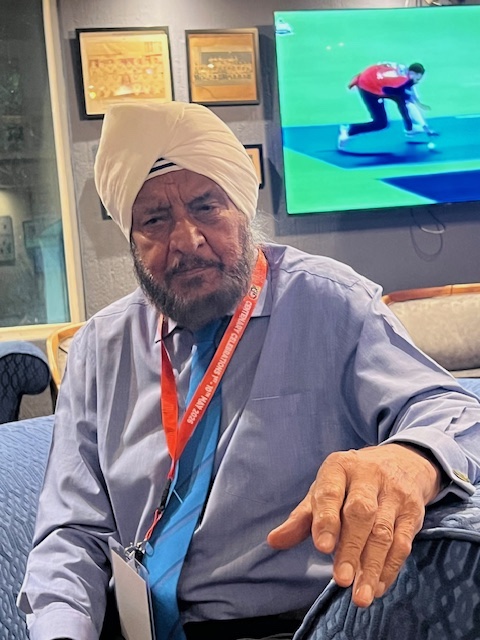
Born in Nairobi in 1938 to Pyara Singh and Parmesari Kaur, Avtar Singh Sohal grew into one of the most respected figures in international hockey, leaving a legacy that spans generations as a player, coach, umpire, technical official, and mentor.
The name “Avtar,” derived from the Sanskrit word “Avatara,” means “descent” and traditionally refers to the earthly manifestation of a deity. In many ways, Sohal embodied that spirit through his lifelong dedication to preserving and promoting hockey across the world.
Although hockey originated in Britain, Sikh athletes have played a major role in shaping the sport’s history. Among the most celebrated was India’s legendary Olympian Balbir Singh Sr., whose Olympic goal-scoring record remains unmatched. Sohal emerged from this rich tradition and carved his own distinguished place in global hockey.
Sohal was among only a handful of players named Avtar to achieve recognition at the international level. While Avtar Singh Bhurji represented Uganda at the 1972 Munich Olympics and another Avtar represented Malaysia at the 1976 Montreal Olympics, Sohal became synonymous with Kenyan hockey and Olympic participation.
Advertisement
Raised near the historic Sikh Union Club in Nairobi, Sohal initially considered cricket before eventually turning to hockey. Tall and athletic with powerful wrists, he excelled both as a cricketer and as a deep defender in hockey.
At the peak of his playing career during the late 1960s and early 1970s, Sohal witnessed the impact of Olympic boycotts that affected the Games in Montreal, Moscow, and Los Angeles. Those disruptions curtailed what many believe could have been an even greater Olympic legacy.
Despite those setbacks, Sohal’s commitment to the sport never diminished. Widely recognized as a “Sikh icon of global hockey,” he remained deeply involved in the game for decades. His remarkable Olympic journey includes participation in six Olympic Games: four as a player, one as coach of the Kenyan Olympic hockey team in 1984, and another as a Technical Judge in 1988.
For more than five decades, Sohal attended major international hockey events, including Olympic Games and World Cups. Throughout much of that journey, he was supported by his wife, Ripudaman Kaur of Chandigarh, who passed away recently following medical treatment in India.
Even amid personal loss, Sohal has continued overseeing the installation of a new deep blue hockey surface at Dasmesh Hockey Stadium of Sikh Union Club, a project he considers deeply meaningful for the future of Kenyan hockey.
“This brand-new surface has been made possible by donations from my friends the world over. No one could imagine that millions of dollars would pour in for this project that would help and take Kenyan hockey far ahead in coming years and decades,” said Avtar Singh Tari.
Reflecting emotionally on the project and the passing of his wife, he said, “we thought after the deep blue surface project, we would retire from hockey and live a retired life. We were wrong. God wished otherwise and has put me a greater test. I hope I keep my commitment to my wife and get the new surface operational in this centenary year of Sikh Union Club.”
Sohal recalled that several people initially suggested installing an older surface to reduce costs, but support from friends and faith in Gurdwara Reetha Sahib helped the project move forward. “Now it is there for all to see,” he said while standing beside the nearly completed facility.
He also expressed disappointment that former International Hockey Federation president Leandro Negre was unable to attend the inauguration due to his wife’s illness. Sohal had also invited several hockey legends, including Indian greats Harbinder Singh and Ajit Pal Singh, as well as friends from Pakistan.
A book documenting Sohal’s life and achievements has been compiled by longtime associate Daljinder “Del” Mudher. The publication includes contributions from friends, former players, and hockey writers who followed his nearly seven-decade-long association with the sport.
Sohal’s hockey journey began at City Primary School in Nairobi when he was seven years old. A decade later, he joined Sikh Union Club, and by the age of 19, he had earned his first international cap representing British Kenya against South Africa.
At 21, he played a central role in Sikh Union Club’s first M.R. D’Souza Gold Cup triumph. Soon afterward, his reputation as one of the finest deep defenders in the game earned him a place in the 1960 Rome Olympics.
Sohal later captained Kenya at the 1964 Tokyo Olympics and the 1968 Mexico Olympics before making his fourth consecutive Olympic appearance at the 1972 Munich Games, his third as captain.
After retiring from international competition in 1978 at age 40, Sohal remained active in the sport as a coach, umpire, and technical official. He coached the Kenyan Olympic hockey team at the 1984 Los Angeles Olympics and returned to the Games in Seoul four years later as an FIH Judge.
Beyond Kenya, Sohal also coached the national teams of Indonesia and Zimbabwe.
Even in his late 80s, Sohal continues to devote himself fully to hockey. Over the years, he shared the field with some of the game’s greatest names, including Indian legends Prithipal Singh, Gurbux Singh, Leslie Claudius, and Pakistani stars Hassan Sardar and Shahnaz Sheikh.
One of Sohal’s biggest regrets remains narrowly missing a podium finish at the international level. Kenya came close to a medal at the 1971 Hockey World Cup, losing 0-1 to India in the match for third place.
Today, many of Sohal’s personal hockey memorabilia, including uniforms, sticks, medals, and trophies, are preserved at the Avtar Singh Sohal Gallery within Sikh Union Club.
A devout Sikh, Sohal and his late wife regularly performed “Sewa” at Gurdwara Reetha Sahib in India, where they spent several months every year. Following her passing in Chandigarh, her Antim Ardas was held at the revered gurdwara in Uttarakhand.