If gaining independence in 1947 was India’s first coming, then the second was its economic reforms, launched in 1991-92; last week’s outcome of the four assembly elections can be called the third. It ensures a measure of both continuity of and departure from the first two.
India has entered a phase of high-octane political realignment and steady economic resilience. The results from West Bengal, Tamil Nadu, Kerala, and Assam have fundamentally redrawn the political map, signaling both a consolidation of central power and a vigorous resurgence of regional identities.
National politics is now defined by a struggle between a dominant central agenda (including the push for “One Nation, One Election”) and states asserting their economic and cultural autonomy. The South remains a formidable barrier to a uniform national wave.
The 2026 assembly elections have been described as a “political earthquake.” While the Bharatiya Janata Party (BJP) has fortified its presence, the opposition landscape is increasingly fragmented and state-specific.
Advertisement
The elections reflect the consolidation of the BJP’s hold in 21 states, covering 72 per cent of the country. Dubbed the “election machine” by critics, its Juggernaut is likely to continue to steamroll the rivals. The salami tactics it has been employing, splitting regional parties, are likely to continue.
And yet, the Congress, too, has gained, albeit in smaller measure. The alliance it leads has returned to power in Kerala. With just five winners in Tamil Nadu, it is poised to be part of the winning alliance after nearly 50 years of being out of power.
The ‘iffy’ opposition alliance, INDIA, has taken a big hit with three of its constituents, the Trinamool Congress of ousted West Bengal Chief Minister Mamata Banerjee, M K Stalin’s Dravida Munnetra Kazhagam (DMK) in Tamil Nadu and the Communist Party of India (Marxist) in Kerala, have lost. Indeed, Banerjee and Stalin lost even in their respective constituencies. And yet, India remains a multi-party polity. Parties do not wither away after being defeated.
Critics say the BJP has been employing “Sama Dam Danda Bheda” (Sama conciliation/negotiation), Daam (incentives/ money), Danda (force/punishment), and Bheda (division/ exploiting weaknesses). This is an ancient Indian diplomatic and strategic framework for achieving goals, often by hook or by crook. In effect, it has used the federal investigation and law enforcement agencies and, in some cases, the judiciary by tying down the rivals in court cases.
The election took place after an extraordinarily sweeping and deeply controversial “Special Intensive Revision” (SIR) of electoral rolls conducted by the Election Commission of India (ECI), ostensibly to remove duplicate, deceased or “ineligible” voters. Across West Bengal, more than nine million names — nearly 12 percent of the electorate — were initially flagged, removed or subjected to scrutiny during the exercise.
The exercise disproportionately targeted Muslims, migrant workers and poorer voters in districts where the BJP has historically struggled electorally. In many constituencies won by the BJP, the number of deleted or disputed voters exceeded the margin of victory.
The implications are grave. India may have crossed from electoral distortion into mass disenfranchisement.
The opposition has tried, though unsuccessfully, to censure the Speaker of the Lok Sabha, the lower house of Parliament and the Election Commission, especially Chief Election Commissioner, Gyanesh Kumar. The proceedings in parliament have seen long periods of disruption. The public discourse between the government, including the constitutional bodies, and the Opposition has been toxic.
The elections mark the end of rule by the Left parties, their last bastion being Kerala. The original Communist Party of India observed its centenary last year. Once a significant player, even a “kingmaker” and an effective advocate of socio-economic change, it will have fewer lawmakers at the central and state levels now. But as Congress lawmaker Shashi Tharoor has stressed, the Left needs to change its outlook and program to voice the aspirations of the poorer sections of society, the workers and the farmers who are suffering in the absence of the weakening of trade unions and means of collective bargaining.
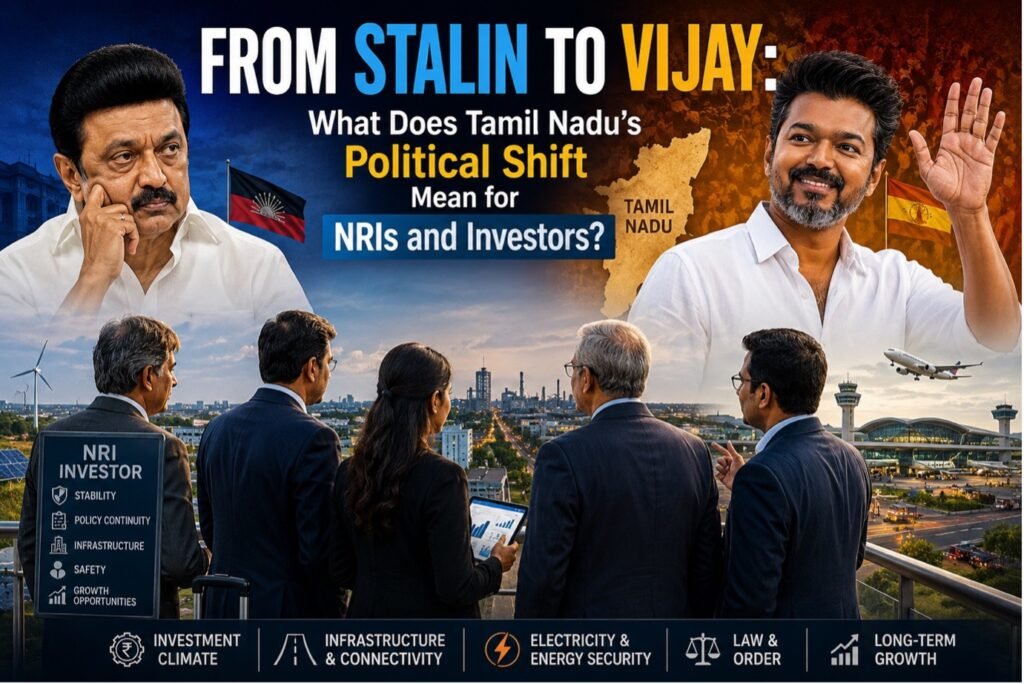
The other big change is in Tamil Nadu, which weakens the Dravidian movement that began in the 1930s. Both the DMK and the Anna DMK, which ruled by turns, have lost. The electorate has placed its faith in yet another film actor, Chandrashekhar Joseph Vijay, popularly known by the last name.
But Vijay, a Christian, has sworn by the pioneers of the Dravidian movement, stressed on social justice and secular values that, by implication, challenge the BJP’s majoritarian platform. On leading his two-year-old party to a victory that shocked everyone, he visited shrines of different faiths to make his point.
The West Bengal outcome represents the biggest takeaway from this month’s verdict. Historically, it has defined India, its period of renaissance and years of ruin. Bengal is where the story of Indian colonialism began after the Battle of Plassey in 1757, when the British East India Company defeated the Nawab of Bengal, transforming from a trading firm into the sword arm of British imperialism in South Asia.
Some 150 years later, the British partitioned Bengal in 1905 – the first major instance of division along religious lines in modern South Asia. That was also the year when the Muslim League was formed in Dhaka under British patronage. Four decades later, it emerged as the principal force that caused the Partition and the birth of Pakistan.
By separating the largely Muslim eastern regions from the Hindu-majority western districts, Lord Curzon, the then British viceroy, established a template in which religious identity could be mapped onto a territory and then mobilized politically.
This triggered huge resistance, the first civilian mass movement called “Bongo Bhango.” Although annulled in 1911, the partition of Bengal catalyzed a new political consciousness in South Asia that took various forms during the anticolonial movement.
It produced national figures of all hues, including several Hindu nationalist ideologues, the most prominent of them being Shyama Prasad Mukherjee, founder of the BJP’s precursor, the Bharatiya Jan Sangh, in 1953.
The BJP’s West Bengal victory has fulfilled Mukhejee’s dream, as Prime Minister Narendra Modi posted on social media: ‘Lotus has bloomed’. The question is how West Bengal, home to nearly 100 million people, 27 per cent of them Muslims, will move on. This applies also to Assam and other states with significant Muslim populations, all surrounding a Muslim-majority Bangladesh.
Amidst this political churning, despite global headwinds, India remains the world’s fastest-growing major economy, with structural reforms providing a buffer against external shocks. The IMF and UN project GDP growth at 6.4 per cent to 6.6 per cent for 2027. Some optimistic domestic forecasts have aimed as high as 7.2 per cent based on robust internal demand. By 2031, analysts from Morgan Stanley suggest India’s GDP could surpass $7.5 trillion, doubling its current share of global exports.
Giving credit where it is due, India has also made rapid strides in information technology. The next few years mark its transition from a “Digital India” to “Intelligent India,” where AI and advanced technology move from experimental labs to everyday governance and utility. AI is being embedded into common apps to assist with voice-based payments in regional languages, personalized education, and crop advice for farmers.
India is expected to reach over one billion internet users by late 2026, with internet penetration exceeding 70 per cent. The 2026-27 Union Budget has placed a heavy emphasis on the creative and AI economy, aiming to create 2 million new jobs through AI-aligned content creator labs in schools and colleges. With 65 per cent of the population under age 35, the focus is shifting toward large-scale AI skilling to ensure this workforce remains globally competitive.
As the 2027 electoral cycle approaches, in Uttar Pradesh, Gujarat and Punjab, several critical issues will dominate public discourse. The conduct by all concerned of this year’s election indicates what might be in store in the coming months.
The “machine” has delivered one of the most significant results in India’s recent electoral history. They have strengthened Modi midway through his third term. However, they also raise serious questions about whether India is moving towards one-party dominance. And with the controversies surrounding the role played by many constitutionally formed institutions, whether elections in the world’s most populous democracy remain free and fair.
Disclaimer: The opinions and views expressed in this article/column are those of the author(s) and do not necessarily reflect the views or positions of South Asian Herald.