 Join WhatsApp Channel

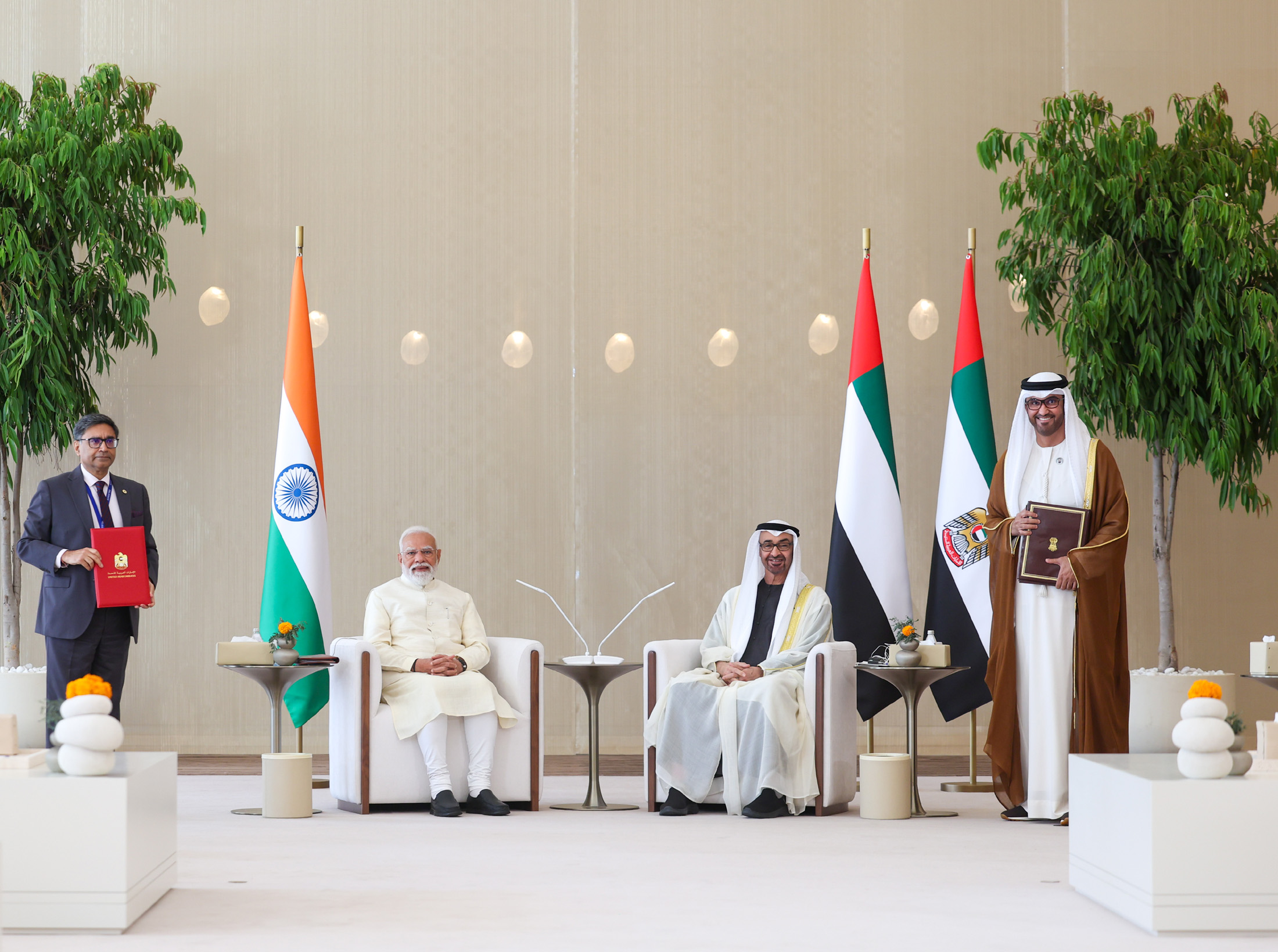
Prime Minister Narendra Modi’s visit to the United Arab Emirates on May 15 unfolded less as a ceremonial diplomatic engagement and more as a calibrated attempt by both countries to reposition their strategic partnership around energy resilience, financial integration, maritime security and emerging technologies at a moment of mounting instability across West Asia and growing uncertainty in global trade corridors.
The visit, which came against the backdrop of heightened tensions around the Strait of Hormuz, renewed concerns over energy supply disruptions and intensifying geopolitical competition in the Indo-Pacific and Gulf regions, produced a cluster of agreements that together signal a broadening of India-UAE ties from a largely trade-and-diaspora driven relationship into a deeper strategic and infrastructure-oriented compact with long-term geopolitical implications.
In his discussions with UAE President Mohammed bin Zayed Al Nahyan, Modi reiterated India’s strong condemnation of attacks on the UAE and underscored New Delhi’s support for secure and uninterrupted navigation through the Strait of Hormuz — a maritime chokepoint through which a substantial portion of India’s energy imports flow. The emphasis on maritime stability reflected India’s growing concern that prolonged regional conflict could sharply elevate oil prices, strain the rupee, widen the current account deficit and disrupt food and energy supply chains across Asia.
The most consequential outcome of the visit emerged in the energy sector, where India and the UAE moved decisively beyond buyer-seller dynamics toward integrated strategic energy planning. The agreement between Indian Strategic Petroleum Reserves Limited and Abu Dhabi National Oil Company to expand the UAE’s participation in India’s strategic petroleum reserves to 30 million barrels represents one of the clearest signals yet that India is seeking to institutionalize long-term energy security partnerships rather than depend solely on volatile spot markets.
Equally significant was the decision to explore reciprocal storage arrangements, including the possibility of Indian reserves in Fujairah. Analysts view the move as strategically important because it gives India greater operational flexibility during supply disruptions while embedding the UAE more deeply into India’s energy-security architecture. The agreement to explore strategic gas reserves and long-term LPG supply arrangements with Indian Oil Corporation further indicates that New Delhi is attempting to diversify and stabilize its hydrocarbon sourcing at a time when global energy markets remain vulnerable to conflict-driven shocks.
The visit also produced nearly USD 5 billion in fresh UAE-linked investments into India, reinforcing the Gulf nation’s emergence as one of the most influential external financial stakeholders in the Indian economy. Investments by Abu Dhabi Investment Authority, Emirates NBD and International Holding Company are expected to strengthen infrastructure financing, banking capitalization and housing finance ecosystems in India at a time when New Delhi is attempting to sustain high public-capital expenditure while simultaneously crowding in foreign institutional capital.
The proposed USD 1 billion partnership between ADIA and India’s National Infrastructure and Investment Fund is particularly notable because it aligns with India’s effort to transform sovereign wealth partnerships into long-duration infrastructure financing mechanisms spanning logistics, ports, transport corridors and urban development. Economists believe such capital flows could become increasingly important as global investors search for large-scale growth markets outside a slowing China.
Beyond economics, the visit marked a substantial expansion in defense and security cooperation. The newly signed Framework for Strategic Defense Partnership broadens bilateral engagement into defense industrial collaboration, cyber defense, maritime security, secure communications and advanced technologies. The agreement suggests India and the UAE are gradually moving toward a more interoperable security relationship driven by shared concerns over maritime vulnerabilities, cyber threats and regional instability.
The defense framework also reflects a larger strategic shift underway in the Gulf, where countries such as the UAE are diversifying partnerships beyond traditional Western security structures and increasingly engaging Asian powers including India in defense manufacturing, technology and maritime security cooperation.
A particularly forward-looking dimension of the visit emerged in the technology sector through the agreement between Centre for Development of Advanced Computing and G42 to establish an 8-exaflop supercomputing cluster under India’s AI Mission. The initiative signals India’s growing ambition to build sovereign artificial intelligence and high-performance computing capabilities rather than remain dependent on external computational ecosystems dominated by the United States and China.
Technology strategists view the partnership as an attempt to create a Gulf-India digital corridor linking capital-rich Gulf economies with India’s engineering and software capabilities. If implemented successfully, the project could support large-scale AI research, climate modelling, defense simulations, pharmaceutical innovation and semiconductor-related applications.
The maritime agreements signed during the visit also indicate that India is seeking to integrate industrial policy with its broader geopolitical outreach. The partnership between Cochin Shipyard Limited and Drydocks World to establish a ship-repair cluster at Vadinar aligns with India’s long-standing ambition to emerge as a regional maritime services hub capable of competing with Singapore and Gulf-based repair ecosystems.
The associated workforce development agreement involving the Centre of Excellence in Maritime and Shipbuilding points toward a larger industrial strategy aimed at positioning India as a supplier of skilled maritime labor and shipbuilding expertise to global shipping networks.
Equally important was the operationalization of the Virtual Trade Corridor through the MAITRI digital framework, which connects customs and port authorities on both sides. The initiative could reduce cargo processing delays, lower logistics costs and accelerate bilateral trade flows under the India-UAE Comprehensive Economic Partnership Agreement. In strategic terms, the corridor represents part of India’s broader attempt to digitize trade infrastructure and reduce friction in cross-border supply chains.
The larger significance of the visit lies in how the India-UAE relationship is increasingly being repositioned as a multi-dimensional strategic axis linking energy security, sovereign finance, digital infrastructure, logistics and defense cooperation. Unlike earlier phases of engagement that were dominated by remittances and hydrocarbon trade, the partnership is now evolving into a long-term geopolitical and economic alignment with implications extending well beyond the Gulf region.
For India, the UAE is steadily emerging not merely as an energy supplier or investment source, but as a critical node in its westward strategic outreach connecting the Middle East, Africa and Europe. For the UAE, deeper integration with India offers access to one of the world’s fastest-growing large economies, a massive consumer market and a technology and talent base capable of supporting the Gulf nation’s post-oil diversification ambitions.
The outcomes of Modi’s visit, therefore, indicate that India-UAE ties are entering a new phase where strategic convergence is increasingly being built around infrastructure, technology and resilience — sectors likely to define geopolitical influence in the coming decade.
Related posts:
 Oil, Inflation and the Rupee: The Economic Fallout of the West Asia Conflict
 Iran War Raises Energy, Trade and Inflation Risks for India and South Asia
 Why U.S.–India Cooperation Is More Powerful When Aligned with the UAE and Israel
 India Stresses Maritime Security and Anti-Terrorism as Pillars of National Strategy
