Join WhatsApp Channel

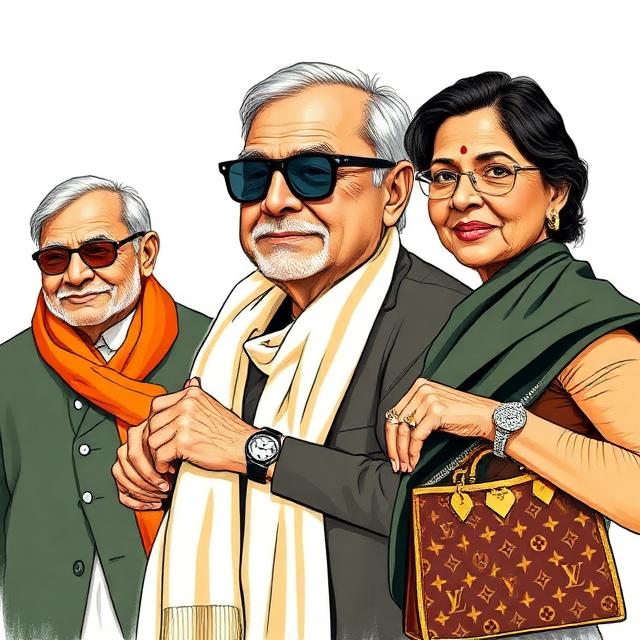
Karnataka’s new Chief Minister D K Shivkumar is said to be worth Rs. 1400 crores and flaunts it in public with a Louis Vuitton scarf and a Cartier watch. The classic scarf is also the favorite of his fellow Karnataka politician, Congress President Mallikarjun Kharge. Siddramaiah, who quit as chief minister, likes the Hublot Big Bang wristwatch.
If men are taking to brand-driven fashion, women have got to be ahead. Mahua Moitra carries a variety of monogrammed Louis Vuitton totes. The clip from the Lok Sabha coverage went viral when she tried to move it away from the camera.
Actor-politician Kangana Ranaut is seen carrying Hermes Herbed Messenger 39 handbags that match Gommino suede loafers. Former minister Anurag Thakur was caught on camera wearing an LV Initials Reversible belt.
The interesting part of these sartorial changes on public (and camera) display is that nobody is coy or embarrassed. Lawmakers and politicians helpfully specify the brand name when a scribe or cameraman asks.
The late Ram Vilas Paswan was a lawmaker and a minister in many union governments, seen in traditional kurta-pyjama and at special functions, a formal suit that could well be crumpled. But his son Chirag, who inherited politics from his father and is a minister now, wore a Moncler jacket at the World Economic Forum. He did not inherit his father’s socialist ideals, except that like his father, he declares his love for the poor whom he serves.
It would be unfair to single him out because he is a Dalit, from the poorest class of society. But Mayawati, four-time Chief Minister of the populous Uttar Pradesh, when in office, wore expensive jewelry. While the media and the middle classes scoffed at it, her followers sincerely believed she was doing the right thing, seeking equal status with the upper-caste politicians, and were proud of her.
Sartorial changes among Indian politicians reflect a shift from the austere, homespun khadi (homespun cotton) synonymous with the Gandhian freedom struggle to a diverse mix of power dressing, regional identity, and aspirational modernity. Wardrobe choices are now meticulously curated for personal branding, media visibility, and voter connection.
Gone are the days of an “all-white” Parliament where a vast majority sported khadi. The days of poorer lawmakers, who won on the votes of the poor and were loath to wear anything looking expensive, ended long ago. This writer had met A K Roy, a trade union leader, who would use the government-supplied door and window curtains to beat Delhi’s winter. No pretense or show, he actually lived frugally.
The decline of the uniform “Khadi White,” enunciated in the era when Mahatma was the supreme leader, began before the end of the last century. The Congressmen and women who were mandated by the party privately resented it, complaining that khadi was expensive to launder and maintain.
Taking a cue from Indira Gandhi, whose taste in cottons and silks was legendary, women took to expensive cotton attire, and men conveniently switched over to safari suits. Rajiv Gandhi donned khadi as prime minister, but introduced expensive walking shoes.
While the traditional white kurta-pyjama remains a staple for many, coarse khadi has largely been replaced by crisper, more comfortable fabrics like linen and fine cotton.
The old ideals and ideologies are gone. Commentators note that as the electorate modernizes, politicians have also become more open about adopting contemporary fashion, shedding the strict expectation of austerity that defined the post-independence era.
What was known as the “Jawahar jacket” became the “Modi Jacket” after the Prime Minister Narendra Modi revolutionized political fashion by popularizing the half-sleeved bandh gala waistcoat paired with tailored kurtas and colorful pocket squares. This look blends formal aesthetics with a strong, regional Indian identity. Modi’s dress-change has since been mind-boggling.
He did create a brief storm when he welcomed US President Barack Obama wearing a monogrammed suit, a gift from a foreign admirer. His contrast to Obama’s staid suit with red tie became glaring. Modi reportedly had his monogrammed suit auctioned and donated the proceeds.
Leaders increasingly use specific attire to consolidate regional support. Examples include Chief Minister Bhagwant Mann’s trademark bright yellow turbans or senior Congress leaders in the south openly wearing high-end designer labels.
Then came the “Common Man” Uniform versus “Luxury Power Dressing.” The rise of the Aam Aadmi Party (AAP) popularized the “everyday man” look—sweaters, mufflers, and the iconic Gandhi cap—projecting approachability and distance from traditional political elites. Arvind Kejriwal popularized it before he was accused of building a “Sheesh Mahal” for himself. His attire remains unchanged.
Expectedly, women in politics have led the way, going beyond the Khadi Saree. While some maintain the traditional, understated cotton saree for mass appeal, others (such as Sushma Swaraj or Smriti Irani) curated strong Bharatiya Nari personas with bold bindis and rich handlooms.
Younger leaders and those from diverse backgrounds have begun mixing traditional sarees with contemporary styling, blazers, and salwar kameez to assert their individuality despite intense public scrutiny.
Overall, the wardrobe of the Indian politician has transformed from a symbol of standardized socialist sacrifice into a dynamic tool of communication, regional pride, and personal identity.
Disclaimer: The opinions and views expressed in this article/column are those of the author(s) and do not necessarily reflect the views or positions of South Asian Herald.