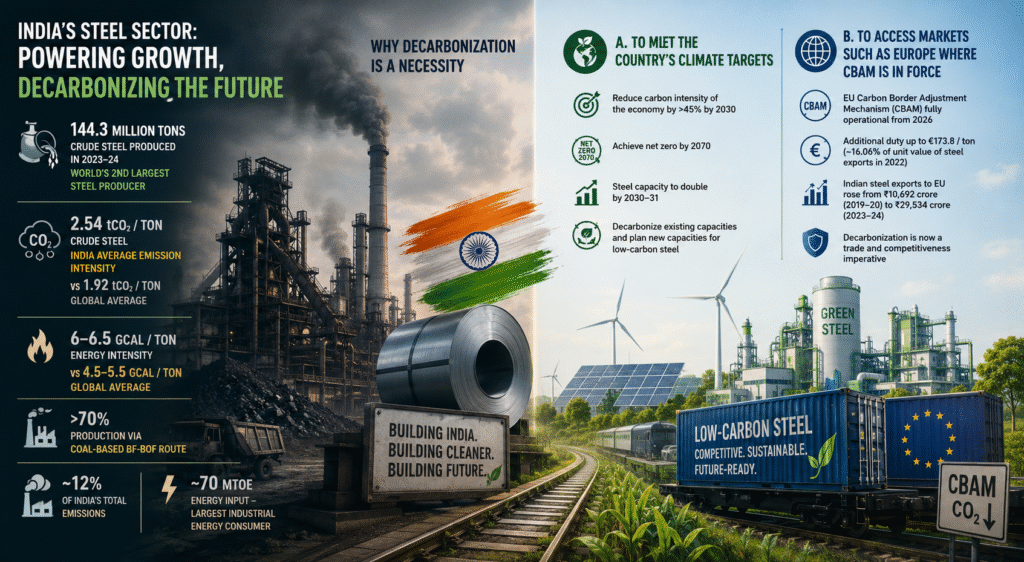
India produced 144.3 million tons of crude steel in 2023–24 and is now the world’s second-largest steel producer. However, the sector remains more carbon-intensive than the global average. India’s average emission intensity is 2.54 tons of CO₂ per ton of crude steel, compared with a global average of 1.92 tons of CO₂ per ton.
Energy intensity is also high at 6–6.5 Gcal per ton of crude steel, against a global average of 4.5–5.5 Gcal per ton. This reflects India’s continued dependence on the coal-based BF-BOF route, which still accounts for more than 70% of steel production. The sector also contributes around 12% of India’s total emissions and consumed about 70 Mtoe of energy input, making it the country’s largest industrial energy consumer.
Why decarbonization is a necessity
A. To meet the country’s climate targets. India has committed to reduce the carbon intensity of its economy by more than 45% by 2030 and to achieve net zero by 2070. Since steel is one of the most emission-intensive industrial sectors, decarbonizing steel is essential if these national commitments are to be met. With production capacity expected to double by 2030-31, immediate steps are needed to ensure that not only the existing capacities decarbonize, but also the capacities to be added focus on low-carbon steel at the planning stage itself.
Advertisement
B. To access markets such as Europe where CBAM is in force. The European Union’s Carbon Border Adjustment Mechanism (CBAM) has become fully operational from 2026 and imposes carbon cost on imports based on embedded emissions. It is reported that the additional duty could be as high as €173.8 per ton, equal to about 16.06% of the unit value of steel exports in 2022. It may be noted that Indian steel exports to the EU increased from ₹10,692 crore (USD 1125 Million) in 2019–20 to ₹29,534 crore (USD 3109 Million) in 2023–24. This means that decarbonization is now not only a climate priority but also a trade and competitiveness imperative.
How can we achieve decarbonization
Industries would focus on decarbonization if there were financial incentives (profitable decarbonization) or compliance requirements. The options for profitable decarbonizations are limited, but they do exist.
A. In the short term, India can make significant progress through interventions that are available today: wider use of renewable energy, introduction of energy-efficiency measures, and greater use of scrap in secondary steel production. These options are relatively mature, can be implemented quickly, and can deliver meaningful reductions in both cost and emissions. However, they need to be customized and designed based on the needs of a specific industry.
B. In the medium to long term, deeper decarbonization will require breakthrough cost-effective solutions such as green hydrogen and carbon capture, utilization and storage (CCUS). These are especially important for emissions that cannot be eliminated through efficiency or renewable electricity alone, particularly in coal-based primary steelmaking routes.
Short-term interventions are largely possible to achieve and they can also be profitable investments
A. Renewable energy. Renewable electricity can lower power costs while reducing emissions. There are three practical pathways: rooftop solar with net metering (up to 500 kW in the state of West Bengal in India), green energy open access, and individual or group captive solar power plants. Rooftop solar offers low-cost power for about 25 years and reduces dependence on the grid supply. Green energy open access can provide scalable clean power with minimal capital investment, while captive and group captive plants can avoid cross-subsidy surcharges and create long-term savings. These options are commercially relevant because renewable power is increasingly cheaper than grid supply in many industrial/commercial settings.
B. Energy efficiency. Many efficiency measures are feasible. A pilot was carried out in which 321 mini-steel mills were retrofitted under the MoS–UNDP–AusAID project, reducing energy use by 20–30% and avoiding about 0.4 million tons of CO₂ per year. The technology interventions included reheating furnaces with recuperators (typically 15–20% fuel savings), energy-efficient motors and variable frequency drives (10–30% electricity savings), covered electric arc and induction furnaces (10–15% energy savings), and LED lighting with smart controls (5–10% electricity savings). PAT-III (Perform, Achieve, Trade) alone is noted to have saved 1.59 Mtoe, equivalent to roughly ₹3,223 crore (USD 339 Million) per year in energy costs.
C. Scrap. Scrap is one of the most attractive decarbonization levers. India generates around 25 million tons of scrap annually but still imports 10–12 million tons per year to meet demand. Scrap already forms 30–40% of the feedstock for secondary steel production, yet scrap as a share of all steelmaking feedstock is still only about 20%. Using more scrap can cut GHG emissions by about 58% per ton. One ton of scrap steel can potentially save roughly 1,100 kg of iron ore, 630 kg of coking coal, 55 kg of limestone, and 40% of water. India’s ferrous scrap imports reached 11.76 million metric tons in 2023, showing both the scale of opportunity and the need for stronger domestic scrap systems. However, the South Asian economies have limited legacy steel and hence the availability of scrap is limited. Therefore, all available resources should be effectively collected and used in the steel industry.
Medium to Long term – the case for hydrogen and CCUS
A. Green hydrogen. Green hydrogen is a transformational option. It can replace coal as the reducing agent in DRI-based steelmaking. Green hydrogen can enable up to 90% CO₂ reduction in the DRI–EAF route. Early pilots and studies in India: Tata Steel’s Jamshedpur trial achieved 7–10% CO₂ reduction through 40% hydrogen injection in a blast furnace. JSW Steel and ArcelorMittal Nippon Steel are studying hydrogen-ready DRI plants. Policy support is emerging through the National Green Hydrogen Mission, which has an outlay of ₹19,744 crore (USD 2078 Million) and targets 5 million tons of green hydrogen production annually by 2030, including ₹455 crore (USD 48 Million) for steel-sector pilot projects. The main constraint is cost: green hydrogen is priced at around ₹397/kg (USD 4.12/kg) at present, much higher than grey hydrogen at about ₹120–200/kg (USD 1.26 – 2.10/kg).
B. CCUS. Carbon capture, utilization and storage is important because India’s steel sector will continue to operate BF-BOF assets for many years. CCUS can capture emissions from hard-to-abate processes and it has a reduction potential of up to 56% for process emissions. Pilots undertaken in this regard: Tata Steel Jamshedpur has a 5 TPD amine-based CCU pilot, JSW Dolvi has about 100 TPD CCS for food and beverage CO₂, and JSPL Angul has a 3,000 TPD capture unit. The NITI Aayog CCUS Policy Framework of 2022 provides a basis for hub-and-cluster deployment and aims for up to 750 million tons per year of CO₂ capture by 2050. Hydrogen and CCUS are therefore medium to long-term pathways once they become cost-effective.
Decarbonization of the steel sector in some other South Asian economies
Across the rest of South Asia, the steel decarbonization agenda is shaped by smaller industry size but similar pressures around energy costs, climate commitments and future export competitiveness. In Bangladesh, the steel industry is expanding rapidly on the back of construction and infrastructure demand, and the sector depends heavily on imported raw materials. It needs better productivity and energy performance as it scales. In Sri Lanka, reports emphasize the need for stronger policy frameworks, better data and financing mechanisms for cleaner industrial processes. Overall, the regional direction is clear: more scrap-based routes, cleaner electricity, energy-efficiency upgrades and, over time, access to lower-carbon technologies and finance. Decarbonization efforts are important across all scales, from large industrial interventions—such as the HIsarna technology being developed by Tata Steel—to smaller efficiency improvements, such as enhancing the performance of air compressors in MSMEs.
Policies will determine how fast this transition can happen. Over the past few years, India has begun to assemble a wider framework for steel decarbonization, from the Perform, Achieve and Trade scheme and the Steel Scrap Recycling Policy to the greening roadmap for the sector, the National Green Hydrogen Mission and the emerging Carbon Credit Trading Scheme.
The Government of India’s Ministry of Steel has officially published the Green Steel Taxonomy (December 2024), which defines the star rating system for green steel based on CO₂ emission intensity. Steel with emissions below 2.2 tons CO₂ per ton of finished steel qualifies, with 3–5 star ratings depending on how low the emissions are. 85 steel units have received green steel certification with a star rating.
These measures are not just about emissions reduction; they are about preparing Indian industry for a world in which carbon performance increasingly shapes market access. The Indian government, along with many other organizations, including non-profit organizations like SwitchON Foundation, is working for decarbonization. The EU’s CBAM has made that reality impossible to ignore. For exporters, carbon intensity is becoming a trade issue as much as an environmental one. Cleaner steel will therefore be crucial not only for meeting climate commitments, but also for protecting competitiveness in international markets.
The transition to low-carbon steel will not be delivered by a single breakthrough, but by a layered strategy combining immediate efficiency gains, renewable energy adoption, stronger recycling systems, supportive finance, industrial innovation and long-term policy certainty. For India, the question is no longer whether steel must decarbonize, but how quickly and how inclusively that transformation can occur. If done well, it could turn one of the country’s most carbon-intensive industries into a proving ground for resilient, competitive and future-ready manufacturing. If delayed, the costs may be measured not only in emissions, but in lost markets, stranded assets, and missed opportunities.
Disclaimer: The opinions and views expressed in this article/column are those of the author(s) and do not necessarily reflect the views or positions of South Asian Herald.