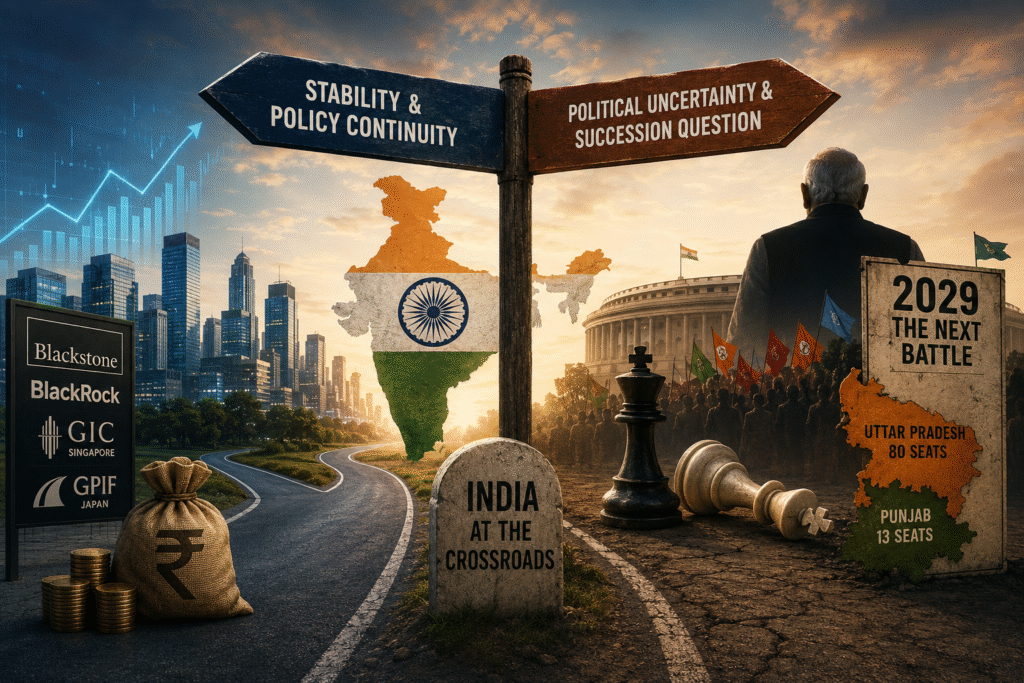
In the boardrooms of Blackstone and BlackRock, in the investment committees of Singapore’s sovereign wealth funds, and in the hushed corridors of Tokyo’s trading desks, a question is being asked with increasing urgency: Is India still a safe bet?
The question is not about economics in isolation. India remains the world’s fastest-growing major economy — GDP expanding at 8.2 percent even as the full weight of American tariffs bore down on its export sectors. The fundamentals, by most measures, remain compelling. But investing in India has never been purely about fundamentals. It has always been about political stability, policy continuity, and the singular figure who has embodied both for more than a decade: Prime Minister Narendra Modi.
And it is here — in the volatile intersection of domestic politics, succession uncertainty, and a geopolitical environment that has turned turbulent almost overnight — that global capital is beginning to hesitate.
The Road to 2029 Runs Through Lucknow and Chandigarh
Advertisement
No map of India’s political future can be drawn without two states at its center: Uttar Pradesh, with its 80 Lok Sabha seats and the demographic heft to make or break national majorities, and Punjab, where the BJP senses an opening even in terrain historically resistant to Hindutva politics.
The arithmetic is unforgiving. In 2024, the BJP fell to 240 seats — well short of the 272 majority threshold — and survived only through the lifeline extended by two coalition partners: N. Chandrababu Naidu’s Telugu Desam Party and Nitish Kumar’s Janata Dal (United). If the BJP is to return to commanding national dominance in 2029, the road leads through UP’s caste labyrinth and Punjab’s fragmented loyalties.
For investors, this matters more than it might seem. Every percentage point of seat share in UP correlates with market sentiment about policy continuity. When the BJP swept UP in 2017 and 2019, foreign portfolio inflows followed. When it stumbled in 2024, markets wobbled. As one senior fund manager at a Mumbai-based institutional investor put it privately: “We don’t just watch the Nifty. We watch the seat count.”
The opposition’s greatest structural advantage is also its greatest weakness: the very fragmentation that makes coordination difficult also means the BJP cannot simply run up the score in one or two states. Every regional quarrel in the INDIA coalition is a gift to the NDA, but every gift comes with a shelf life.
The Fracturing Opposition: A Gift That Keeps Giving — Until It Doesn’t
The collapse of the INDIA alliance in slow motion is visible to anyone watching Indian politics from abroad, and it is being watched very carefully indeed.
In Tamil Nadu, Chief Minister M.K. Stalin’s DMK — which spent years providing Congress with electoral oxygen, helping it retain national relevance without any organizational engine of its own — now finds itself confronted with the possibility that Rahul Gandhi may be quietly cultivating actor-politician Vijay and his rapidly emerging Tamilaga Vettri Kazhagam (TVK) as a parallel power center. To the DMK’s inner circle, this registers as a betrayal of the most intimate kind: the abandonment of a loyal foot-soldier in favor of an untested celebrity with a fan base that cuts across caste lines in ways that traditional Dravidian politics has never had to account for.
In West Bengal, Mamata Banerjee faces perhaps the most sustained pressure of her political career. The BJP’s penetration of social groups once thought permanently aligned with the Trinamool Congress — aided by defections, cadre mobilization, and the strategic deployment of her former lieutenant Suvendu Adhikari — has fundamentally altered the landscape. Foreign investors following Bengal closely note the consequences: the uncertainty over the Kolkata port development, which had been caught between the Adani group’s tender disputes and Mamata’s arm’s-length approach to the industrial house, symbolizes precisely the kind of policy limbo that deters long-term capital commitment.
In Maharashtra, the slow-motion demolition of both the Shiv Sena and the Nationalist Congress Party has produced not clarity but a maze of factional confusion. Uddhav Thackeray retains emotional capital among Marathi voters but his party’s grassroots machinery, once formidable, is a shadow of what it was. The BJP thrives in such fragmentation — and investors, who prize predictability above all, eye each new split with mounting unease.
The Aam Aadmi Party, which was supposed to serve as the INDIA bloc’s urban north Indian spearhead, is struggling for survival outside Punjab after its humiliating Delhi collapse. And the Jharkhand Mukti Morcha, while still nominally aligned, is privately calculating its futures in terms of regional survival, not national ideology.
What holds this fractious coalition together? The answer — Congress — is also what threatens to pull it apart. Rahul Gandhi has proved himself a sharper politician than his critics once assumed, but he has not yet emerged as a universally credible challenger to Modi. And the Sonia Gandhi paradox remains at the heart of opposition strategy: she understands coalition architecture better than any younger Congress strategist, but she is no longer in a position to manage it daily. Without her steady hand, the question of whether Congress can remain the ideological glue binding diverse secular and regional forces is genuinely open.
Bihar’s Wildcard: What Happens When Nitish Kumar Leaves the Stage
Global investors rarely think about Bihar. They should.
Nitish Kumar and his Janata Dal (United) are the hidden load-bearing wall of the Modi government’s third-term architecture. If the JDU is destabilized — whether by Nitish’s health, a political miscalculation, or the simple arithmetic of Bihar’s complex caste coalitions — the NDA’s majority becomes mathematically precarious almost overnight.
Bihar’s political scenario has the potential to redraw itself entirely in Nitish Kumar’s absence. The Rashtriya Janata Dal under Tejashwi Yadav remains a formidable force among Yadavs and Muslims. Congress is a minor presence. And the BJP, despite its national strength, has never been able to fully penetrate Bihar’s social architecture without Nitish as its bridge to non-Yadav OBC communities.
A Bihar that slips away from the NDA before 2029 is not merely a statistical inconvenience. It is a coalition-threatening earthquake. Investors in infrastructure, manufacturing, and logistics — all sectors where policy continuity is essential for project timelines measured in years or decades — cannot afford to ignore this scenario.
The RSS Question: Is Modi’s Biggest Problem Within His Own Family?
The tension between the Bharatiya Janata Party and its ideological mother-ship, the Rashtriya Swayamsevak Sangh, is perhaps the most consequential political dynamic that Western investors consistently underestimate.
When the RSS chief Mohan Bhagwat publicly remarked that leaders should retire at 75 — and then carefully walked that back — he sent a message that political India understood instantly. The RSS views personality cults as antithetical to its foundational ideology of organization over individual. Modi’s spectacular success through three election cycles had kept all internal naysayers muted. But the 2024 result — the BJP dropping from 303 seats to 240 — cracked the aura of electoral invincibility.
Now, as analysts at Gulf News and The Quint have noted, there is a quiet but persistent campaign within the Sangh Parivar for a “hard reset.” Amit Shah has publicly insisted Modi will lead the party beyond 2029. Maharashtra Chief Minister Devendra Fadnavis has said the same. But the question of succession — of who follows Modi into an era when the BJP can no longer campaign on his personal charisma alone — is no longer a whispered corridor conversation. It is becoming an active political debate.
Enter Chandrababu Naidu: Washington’s Favorite
If there is one Indian politician who has captured the imagination of the American foreign policy and business establishment more than any other right now, it is not Rahul Gandhi, not Mamata Banerjee, and increasingly — at least in Washington’s informal calculations — not even Narendra Modi.
It is N. Chandrababu Naidu, Chief Minister of Andhra Pradesh.
Naidu’s track record speaks to a specific kind of governance that American investors, Silicon Valley technology companies, and Washington’s Indo-Pacific strategists find deeply reassuring. He turned Hyderabad into India’s technology capital in the 1990s. He speaks fluently the language of “speed of doing business” rather than “ease of doing business” — a deliberate upgrade in ambition. In less than two years back in office, Andhra Pradesh has attracted over $20 billion in committed investments, secured a $15 billion Google AI data center for Visakhapatnam, and positioned itself as accounting for over 25 percent of all proposed investments in India in the first nine months of FY26.
At Davos in January 2025, Naidu told global investors that “the brand of India has been reinforced” under Modi — but the subtext was clear to anyone listening: Andhra Pradesh is the proof of concept. He was selling not just a state but a governing philosophy.
In Washington, this matters because Naidu has always been seen as ideologically compatible with American techno-capitalism in a way that the BJP’s harder Hindutva wing simply is not. He has praised Mohan Bhagwat publicly and navigated his relationship with the RSS with considerable finesse. He is simultaneously pro-business, culturally conservative enough for the Sangh Parivar, and internationally legible enough for American CEOs and Pentagon planners.
Is Naidu positioning himself as a post-Modi stabilizing figure? He denies any such ambition. But in Delhi’s political salons, and in the quiet calculation of American think tanks, the question is asked.
The Geopolitical Maze: Modi’s Multi-Alignment, Under Strain
For most of the past decade, India’s “strategic autonomy” — its refusal to permanently anchor itself to any single great power — was celebrated by Western analysts as sophisticated statecraft. India bought Russian oil and American fighter jets. It hosted Chinese investments and joined the Quad. It was, in the language of foreign policy, a “swing state” of the highest order.
That posture is now under severe pressure.
The Trump administration’s imposition of cumulative 50 percent tariffs on Indian goods in 2025 — punishing New Delhi simultaneously for its trade surplus and its purchase of Russian oil — was a profound shock to the Indian foreign policy establishment. Commerce Minister Piyush Goyal declared that India would “neither bow down nor ever appear weak.” Modi’s government remained publicly composed but privately furious.
The eventual February 2026 deal — reducing reciprocal tariffs to 18 percent from 25 percent — was hailed as a reset, but Chatham House’s analysts noted that “the relationship has been scarred by a year of hostility.” Crucially, Modi’s own public statement on the deal conspicuously omitted any commitment to stop buying Russian oil or to purchase $500 billion in American goods — commitments Trump had enthusiastically advertised. The gap between what Washington claimed India had agreed to and what New Delhi confirmed was, in the words of one Carnegie Endowment analyst, “too much uncertainty.”
Meanwhile, Europe is recalibrating. As Brussels distances itself from Washington under Trump’s transactional foreign policy, European capitals are developing independent India strategies — but they come with their own conditions around human rights, press freedom, and democratic governance that create friction with the BJP’s domestic political imperatives.
China’s shadow lengthens over all of this. Modi’s careful effort to stabilize the border dispute — symbolized by his September visit to the SCO Summit — reflects a pragmatic recognition that economic confrontation with Beijing is a luxury India cannot currently afford. But for investors from Japan, South Korea, and the United States who are explicitly seeking alternatives to China in the “China Plus One” supply chain strategy, India’s ambiguity about its relationship with Beijing introduces a layer of strategic uncertainty that complicates long-term commitment.
What Global Capital Is Actually Pricing In
In the final analysis, international investors are making three bets simultaneously, and the tension between them is unresolved.
The first bet is on India’s structural growth story — its demographics, its domestic consumption, its rapidly expanding digital economy. This bet does not depend on Modi, or the BJP, or the INDIA coalition. It depends on 1.4 billion people and a middle class that is still expanding.
The second bet is on political continuity — specifically, on the BJP’s ability to maintain a governing majority capable of executing infrastructure investment, manufacturing incentives, and the regulatory reforms that make large-scale capital deployment viable. This bet is nervous. Every crack in the NDA coalition, every seat-sharing dispute in UP or Bihar, every whisper from the RSS about leadership succession, raises the cost of this bet.
The third bet — the most speculative and the most quietly discussed — is on what comes after Modi. And here, the name that circulates most comfortably in boardrooms from New York to Singapore is not Yogi Adityanath, whose hard Hindutva positioning alarms many international investors, nor Amit Shah, whose image outside India remains polarizing. It is Chandrababu Naidu: the technocrat, the dealmaker, the man who can speak simultaneously to the RSS and to Google.
The Scenario Map: Three Futures for India
Scenario One: BJP consolidates UP and Punjab, Modi leads NDA into 2029. The INDIA coalition continues fracturing — DMK-Congress tensions deepen, AAP fades, Bihar holds for NDA even post-Nitish through a managed succession. Foreign investment accelerates, particularly in infrastructure and semiconductors. The market-friendly trajectory of Modi 3.0 continues. Geopolitically, India settles into a managed equilibrium with both Washington and Moscow, extracting maximum leverage from its non-alignment. This is the scenario global markets are currently half-pricing.
Scenario Two: UP fractures, Bihar slips, the NDA coalition wobbles. If the Samajwadi Party’s Akhilesh Yadav consolidates an effective caste coalition in UP and Congress-SP seat-sharing works, the BJP’s 2029 arithmetic becomes genuinely perilous. Add a weakened JDU in Bihar and an Andhra Pradesh TDP that grows more assertive, and the NDA majority could evaporate entirely. In this scenario, foreign direct investment slows — not because India’s economy is broken, but because investors hate uncertainty above all else. The Sensex could shed 15 to 20 percent in the months preceding a genuinely contested 2029 election.
Scenario Three: A managed transition — to Naidu, or to a coalition configuration that makes him central. This is the scenario that American investors privately prefer and that New Delhi’s establishment privately fears discussing. A post-Modi BJP or NDA configuration in which Naidu’s TDP becomes the ideological and administrative anchor of a business-friendly governing coalition would be, from Wall Street’s perspective, a deeply comfortable outcome. Whether it is politically achievable is another matter entirely.
The Bottom Line
India’s story remains the most compelling emerging-market narrative of the 2020s. No serious global investor is walking away from the subcontinent. But they are hedging.
They are hedging against the possibility that the INDIA coalition’s fractures are not deep enough to prevent a genuine contest in 2029. They are hedging against the possibility that Modi’s third term ends not in triumph but in managed decline. They are hedging against the geopolitical reality that India’s famous multi-alignment, under simultaneous pressure from Washington, Brussels, Beijing, and Moscow, may finally be forced to choose a side.
And beneath all of it, they are watching two states — Uttar Pradesh and Punjab — where the next chapter of the world’s largest democracy will, as it has so many times before, be written first.
The money is patient. But patience is not infinite.
Disclaimer: The opinions and views expressed in this article/column are those of the author(s) and do not necessarily reflect the views or positions of South Asian Herald.