Join WhatsApp Channel

Most of us who grew up in South Asia have a power-cut story. The candles kept ready in a kitchen drawer, perhaps, or the torch that lived by the bed, and later the inverter that beeped through dinner. Mine is simpler, because our home in a village in Uttar Pradesh had no electricity to cut. My father went to great lengths to make sure there was kerosene in my lamp so that I could study after dark. Long before I could explain it in the language of policy, that lamp taught me that energy decides who gets an evening, and who gets a future.
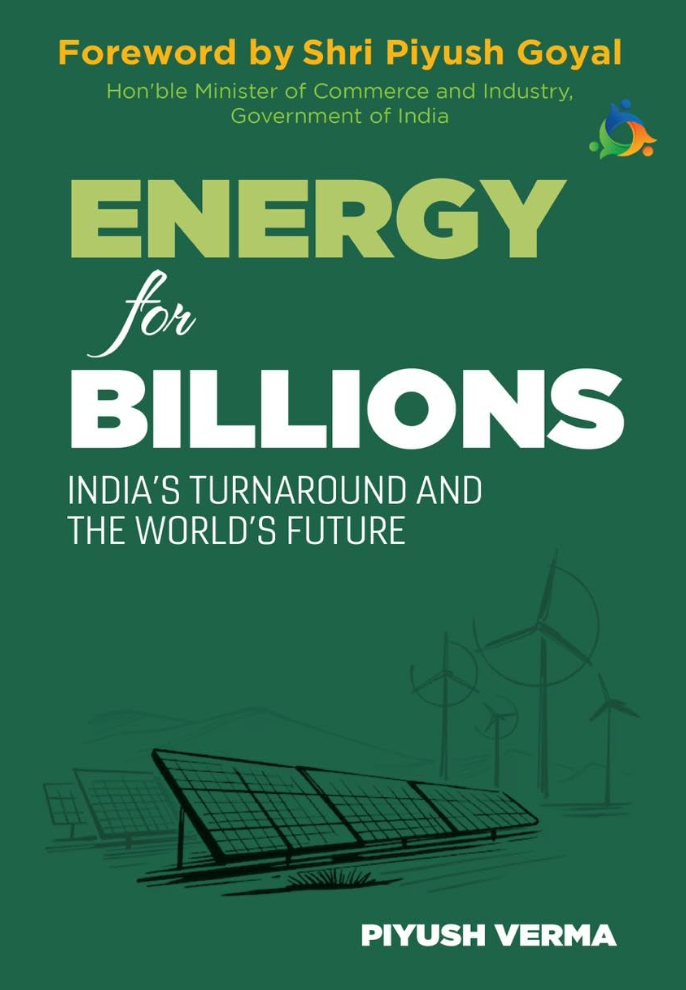
That lamp is where my book, Energy for Billions: India’s Turnaround and the World’s Future, begins. It is now available on Amazon in the United States and worldwide. It is a memoir, and also a chronicle of something far larger than one family: how the world’s most populous democracy went, within a single generation, from chronic scarcity to a place among the leaders of the global clean energy economy.
That lamp took me further than I could have imagined. I earned bachelor’s and master’s degrees in electrical engineering in India, where my early career included Tata Tinplate (now part of Tata Steel) and the Bureau of Energy Efficiency under the Ministry of Power. Then came a PhD in energy technology and policy at the University of Auckland, and an MPA at Harvard Kennedy School as a Mason Fellow. I have been fortunate to work on energy and climate policy in India, New Zealand, Ireland, Vanuatu, Niue and the United States, with universities, governments, companies, nonprofits and the United Nations Development Programme in New York, where I led its global energy governance portfolio for its 170 member countries. Today I lead energy and climate policy work at ORF America in Washington, DC.
That range of vantage points is the reason this book exists. I have seen the same energy question at almost every scale, from Niue, home to fewer than 2,000 people, to India, home to close to 1.5 billion. Wherever I went, the conversation kept returning to India: how did a country once defined by power shortages connect so many people so quickly, and become a clean energy leader? The answers were mostly statistics, rarely from someone who had lived the first chapter and then spent the past decade watching the rest closely from abroad, working on the same questions elsewhere. I wanted to write that account, in plain language, for readers who will never open a policy report. I also wrote it for young people growing up where I did, as proof that where you start does not limit what you can contribute.
The change came fast. Since the launch of Saubhagya, a household electrification program launched in 2017, 28.6 million homes were connected to power. Nearly a third of them, more than 9 million, were in Uttar Pradesh. When the last villages were connected in April 2018, the International Energy Agency called it “one of the greatest achievements in the history of energy” and highlighted two key lessons: committed political leadership and transparent monitoring and tracking. A connection is only a beginning, so reliability mattered as much as reach. According to the Ministry of Power, average electricity supply in rural India rose from 12.5 hours a day in 2014 to 22.6 hours in 2025. But the transformation inside Indian homes was not limited to the light switch. The way families cooked was changing too. Under the Ujjwala scheme, nearly 106 million poor households have received LPG connections, expanding access to a cleaner alternative to firewood and dung.
The supply side moved just as fast. India’s solar capacity has grown from about 2.8 gigawatts in 2014 to roughly 168 gigawatts by August 2026. By the end of that month, installed capacity from non-fossil sources had reached more than 304 gigawatts, more than half of the national total. India reached its international target of 50 percent non-fossil installed electricity capacity in June 2025, five years ahead of its 2030 deadline, and ranks third in the world for installed renewable capacity. It is building the factories too: solar module manufacturing capacity on the government’s approved list has reached more than 228 gigawatts, compared with just 2.3 gigawatts of domestic manufacturing capacity in 2014. And Uttar Pradesh, the state that needed the most new connections only a few years ago, is now among the leaders of India’s national rooftop solar program.
Numbers like these arrive as headlines and leave as trivia. What I wanted to capture in the book is how they happened, because the how is what other countries can use. Technology mattered, but the decisive ingredient was governance: clear national targets backed by delivery machinery that reached the last household, and a willingness to measure progress in public.
Consider the LED bulb. In 2014, one cost ₹450–500 in Indian shops. By pooling demand and buying in bulk, the public-sector company Energy Efficiency Services Limited cut its procurement price by almost 90 percent between 2014 and 2017. UJALA has since distributed more than 368 million bulbs. The breakthrough was not a new bulb, but a market redesigned around it.
India also declined to treat energy access and clean energy as rival goals. It pushed connections to the last village while building clean supply at scale. For a developing country, holding both ambitions at once is the real lesson.
This is what India’s turnaround means for the world. The latest global tracking report on energy access, released in June by the IEA, the World Bank and partners, finds that 655 million people still live without electricity, more than 560 millions of them in sub-Saharan Africa, and that about two billion still cook with polluting fuels. For the countries behind those numbers, India’s decade is a working manual rather than a distant aspiration.
India’s own next chapter will be demanding in new ways. Reliability is unfinished business: an average of 22.6 hours still means outages in too many villages, and closing that gap matters as much as any new solar park or a wind farm. The country has set goals of energy independence by 2047 and net zero emissions by 2070. Reaching them means building transmission fast enough to carry desert sunshine to cities and storing midday solar power for the evening peak. It also means powering a digital economy that increasingly runs on data centers where India has indicated larger ambition.
That is where this story meets America. In September, at a G20 energy meeting in Houston, India’s Power Minister Manohar Lal and US Energy Secretary Chris Wright reaffirmed cooperation under the US–India Energy Security Partnership, discussing India’s nuclear expansion, resilient grids and the power infrastructure needed for AI and data centers. The United States is also now India’s largest LPG supplier, according to a senior US State Department official.
Both countries face the same practical question: how to build energy infrastructure fast enough, at prices people can afford. India brings hard-won experience of deploying at scale and at low cost, as its solar and LED transformation demonstrates. It is also building the India Energy Stack, a shared digital backbone for the power sector that aims to bring the kind of interoperability to electricity that UPI brought to payments. The United States brings depth in innovation and capital, from advanced nuclear and grid software to data center infrastructure. Having worked on energy policy in both countries, I am convinced the partnership is strongest when lessons travel in both directions.
For many of us who live outside India, our picture of home is shaped partly by the country we remember and partly by what we see on each return. Over the past decade, I have watched India’s energy transformation from abroad, through the lens of my work on global energy policy. For readers with connections in both India and America, that experience of rediscovering a changing home may feel familiar. For me, each return has made that transformation visible: brighter streets, more reliable power, humming air conditioners, solar panels appearing on rooftops, and an energy system increasingly different from the one I grew up with.
I still think about the small circle of light that kerosene lamp threw across my schoolbooks. It was enough for me that evening. My book begins with memories like this, weaving personal memoir into an account of India’s energy journey. It explores the energy choices that can help realize the ambition of Viksit Bharat—a developed India—and the lessons other economies might draw from India’s achievements and unfinished work. That unfinished work, from stronger grids and storage to secure supply chains for minerals and components, will shape the next decade. At its heart is a question that reaches beyond national borders: how to make reliable, affordable energy part of everyone’s daily life.
Related posts:
 Tariff Threat Looms as U.S. Examines India’s Manufacturing Expansion
 Rivals at the Crease, Teammates on Clean Energy: Bowen Makes Australia’s Pitch in New Delhi
 India’s Renewable Push Faces Growing Grid Stability Test
 Waaree Solar Americas Launches First Solar Module in Texas: A Breakthrough for US-India Clean Energy Collaboration