Join WhatsApp Channel

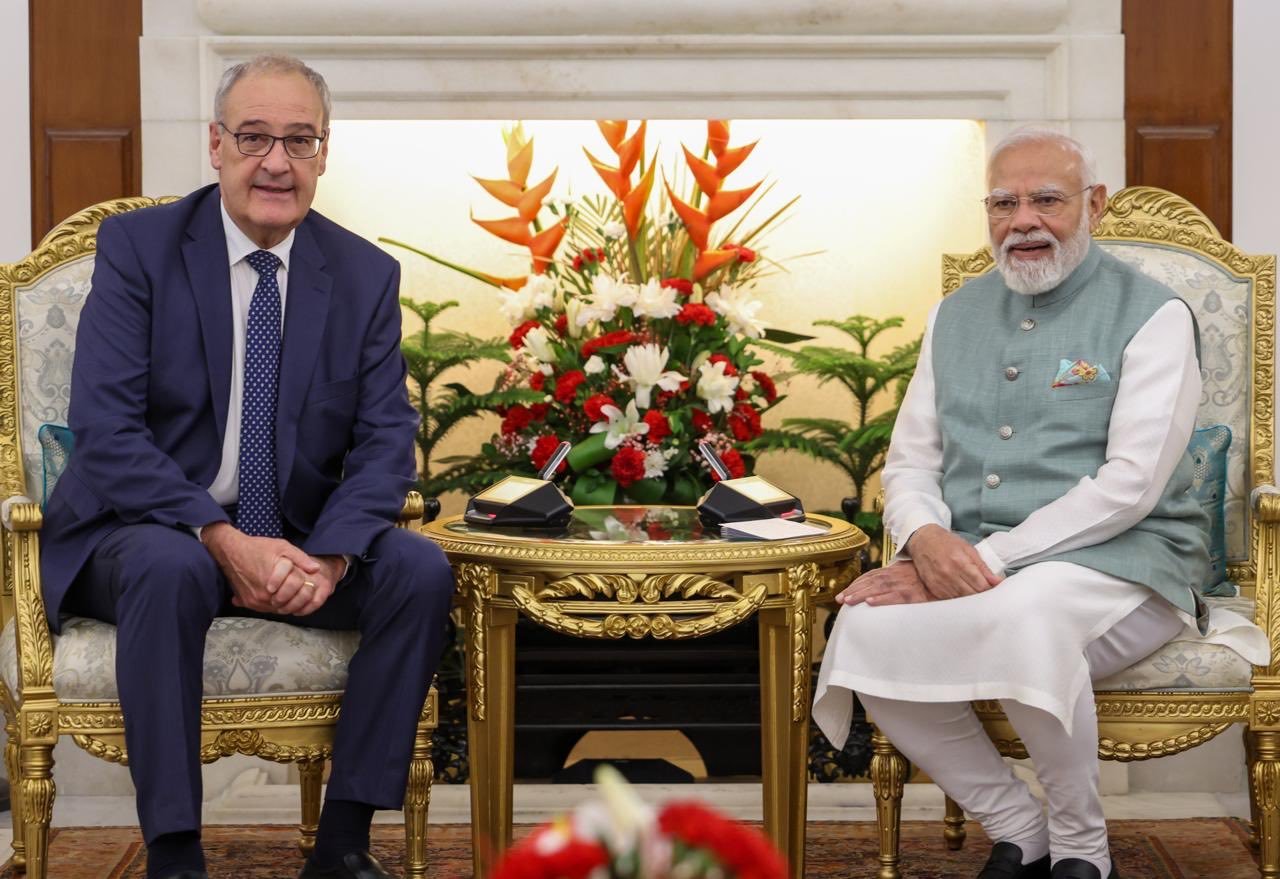
When the Swiss Confederation President Guy Parmelin arrived in India, he brought with him more than the symbolism of a high-level state visit. His visit came at a moment when India–Switzerland relations are moving from a traditionally cordial partnership towards a more ambitious relationship built around trade, technology, investment, research, mobility and innovation.
The timing is significant. President Parmelin’s October 5–7 visit marked the first anniversary of the implementation of the Trade and Economic Partnership Agreement between India and the European Free Trade Association (EFTA), of which Switzerland is a key member. The agreement has created a new framework for expanding economic engagement and carries an ambitious objective of encouraging $100 billion in investment in India and generating one million direct jobs over 15 years.
But the India–Switzerland relationship cannot be measured only through trade figures.
It is a partnership where Swiss precision and Indian scale can complement each other.
Switzerland has expertise in advanced manufacturing, pharmaceuticals, financial services, precision engineering, transportation technologies, research and innovation. India, meanwhile, offers one of the world’s largest markets, a rapidly expanding digital economy, a strong talent base and growing demand for sophisticated infrastructure and technology.
The opportunity lies in connecting these strengths.
Beyond trade
More than 330 Swiss companies are currently operating in India, while Indian companies have developed a significant presence in Switzerland. Bilateral cooperation already extends into science, education, technology and culture. Switzerland itself describes India as its most important trading partner in South Asia.
The next phase should therefore focus on moving from market access to joint value creation.
India does not simply need foreign investment. It increasingly seeks partnerships that bring technology, skills, research capabilities and global value chains. Switzerland, with its strong research institutions and innovation ecosystem, can become an important partner in this transformation.
The newly announced cooperation in transportation technologies, mobility systems and infrastructure is one such example. Areas including electric mobility, ropeways, tunnels and sustainable infrastructure provide practical opportunities for Indo-Swiss collaboration.
Science, technology and the innovation bridge
Perhaps the most promising dimension of the relationship is science and technology.
The two countries have already developed institutional cooperation in research. The latest initiatives seek to deepen collaboration between Indian and Swiss research communities, while cooperation with Swiss universities is also opening avenues in technology transfer, entrepreneurship and startup development.
This is where the partnership can become truly future-oriented.
Artificial intelligence, clean technologies, biotechnology, advanced materials, space, healthcare and climate solutions are areas where India and Switzerland can move beyond traditional bilateral projects towards co-development.
The two countries have already demonstrated a shared interest in responsible AI. Switzerland is scheduled to host the next AI Summit in Geneva in 2027, creating another opportunity for India and Switzerland to shape the global conversation around technology, innovation and responsible digital governance.
People must remain at the center
Economic diplomacy becomes sustainable only when it creates opportunities for people.
The new Migration and Mobility Partnership and the Young Professionals Exchange Agreement can give the relationship an important human dimension. The young professionals framework envisages exchanges of hundreds of people annually, while the mobility agreement aims to facilitate legitimate movement while addressing irregular migration and human trafficking.
For students, researchers, entrepreneurs and young professionals, mobility can become a bridge between two very different but complementary societies.
Education can play an equally important role. Switzerland’s universities and India’s expanding higher-education and research ecosystem have considerable potential for joint programmes, applied research, vocational training and innovation partnerships.
From infrastructure to sustainability
India’s infrastructure transformation creates another natural area of cooperation.
Swiss expertise in sustainable transportation, urban mobility, environmental technologies, water management and precision engineering can find a large and growing market in India.
At the same time, India’s experience in implementing large-scale digital and physical infrastructure projects can offer Switzerland opportunities to engage with one of the world’s fastest-changing major economies.
Climate change should also become a central pillar. The Himalayas, glaciers, water security, sustainable cities and renewable energy are not merely environmental subjects; they are shared strategic concerns.
A partnership with global relevance
India and Switzerland also have an opportunity to cooperate beyond bilateral interests.
Both countries have traditionally valued multilateralism, international cooperation and dialogue. In a world facing geopolitical uncertainty, supply-chain disruptions, technological competition and climate challenges, middle and major powers can build practical coalitions around solutions rather than blocs.
The relationship therefore has the potential to evolve from a bilateral partnership into a platform for wider cooperation in innovation, sustainable development and global governance.
India and Switzerland will celebrate 80 years of diplomatic relations in 2028.
That anniversary should not simply be a celebration of the past. It can become a milestone for defining the next 25 years.
The question is no longer whether India and Switzerland have a strong relationship. They clearly do.
The more important question is: how much more can two countries with such complementary strengths achieve together?
The answer will depend on whether the partnership can move from agreements to implementation, from investment to innovation, and from government-to-government engagement to deeper connections between businesses, universities, researchers and people.
The Swiss President’s visit offers an opportunity to begin that next chapter.
The Alps and the Himalayas may be geographically distant. But in an increasingly interconnected world, the distance between them is becoming less relevant than the possibilities that lie between them.